
In eCommerce, churn prediction helps brands identify which customers are likely to stop buying before that loss shows up in revenue. For online retailers facing rising acquisition costs and intense competition, this makes churn prediction more than a reporting exercise. It becomes a practical way to protect repeat purchases, improve retention, and increase customer lifetime value.
A churn prediction model works by combining signals such as purchase frequency, order value, browsing activity, support interactions, and fulfillment issues to estimate customer risk. When used well, it helps teams move from reactive retention to proactive intervention by spotting warning signs early enough to act.
This article explains the main methods used to build a churn prediction model, the metrics that matter when evaluating performance, and the most valuable use cases for applying churn insights in eCommerce.
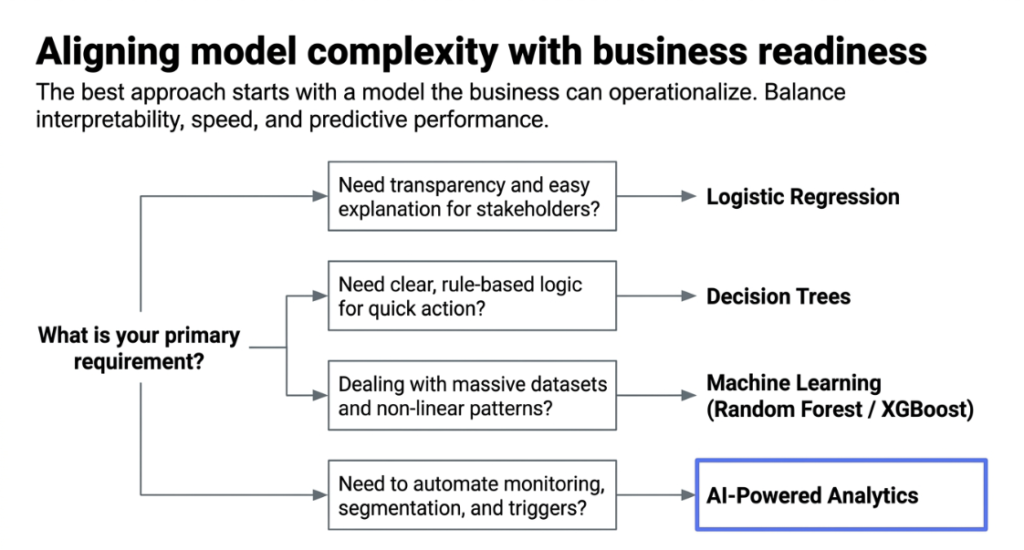
For most eCommerce teams, the best approach is to start with a model the business can understand and operationalize, then add sophistication only when it improves outcomes. The right choice depends on data quality, available expertise, and how quickly the business needs to turn predictions into action.
In practice, simpler models are often easier to explain and deploy, while more advanced models can capture complex patterns at scale. The key is to balance interpretability, speed, and predictive performance rather than assuming the most complex model is automatically the best one.
1. Logistic Regression
Logistic regression remains a strong starting point for churn prediction because it estimates the probability that a customer will leave based on historical variables such as recency, frequency, average order value, return rate, and support history.
It is especially useful when teams need a transparent model that marketing, retention, and leadership stakeholders can interpret easily. While it may not capture every non-linear pattern, it often performs well enough to support early retention programs and establish a reliable baseline.
2. Decision Trees
Decision trees are useful when businesses want clear, rule-based logic showing how different customer signals lead to churn risk. They can reveal practical patterns that teams can act on quickly without needing deep statistical interpretation.
For example:
This makes churn prediction easier to visualize and explain, although single trees can become unstable or less accurate than ensemble methods when customer behavior is more complex.
3. Machine Learning Models
Advanced machine learning models are better suited to large eCommerce datasets where churn depends on many interacting variables. These models can capture more complex patterns across transactional, behavioral, and service-related data than simpler approaches.
Popular models include:
Models such as Random Forest and XGBoost often deliver stronger predictive performance, especially when churn drivers are non-linear or highly segmented. The trade-off is that they usually require more tuning, more monitoring, and more effort to explain to non-technical teams.
4. AI-Powered Predictive Analytics
AI-powered predictive analytics extends beyond model scoring by helping teams automate monitoring, segmentation, and activation. Instead of only identifying churn risk, these systems can connect predictions to workflows such as alerts, campaign triggers, and audience prioritization.
That matters because churn prediction only creates value when the business can act on it consistently. Once a model is in place, the next question is not just how it works, but how to measure whether it is good enough to support retention decisions.
A churn prediction model should never be judged by accuracy alone. In most eCommerce datasets, retained customers outnumber churned customers, so a model can appear accurate while still missing many of the customers the business most needs to save.
Key metrics to track include:
Precision: How many predicted churn customers actually churned.
Recall: How many real churned customers the model successfully found.
F1-score: A balance between precision and recall.
ROC-AUC: Measures how well the model separates churned and non-churned customers.
Lift and gain charts: Help show whether the model is useful for targeting high-risk customers.
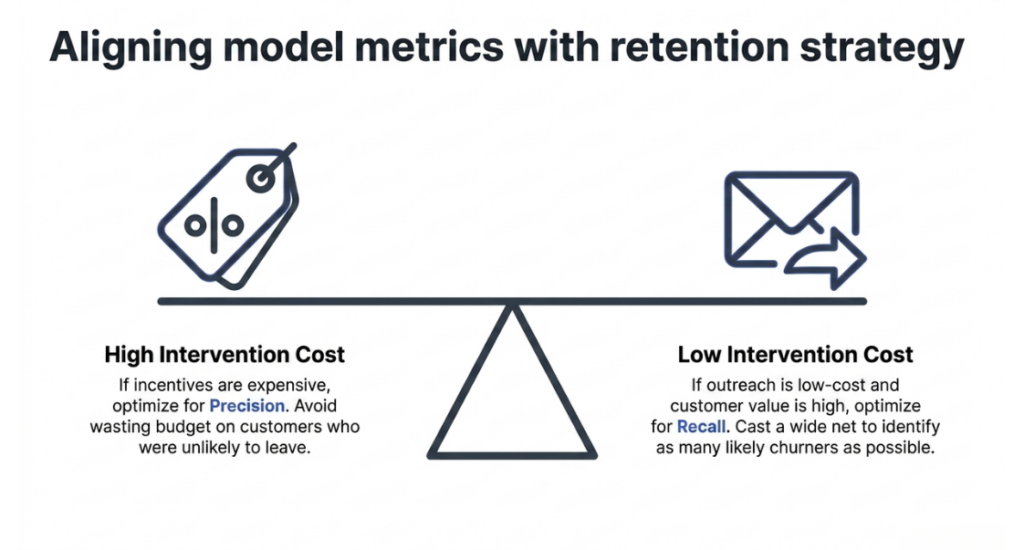
The right metric depends on the retention strategy. If outreach is low-cost and the value of saving an at-risk customer is high, recall may matter more because the business wants to identify as many likely churners as possible. If incentives are expensive, precision becomes more important because teams need to avoid spending heavily on customers who were unlikely to leave. In mature programs, the strongest evaluation goes beyond model metrics and asks whether the model improves intervention ROI.
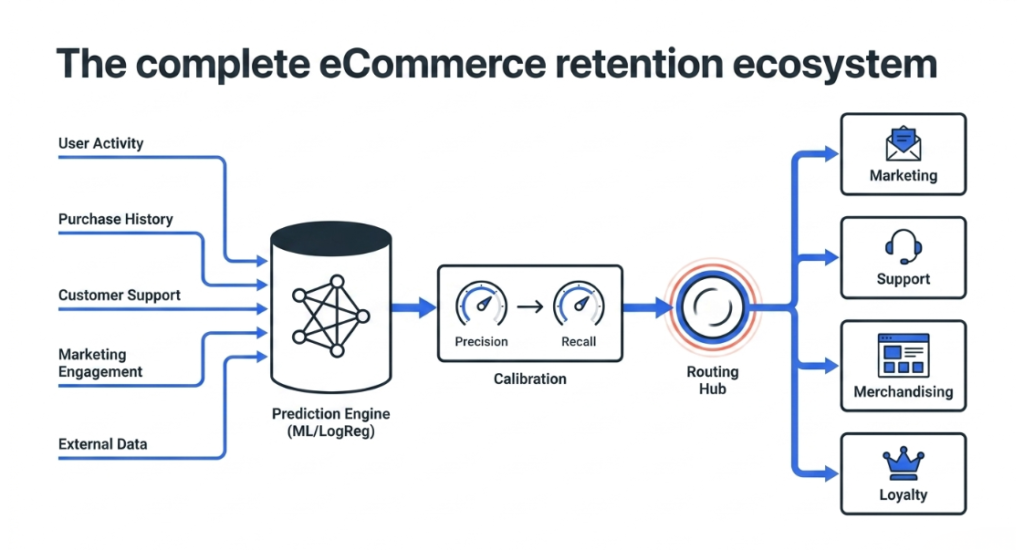
A churn prediction model should support practical business action, not sit unused in a dashboard. The strongest programs connect churn signals to specific decisions across marketing, customer service, loyalty, and merchandising.
Common eCommerce use cases include:
Personalized discounts and win-back offers: Brands can target high-risk customers with timely incentives instead of sending broad promotions to the entire base.
Automated retention campaigns: Email, SMS, or app journeys can be triggered when churn risk increases, using product recommendations, reminders, or replenishment prompts.
Loyalty and VIP protection: Retention teams can prioritize high-value customers who show early signs of disengagement and design offers that match their long-term value.
Customer support prioritization: Service teams can route at-risk customers faster, especially when churn signals are linked to delays, complaints, or unresolved post-purchase issues.
Merchandising and cross-sell decisions: Churn risk can be paired with browsing and purchase behavior to deliver more relevant product recommendations before engagement drops further.
The common thread across these use cases is simple: prediction matters only when it changes how the business allocates attention, budget, and customer experience effort.
Summary
Building a churn prediction model is no longer optional for eCommerce brands that want sustainable growth. The real advantage comes not only from identifying which customers may leave, but from understanding when to intervene, how to measure model performance, and how to connect insights to meaningful retention action.