
For SaaS companies, growth does not come from new sign-ups alone. It comes from helping customers reach value quickly, use the product consistently, and stay long enough to renew, expand, and advocate for the brand.
That is why churn matters so much. When customers leave early, SaaS businesses lose recurring revenue, reduce lifetime value, and put more pressure on sales and marketing teams to replace what was lost. In contrast, strong retention makes growth more stable and more profitable.
High-performing SaaS teams do not treat churn as a surprise. They study behavior patterns, identify risk signals early, and improve the customer experience before dissatisfaction turns into cancellation. This is where customer churn analysis and customer churn prediction become especially valuable.
Customers usually do not churn for a single reason. Most cancellations happen after a series of small frustrations, unmet expectations, or moments where the product fails to prove ongoing value.
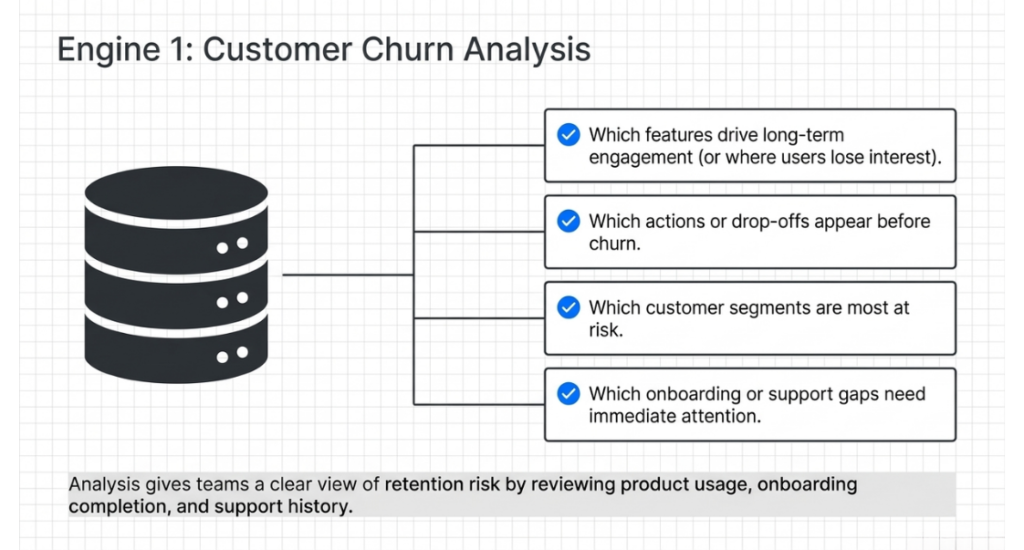
Without structured analysis, teams often guess at these causes. Effective customer churn analysis helps SaaS companies identify which users are leaving, when they disengage, and what product or service issues appear most often before cancellation.
Customer churn analysis gives SaaS teams a clearer view of retention risk. By reviewing product usage, onboarding completion, support history, renewal behavior, and feedback, companies can spot where customers lose momentum and where intervention is most likely to help.
Recent benchmark reporting shows that retention outcomes vary widely by company type and segment, but the pattern is consistent: better onboarding, stronger product adoption, and earlier intervention improve the odds that customers stay. That makes churn analysis more than a reporting task. It becomes a practical guide for product, success, and revenue teams.
The first days of the customer journey are critical. If users feel overwhelmed or fail to see value quickly, they are much more likely to disengage. Strong onboarding reduces that risk by guiding users toward a clear first win through checklists, contextual prompts, guided tours, and role-based education. Well-known SaaS products such as Slack and Figma are often cited for reducing friction by simplifying sign-up and helping users reach value faster.
Customer churn prediction helps teams move from reactive support to proactive retention. By monitoring signals such as declining logins, reduced feature usage, unresolved support issues, failed payments, or negative feedback, SaaS companies can flag at-risk accounts early and respond with targeted outreach, training, or account support before the customer leaves.
Retention improves when teams act on what customers are already saying. Exit surveys, support conversations, usage trends, and renewal objections can reveal whether the problem is onboarding, missing functionality, pricing friction, or poor communication. When those insights lead to better guidance, faster fixes, and smarter product updates, customers are more likely to stay.
Conclusion
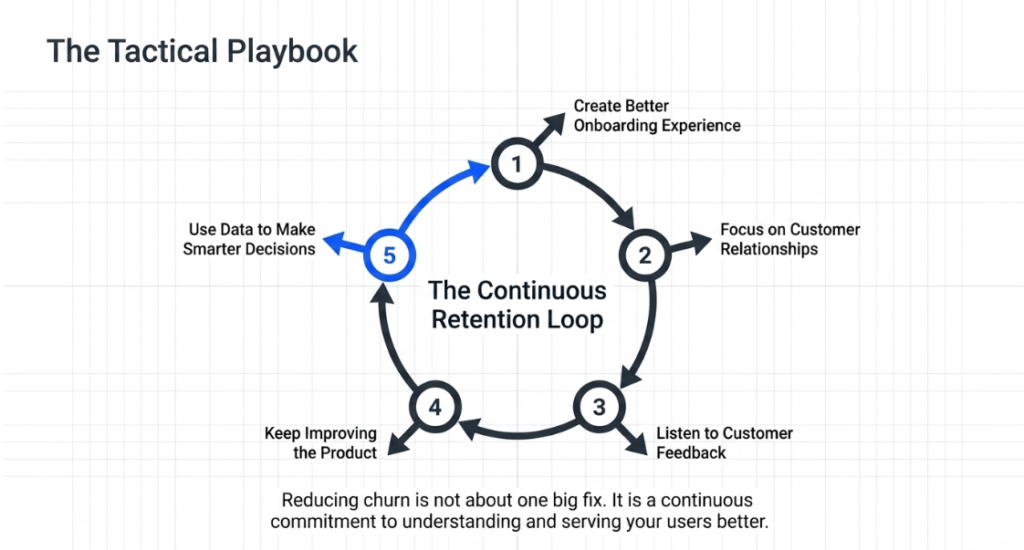
Reducing churn is not about a single tactic. It requires a repeatable system for understanding customer behavior, identifying risk early, and improving the experience across onboarding, support, and product value delivery. SaaS companies that combine customer churn analysis with customer churn prediction are better positioned to protect revenue and build long-term retention.
For brands such as Priorise, this creates an opportunity to position retention not just as a metric, but as a strategic growth lever supported by better data, better customer insight, and better execution.