
The supply chain industry is evolving faster than ever in 2026. Businesses across manufacturing, retail, healthcare, and eCommerce are adopting artificial intelligence to improve operations and stay competitive. From predicting demand to reducing delivery delays, AI is transforming how supply chains operate.
Today, companies are investing heavily in ai for supply chain optimization because traditional systems can no longer handle modern customer expectations and global logistics challenges.
At the same time, the rise of ai in logistics and supply chain operations is helping organizations improve speed, accuracy, and profitability.
Let’s explore the top 10 benefits of AI in supply chain management for 2026 and why businesses are making AI a core part of their operations.
One of the biggest advantages of ai for supply chain management is accurate demand forecasting. AI systems analyze historical sales data, customer behavior, seasonal trends, and market changes to predict future demand more effectively. This helps businesses avoid overstocking or stock shortages.
Modern businesses using ai in logistics and supply chain operations can now make faster and more informed inventory decisions.
Inventory management has always been a major challenge for businesses. AI-powered systems help companies maintain the right stock levels in real time. Using ai for supply chain optimization, organizations can track inventory movement across warehouses, suppliers, and retail locations.
Businesses using ai in logistics and supply chain systems are achieving greater inventory visibility than ever before.
Speed is critical in today’s supply chain ecosystem. Customers expect faster deliveries, and businesses need efficient logistics networks to meet those demands. AI helps optimize transportation routes, delivery schedules, and fleet management.
The growth of ai in logistics and supply chain technology is making transportation systems more intelligent and responsive.
Global supply chains face constant disruptions from weather events, political instability, supplier delays, and economic fluctuations. AI helps businesses identify risks early and respond proactively.
For example, ai for supply chain platforms can monitor supplier performance, shipping conditions, and market trends in real time.
Companies adopting ai in logistics and supply chain systems are becoming more adaptable during uncertain conditions.
Warehouses are becoming smarter with AI-driven automation tools. AI-powered robots and intelligent systems can manage sorting, packing, inventory tracking, and shipment preparation more efficiently than traditional manual methods.
The expansion of ai in logistics and supply chain automation is helping businesses scale operations without increasing complexity.
One major challenge in supply chain management is the lack of real-time visibility.
AI systems provide live tracking and monitoring across the entire supply chain network. Using ai for supply chain visibility solutions, businesses can monitor:
Real-time insights from ai in logistics and supply chain systems help businesses make faster operational decisions and improve transparency.
Customer expectations continue to rise in 2026. Businesses must provide accurate delivery timelines, quick responses, and reliable service. AI helps improve customer experiences through predictive analytics and automated communication systems.
Companies investing in ai in logistics and supply chain technologies are building stronger customer trust and loyalty.
Reducing operational costs remains a top priority for businesses worldwide.
AI helps optimize multiple supply chain processes simultaneously, including procurement, transportation, warehousing, and inventory management.
The adoption of ai in logistics and supply chain systems is helping businesses improve profitability while maintaining operational efficiency.
Modern supply chains generate massive amounts of data daily. AI helps businesses analyze that data quickly and accurately. Using advanced analytics, ai for supply chain platforms can uncover patterns and provide actionable insights for leadership teams.
Organizations using ai in logistics and supply chain management can make smarter business decisions with greater confidence.
Sustainability is becoming a major focus for global businesses in 2026. AI helps organizations reduce waste, optimize transportation routes, and lower carbon emissions.
Through ai for supply chain optimization, companies can improve resource utilization and support eco-friendly operations.
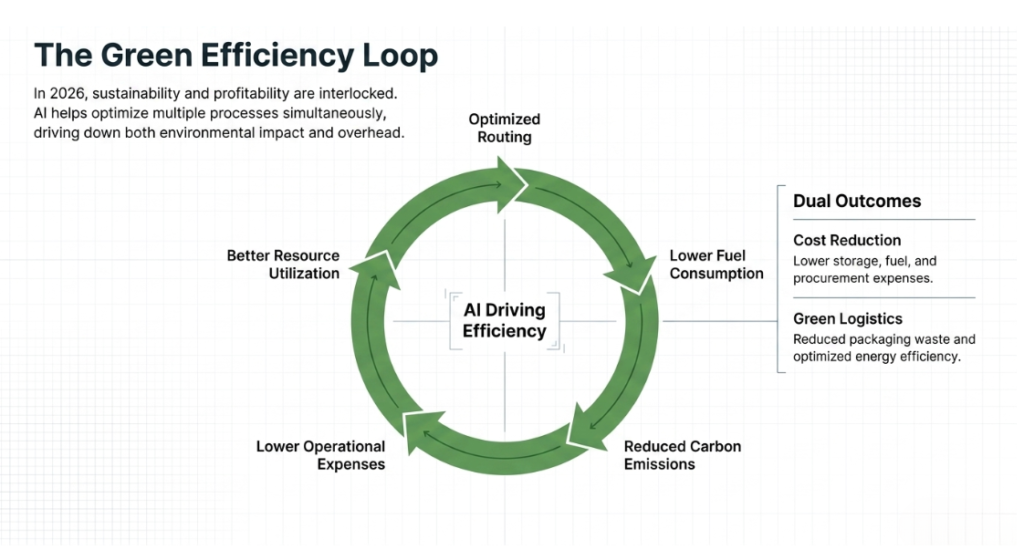
The rise of ai in logistics and supply chain sustainability initiatives is helping businesses meet environmental goals while reducing costs.
Summary
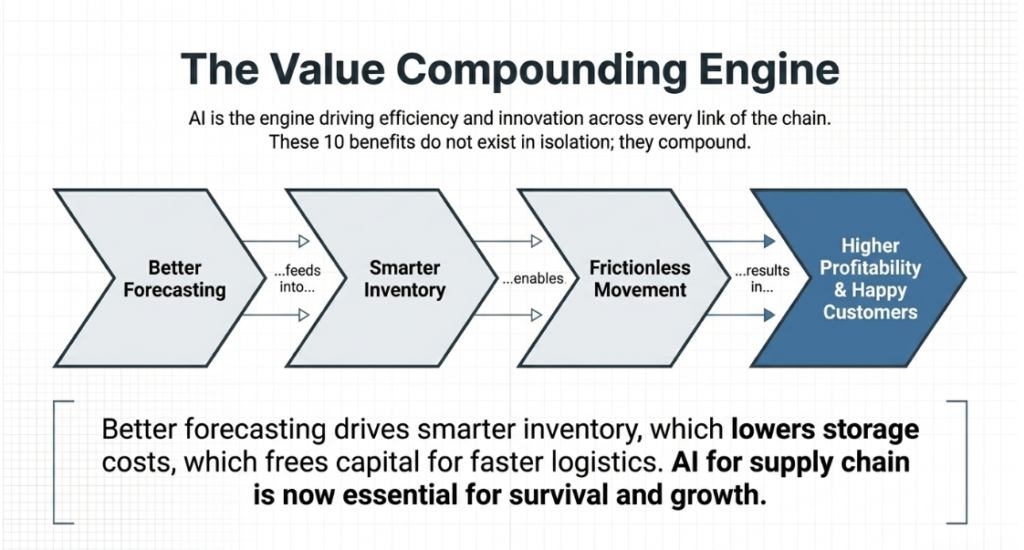
The top 10 benefits of AI in supply chain management for 2026 are clear: better forecasting, smarter inventory, lower costs, faster decisions, optimized routes, predictive maintenance, automated warehouses, superior supplier evaluation, stronger resilience, and happier customers. Ai for supply chain is now essential for survival and growth. Ai in logistics and supply chain is the engine driving efficiency and innovation across every link of the chain.
Don’t let your business fall behind. Partner with Priorise to unlock the full potential of AI for supply chain and see how AI in logistics and supply chain can transform your operations.