
The automotive AI trends of 2026 are no longer about futuristic concepts but about the hard metrics of mass adoption. We are witnessing a fundamental shift as the industry transitions from “software-defined” to “AI-defined” vehicles. This evolution is not merely technological; it is a complete re-engineering of how cars are built, how they operate, and how they are produced.
Automotive AI trends are reshaping boardroom conversations and factory floors alike as automakers race to stay competitive in a software-driven era.
A decade ago, automakers largely measured vehicle innovation by horsepower, fuel efficiency, and manufacturing capacity. Today, the competitive battlefield has shifted toward software-defined vehicles (SDVs), intelligent manufacturing systems, and enterprise-wide AI integration. Automotive leaders are no longer asking whether artificial intelligence will transform operations—they are determining how quickly they can scale it across design, production, supply chains, and customer experiences.
In 2026, the convergence of AI, cloud computing, edge analytics, and connected vehicle ecosystems is creating unprecedented opportunities for manufacturers. From predictive maintenance in smart factories to autonomous software updates in vehicles, AI in automotive industry applications has evolved from experimentation to large-scale deployment.At the same time, AI in manufacturing is transforming production environments into data-driven smart factories, while every leading automaker is implementing an AI adoption framework to scale innovation successfully.
This article serves as a technical deep-dive into the core pillars of this transformation. By analyzing the latest statistics on Software-Defined Vehicle (SDV) adoption, the rise of AI-driven “smart factories”, and the frameworks required for enterprise-level scaling, we will examine the key automotive AI trends defining 2026.
The leading automotive ai trends in 2026 reflect a broader industry transformation. Manufacturers are investing heavily in autonomous systems, software-defined vehicles, intelligent factories, and enterprise-wide AI deployment. These automotive ai trends are helping organizations reduce operational costs, improve quality, accelerate innovation, and create new revenue streams.
As competition intensifies, AI in automotive industry programs is becoming strategic priorities rather than experimental projects. The most successful organizations are combining advanced analytics, machine learning, and generative AI with a structured AI adoption framework to achieve sustainable growth.
Industry analysts tracking Automotive AI Statistics 2026 consistently highlight AI as one of the primary drivers of competitiveness and profitability in the automotive sector.
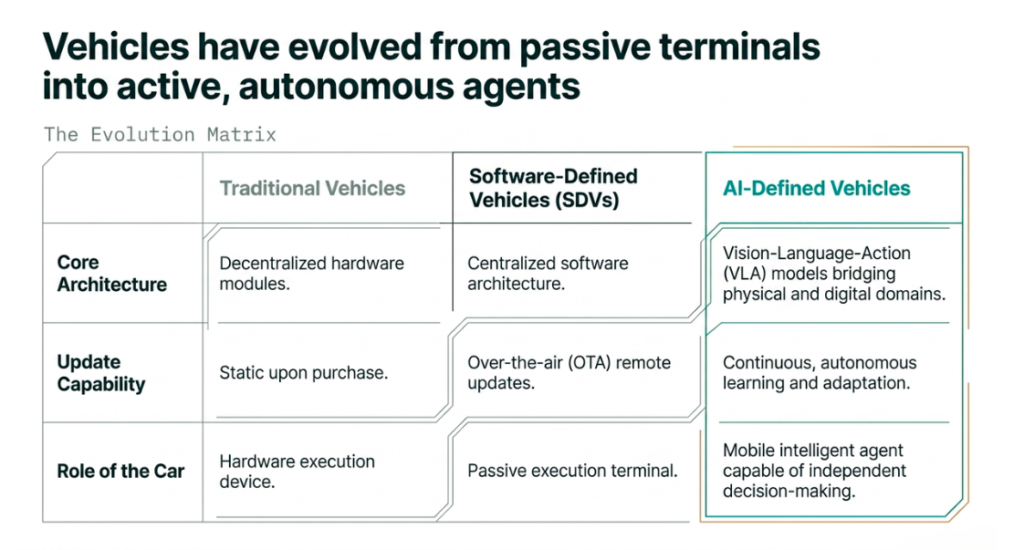
The narrative has shifted from “software-defined” to “AI-defined”. While traditional software-defined vehicles (SDVs) solved hardware-software decoupling for over-the-air updates, AI takes this a step further. It transforms vehicles from passive execution terminals into active, autonomous “mobile intelligent agents” capable of independent thinking and decision-making. This transition marks a pivotal point in current automotive AI trends.
Software-Defined Vehicles (SDVs): The New Automotive Standard
Software-defined vehicles represent a fundamental shift in how automobiles are designed, maintained, and upgraded.
Unlike traditional vehicles, SDVs rely on centralized software architectures that allow manufacturers to:
By 2026, SDVs are becoming the foundation of modern vehicle development strategies.
The market is responding aggressively to this shift. The automotive artificial intelligence market is experiencing exponential growth, projected to reach $24.35 billion by 2030, growing at a compound annual growth rate (CAGR) of 35.9%. This surge stems from the proliferation of advanced driver-assistance systems (ADAS) and in-cabin intelligence.
These Automotive AI Statistics 2026 demonstrate that artificial intelligence has become a core business investment rather than an emerging technology.
AI is optimizing more than just driving; it is managing the vehicle’s health. AI techniques enhance battery management systems (BMS) by using machine learning to accurately estimate state-of-charge and state-of-health, significantly increasing battery life and driving range.
Furthermore, Generative AI is proving invaluable in autonomous driving validation by generating massive amounts of synthetic training data, helping the industry address the “corner cases” that are impossible to capture physically.
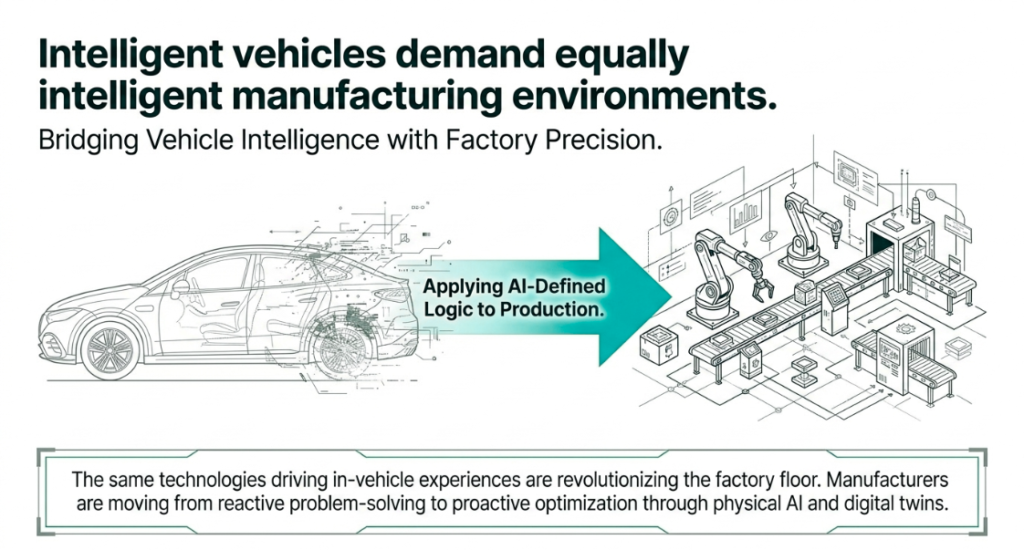
The same automotive AI trends driving in-vehicle experiences are revolutionizing the factory floor. AI-powered digital twins and physical AI are transforming traditional manufacturing lines into smart factories. The adoption of AI in manufacturing has expanded significantly as manufacturers seek greater visibility across production lines, equipment performance, and supply chain operations.
AI integration is moving manufacturers from reactive problem-solving to proactive optimization. Statistics show that up to 50% of manufacturers are now deploying AI in production, with larger firms taking the lead. Industry leaders are leveraging massive AI factories—such as Hyundai Motor Group’s collaboration with NVIDIA using 50,000 NVIDIA Blackwell GPUs—to train, validate, and deploy models for manufacturing.
Digital twins are a core technology enabling this shift. By creating physically accurate virtual representations of factories, AI enables:
The final frontier in 2026 is moving beyond pilots. According to recent research from Accenture and the CMU Software Engineering Institute (SEI), a significant challenge remains. While AI investments are rising, 95% of organizations are realizing no returns on their generative AI investments due to misaligned applications and poor execution.
To harness automotive AI trends and achieve enterprise value, companies must adopt structured frameworks. The SEI and Accenture have developed an AI Adoption Maturity Model to guide organizations from hype to predictable outcomes. This framework assesses an organization’s readiness across eight core dimensions: organisational strategy, workforce and culture, data, and engineering, among others.
To achieve “Scaled AI” or “Future-Ready” status (where AI use is successful at scale with repeatable results), organizations must focus on:
A structured AI adoption framework helps organizations scale responsibly.
AI initiatives should align directly with business goals such as:
Reliable AI outcomes require:
Organizations should focus on areas with measurable value, including:
Automotive environments demand rigorous oversight.
Governance frameworks should address:
AI systems require ongoing monitoring and refinement.
Leading organizations continuously evaluate the following:
As automotive ai trends continue to evolve, organizations require clear prioritization strategies to maximize value creation. Priorise helps businesses identify opportunities within AI in automotive industry programs, smart factory initiatives, and enterprise transformation efforts.
Whether implementing AI in manufacturing solutions, scaling SDV capabilities, or deploying an enterprise-wide AI adoption framework, organizations benefit from structured decision-making processes that improve outcomes and reduce implementation risks.
The automotive AI trends of 2026 indicate a clear trajectory: the industry is moving toward a future where AI is the engine of value creation. Success is no longer defined by the number of sensors in a car but by the intelligence of the software, the efficiency of AI-driven manufacturing, and the strategic maturity of the enterprise implementing it. As the industry navigates the complexities of AI adoption from the vehicle cabin to the factory floor, establishing a strong foundational strategy is imperative.
Are you ready to move from AI hype to measurable results? Discover how a structured AI Adoption Framework can transform your automotive or manufacturing operations. Contact Priorise today to start your journey toward enterprise-level AI integration.
The automotive artificial intelligence market is valued at $7.14 billion in 2026, with projections indicating exponential growth to $24.35 billion by 2030.
While SDVs focus on the ability to update software over-the-air (OTA), AI-Defined Vehicles leverage AI to create autonomous agents capable of perception, prediction, and proactive decision-making.
AI powers “smart factories” through digital twins for simulation, predictive maintenance to prevent downtime, and robotics optimized via physical AI to maximize production efficiency.
Key trends include widespread SDV adoption, AI-driven smart factories, and enterprise-wide scaling. Priorise helps businesses stay ahead of these shifts.
Assess your current state, define goals, and partner with experts like Priorise for strategy, implementation, and scaling.