LangChain vs LlamaIndex has become one of the most significant discussions among enterprises building AI-powered applications in 2026. Organizations are no longer evaluating AI success solely based on the performance of a large language model (LLM). Instead, they are focused on how effectively AI systems can retrieve information, orchestrate workflows, interact with business tools, and scale across enterprise environments.
Imagine a product team launching an intelligent customer support assistant. The initial prototype performs impressively in demonstrations, but once connected to enterprise data sources, challenges quickly emerge. Documents are scattered across systems, retrieval quality varies, responses become inconsistent, and performance degrades as data volume increases. At this stage, the challenge is not selecting the right model—it is choosing the right framework.
As businesses increasingly invest in Retrieval-Augmented Generation (RAG), AI agents, workflow automation, and Multi-agent AI systems, two frameworks consistently dominate conversations: LangChain and LlamaIndex. Both have matured significantly and now serve as critical building blocks within modern LLM application frameworks. However, their architectures, strengths, and ideal use cases differ considerably.
This comprehensive LangChain vs LlamaIndex comparison explores their capabilities, strengths, limitations, and enterprise applications to help technical leaders, developers, and AI consulting services teams make informed implementation decisions.
Building enterprise AI applications in 2026 requires much more than connecting an LLM to a chatbot interface. Organizations demand systems capable of managing complex business workflows while maintaining reliability, security, and scalability.
Developing these capabilities from scratch significantly increases engineering effort and maintenance costs. As a result, organizations increasingly rely on specialized frameworks that accelerate development and reduce implementation complexity.
Within this ecosystem, LangChain and LlamaIndex have emerged as two of the most widely adopted solutions.
Enterprise adoption is accelerating, but operational maturity remains limited. McKinsey reports that nearly two-thirds of organizations remain in experimentation or pilot phases, despite widespread AI deployment. This gap between experimentation and production is one reason organizations increasingly adopt specialized frameworks such as LangChain and LlamaIndex rather than building infrastructure from scratch.
LangChain is an open-source framework designed to simplify the creation of applications powered by large language models. Its primary focus is orchestration, enabling developers to connect LLMs with tools, APIs, databases, memory systems, and external services.
The framework has evolved from a simple prompt-chaining library into a comprehensive platform for building sophisticated AI systems.
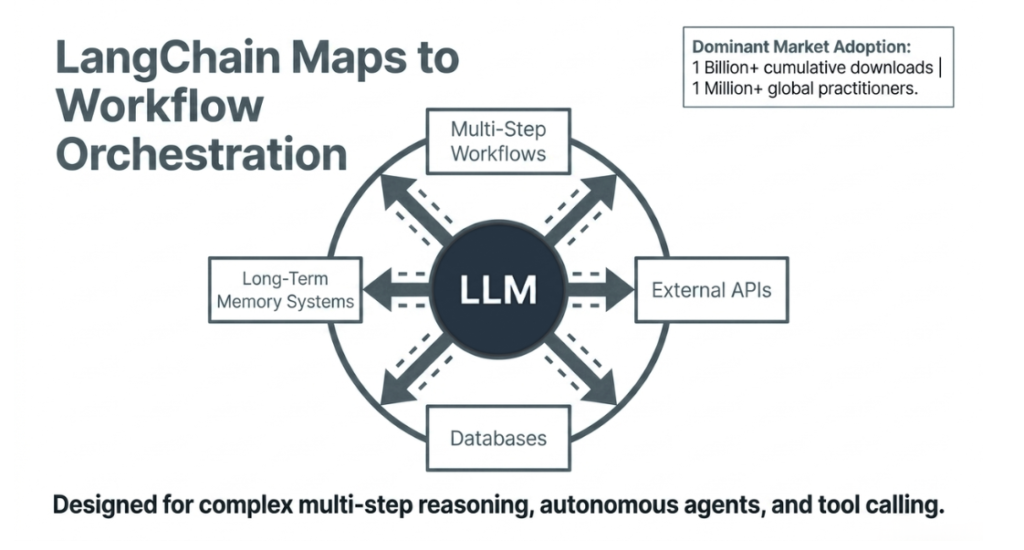
LangChain has emerged as one of the most widely adopted AI agent frameworks in the market. The LangChain ecosystem reports more than 1 billion cumulative framework downloads and usage by over one million practitioners worldwide, reflecting its dominance in AI agent orchestration and enterprise AI application development.
LlamaIndex focuses primarily on data ingestion, indexing, retrieval, and retrieval-augmented generation.
Originally created to help LLMs access private business data, it has evolved into one of the most advanced retrieval frameworks available for enterprise AI applications.
Rather than emphasizing workflow orchestration, LlamaIndex specializes in helping AI systems find, organize, and retrieve relevant information efficiently.
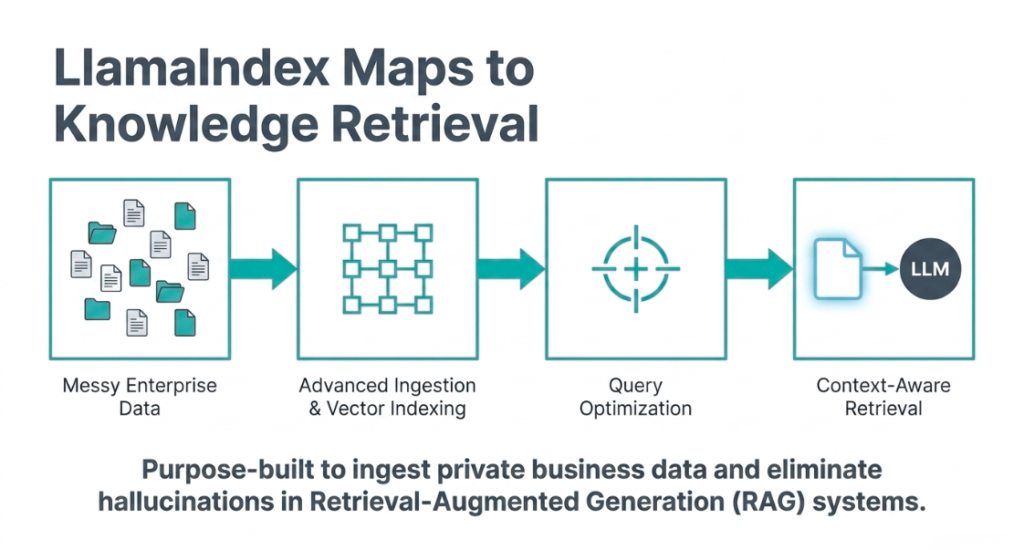
As enterprise knowledge repositories continue to grow, retrieval quality has become a strategic differentiator. Research on retrieval-augmented generation consistently identifies retrieval accuracy, context relevance, and metadata optimization as primary drivers of RAG performance and answer reliability. Modern enterprises increasingly prioritize retrieval architecture as a core component of enterprise AI strategy. Because retrieval quality directly impacts AI response accuracy, LlamaIndex has become a preferred choice for organizations building production-grade RAG systems.
The biggest distinction in the LangChain vs LlamaIndex comparison lies in their primary objectives.
| Feature | LangChain | LlamaIndex |
| Primary Focus | AI application orchestration and agent workflows | Data ingestion, indexing, and retrieval for RAG systems |
| Core Strength | Building complex AI workflows and agents | Building efficient retrieval and knowledge systems |
| Best Use Case | AI assistants, autonomous agents, workflow automation | Enterprise search, document Q&A, knowledge assistants |
| Architecture | Workflow-centric | Retrieval-centric |
| Learning Curve | Higher due to extensive capabilities | Lower and easier for RAG implementations |
| Agent Support | Advanced native AI agent framework capabilities | Basic to moderate agent support |
| RAG Capabilities | Strong, but often requires more configuration | Purpose-built and highly optimized for RAG |
| Data Indexing | Available through integrations | Core functionality |
| Document Retrieval | Good | Excellent |
| Tool Integration | Extensive API and tool ecosystem | More focused on data sources and retrieval |
| Workflow Automation | Highly flexible and customizable | Limited compared to LangChain |
| Development Speed | Faster for agent-based applications after setup | Faster for retrieval-focused applications |
| Scalability | Strong for complex enterprise workflows | Strong for large-scale document retrieval |
| Enterprise Applications | Customer service agents, research assistants, process automation | Knowledge bases, compliance systems, internal search |
| Complexity | Higher | Lower |
| Customization | Very high | Moderate |
| Performance Strength | Multi-step reasoning and orchestration | Retrieval accuracy and context management |
| Ideal Users | Teams building advanced AI agent framework solutions | Teams building RAG-focused applications |
| Main Challenge | Greater implementation and maintenance complexity | Less powerful workflow orchestration |
| Recommended When | You need autonomous agents, tool calling, and workflow automation | You need fast, accurate, and scalable knowledge retrieval |
| 2026 Trend | Preferred for agentic AI systems | Preferred for enterprise RAG deployments |
| Hybrid Approach | Often used as the orchestration layer | Often used as the retrieval layer |
Any meaningful RAG framework comparison must begin with understanding why retrieval-augmented generation has become critical.
Enterprise AI systems often struggle with hallucinations, outdated knowledge, and inaccurate responses. RAG addresses these issues by retrieving relevant information before generating answers.
A typical RAG architecture includes:
The framework responsible for retrieval often determines the quality of the final output.
As enterprises deploy larger knowledge repositories, retrieval quality has become a strategic concern. Internal search, knowledge management, compliance documentation, and customer support increasingly depend on retrieval-augmented generation (RAG) architectures capable of delivering accurate and context-rich information at scale. Industry surveys indicate that organizations are prioritizing data architecture and retrieval quality as foundational requirements for successful AI deployments.
LlamaIndex offers:
These features make it highly effective for complex document repositories.
LangChain provides:
However, retrieval itself is generally not as specialized as LlamaIndex.
Verdict:
For pure RAG framework comparison, LlamaIndex typically delivers superior retrieval performance and easier implementation.
Organizations investing in AI consulting services increasingly evaluate frameworks based on production readiness rather than experimentation capabilities. Recent industry research shows:
These findings reinforce why selecting the right LLM application frameworks, AI agent orchestration tools, and RAG framework architecture has become a strategic business decision.
Choose LangChain when:
Choose LlamaIndex when:
Use both together: Many production systems combine LlamaIndex for retrieval with LangChain for orchestration. LlamaIndex indices wrap as LangChain tools, maximizing capability without redundancy.
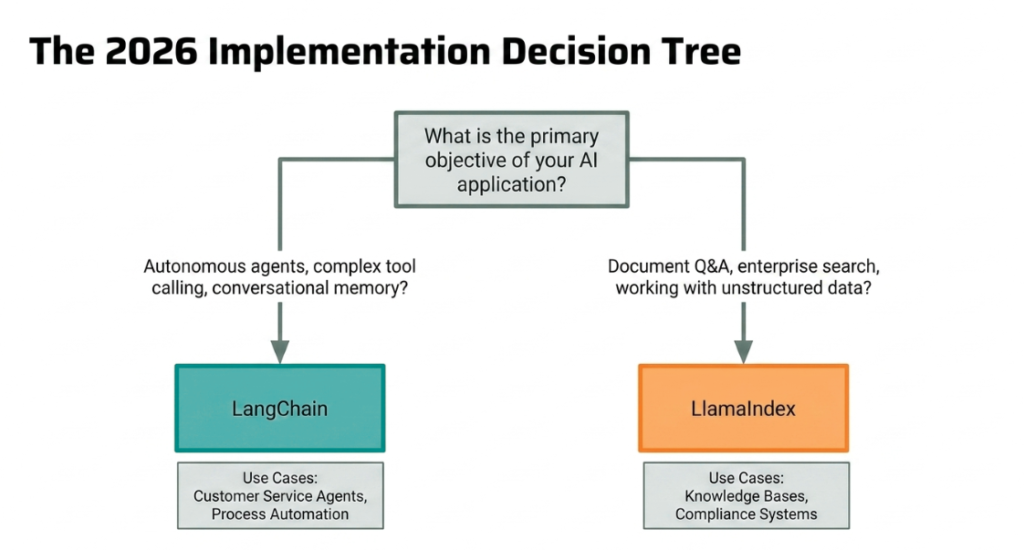
The RAG framework comparison between LangChain vs LlamaIndex will remain pivotal as AI evolves through 2026. Enterprises that master these LLM application frameworks gain a decisive edge, orchestrating multi-agent AI systems that deliver actionable insights at scale. Whether building complex agent-driven workflows or unlocking deep enterprise data, the right platform, backed by expert data analytics consulting services, empowers true transformation.
Ready to future-proof your AI stack? Explore how Priorise can support your journey with advanced AI consulting services and tailored RAG framework integration.
Priorise provides AI consulting services to design, deploy, and optimize RAG applications, AI agents, and enterprise AI solutions using LangChain and LlamaIndex
Yes. Many enterprises use LlamaIndex for retrieval and LangChain for workflow orchestration, creating a powerful hybrid architecture.
Yes. LangChain provides advanced capabilities for AI agent orchestration, task delegation, tool usage, and agent collaboration, making it ideal for Multi-agent AI systems.
LlamaIndex offers advanced indexing, metadata filtering, hybrid search, and knowledge graph capabilities that improve retrieval quality across large enterprise datasets.
AI consulting services assess business goals, data architecture, compliance requirements, and scalability needs to recommend the most effective AI framework strategy and deployment model.