
Artificial intelligence is evolving rapidly in 2026. Businesses are no longer relying only on single AI tools to automate simple tasks. Instead, organizations are building intelligent ecosystems where multiple AI agents work together to solve complex problems.
This is where multi agent systems in artificial intelligence are becoming highly important.
A modern AI multi agent system allows different AI agents to collaborate, communicate, and make decisions together. These systems are transforming industries such as healthcare, logistics, finance, customer service, cybersecurity, and enterprise automation.
As agentic AI adoption increases, understanding how multi-agent systems work is becoming essential for businesses and technology leaders.
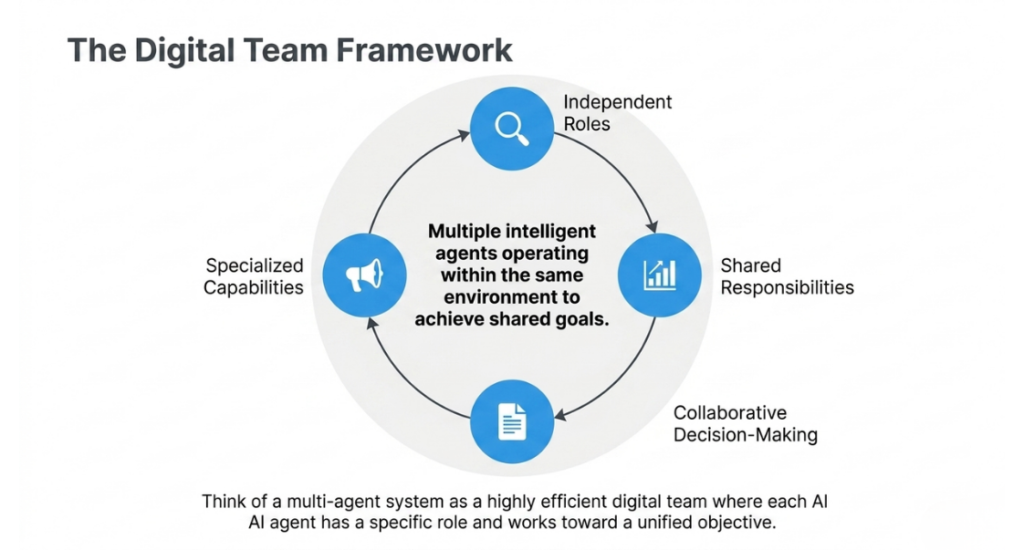
A multi-agent system is a setup where multiple intelligent agents operate within the same environment to achieve shared or individual goals.
Each agent in the system has its own role, responsibilities, and decision-making abilities.
In simple terms, think of it like a highly efficient digital team.
For example:
Together, they form an advanced AI multi agent system capable of handling tasks much faster and more efficiently than a single AI model. This collaborative structure is why multi agent systems in artificial intelligence are becoming a key part of enterprise AI strategies.
In an AI multi agent system, agents communicate continuously to exchange information and coordinate actions.
These systems generally include:
1. Independent AI Agents
Each agent performs a specialized function.
2. Shared Environment
Agents operate within a connected digital ecosystem where they access shared data and workflows.
3. Communication Mechanisms
Agents exchange updates, requests, and decisions in real time.
4. Coordination Logic
The system manages how agents collaborate and avoid conflicts.
Modern multi agent systems in artificial intelligence often use Large Language Models, machine learning, automation tools, and real-time analytics to operate efficiently.
Adopting multi agent systems in artificial intelligence brings several advantages:
These benefits make AI multi agent system frameworks ideal for industries like logistics, finance, smart cities, and more.
| Aspect | Single-Agent System | AI Multi-Agent System |
| Complexity handling | Limited to simpler tasks | Handles complex, multi-step problems |
| Scalability | Harder to scale | Easily scales by adding agents |
| Specialization | One agent does everything | Specialized agents for different roles |
| Resilience | Single point of failure | More resilient to failures |
Many industries are already adopting AI multi agent system technology.
One AI agent predicts inventory demand, another manages logistics routes, while another monitors supplier performance.
Different AI agents handle ticket classification, customer communication, sentiment analysis, and issue escalation.
Agents assist with patient scheduling, medical record analysis, diagnostics, and treatment recommendations.
Multiple agents monitor network activity, identify threats, and respond to security incidents automatically.
These real-world applications show how multi agent systems in artificial intelligence improve efficiency across industries. Priorise partners with organizations to design and implement robust AI multi agent system solutions, driving innovation and operational excellence.
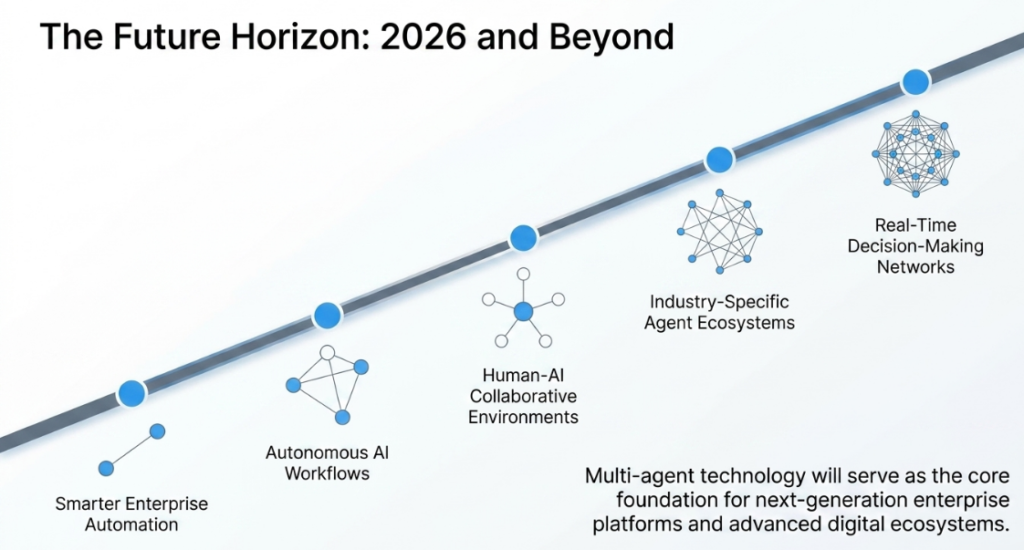
The future of agentic AI will rely heavily on collaboration between intelligent systems. Experts predict that AI multi agent system technology will power next-generation enterprise platforms, autonomous business operations, and advanced digital ecosystems.
In the coming years, we can expect:
As AI technology matures, multi agent systems in artificial intelligence will become a core foundation of digital transformation.
Summary:
Multi-agent systems are redefining how businesses use AI in 2026. Instead of relying on isolated tools, organizations are adopting connected AI ecosystems where intelligent agents collaborate to solve complex business challenges.
An advanced AI multi agent system enables businesses to automate operations, improve scalability, enhance efficiency, and support smarter decision-making.
As the demand for intelligent automation continues to grow, multi agent systems in artificial intelligence will play a major role in shaping the future of agentic AI and enterprise innovation.