


Business intelligence consulting drives data-driven decisions by building clean ETL pipelines, unifying scattered data sources, and configuring dashboards like Power BI for instant, self-service insights. Companies use these services to replace guesswork with a reliable decision-making mechanism, backed by cloud migration and data engineering that scale as the business grows.
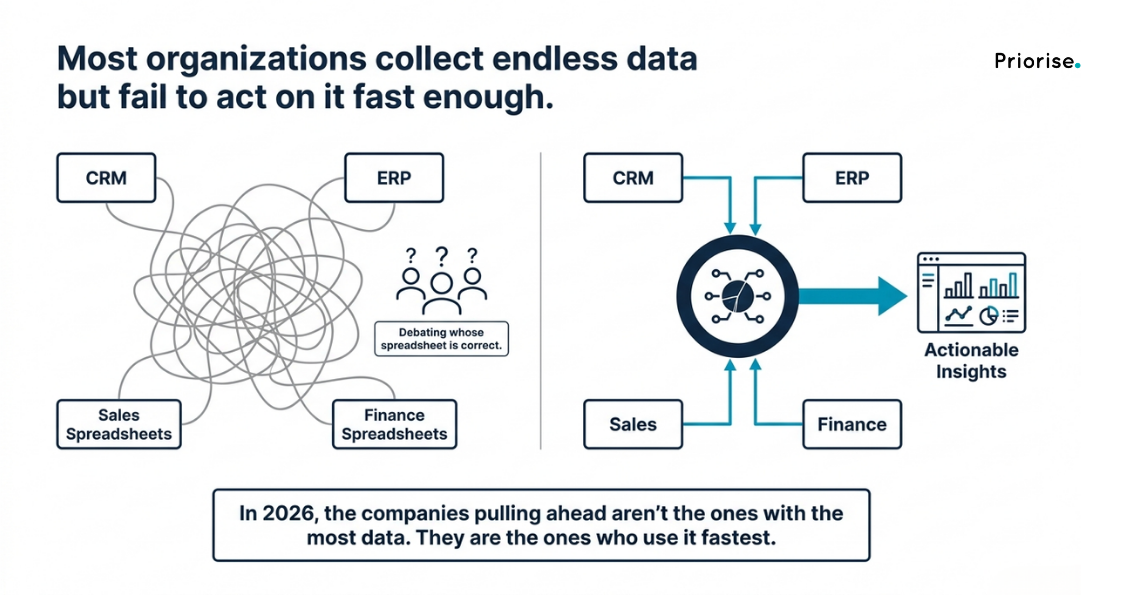
In 2026, the companies pulling ahead aren’t the ones with the most data, they’re the ones who use it fastest. Most organizations are still drowning in spreadsheets and reports nobody fully trusts. That gap between collecting data and acting on it is exactly where business intelligence consulting services earn their keep.
The Foundation: Data Engineering and ETL
Clean, structured data doesn’t happen by accident. Data engineering is the discipline that builds the pipelines and infrastructure needed to handle information at scale, and ETL data integration (extract, transform, load) sits at the center of that work.
Without proper ETL, information stays trapped in silos: sales numbers in one system, finance numbers in another, and nobody agrees on which one is right. A solid provider of business intelligence consulting services connects your CRM, ERP, and marketing platforms so every team pulls from one shared source of truth instead of arguing over whose spreadsheet is correct.
Why Business Intelligence Still Matters in 2026
Business intelligence is not a new idea, but it has never been more central to how companies operate. The global business intelligence market is projected to grow from USD 39.79 billion in 2026 to USD 121.56 billion by 2034, according to Straits Research.
Beyond the numbers, the real shift is in mindset. Business intelligence used to mean a monthly report someone in finance emailed around. Today it means live dashboards that update as new data comes in, accessible to anyone who needs them. Leadership no longer waits for a report to know how the business is performing right now.
This shift also changes how teams make decisions day to day. Instead of debating whose spreadsheet is correct, teams look at one shared source of truth and move straight to solving the problem in front of them. That is the practical value business intelligence consulting services deliver: less time spent arguing about numbers and more time spent acting on them. That gap between having data and using it well is exactly where business intelligence consulting services create value.
What a Decision-Making Mechanism Actually Looks Like
Every company already has some kind of decision-making mechanism, whether it’s deliberate or just whoever talks loudest in a meeting. One worth trusting, built through solid business intelligence consulting services, usually includes the following:
- Clean data pulled from every system that matters, not just the convenient ones
- Dashboards that show identical numbers to every department
- Clear ownership over what each metric means and how it’s calculated
- Reporting cycles tied to actual business goals, not calendar habits
- A feedback loop that checks whether past calls actually paid off
Without that structure, a business isn’t really making data-driven decisions it’s making data-flavored guesses dressed up to look official. A working mechanism like this turns raw numbers into something leadership can act on with confidence every time.
ETL Data Integration: The Backbone Nobody Sees
This is the unglamorous work that makes everything else possible: pulling data out of scattered systems, cleaning it up, and delivering it somewhere useful. Integrate.io’s research puts the global ETL tools market at $10.24 billion in 2026 and notes that data engineers spend an estimated 40 to 60% of their time on pipeline maintenance rather than analysis.
In practice, ETL data integration runs in three stages: data gets pulled from wherever it lives, a CRM, a point-of-sale system, or an accounting tool, reshaped into a consistent format so a date or a name looks the same everywhere, and then loaded into a central location analysts and dashboards can actually use.
Most companies aren’t short on data; they’re short on data that talks to itself across systems. Handle this step poorly, and every dashboard built on top inherits the same mistakes, which is why experienced consultants start here, not with the reporting layer.
Power BI and the Rise of Self-Service Analytics
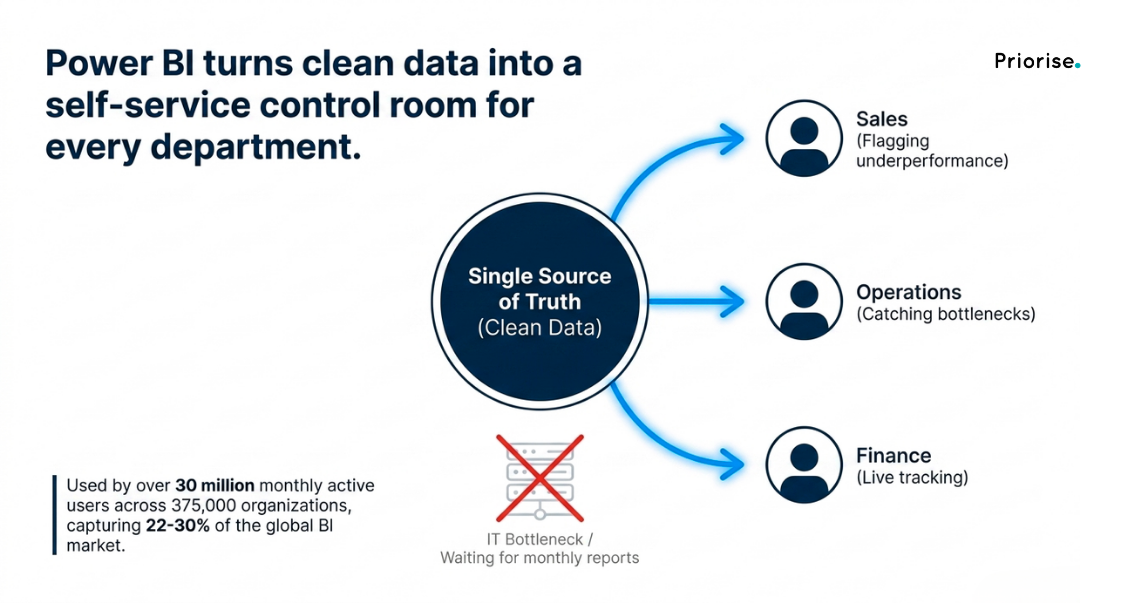
Once the data is clean, people need a way to actually see it. Microsoft’s own figures show Power BI is used by over 30 million monthly active users across more than 375,000 organizations worldwide, and independent trackers put its share of the global BI market at roughly 22% to 30%.
What makes it stand out isn’t just its footprint, it’s how ordinary business users interact with it day to day. Teams build their own reports without waiting on IT, connect dozens of sources instantly, and push a dashboard to the whole company in a few clicks. Good business intelligence consulting services configure the platform around the questions a business actually asks: a sales view that flags an underperforming region on its own, or an operations dashboard that catches a bottleneck before it turns expensive.
Cloud Data Migration: The Shift Nearly Every Business Is Making
Legacy, on-premise systems are quickly becoming the exception rather than the rule. Cloud data migration is now the default path for companies serious about business intelligence.
- 75% of businesses had adopted cloud-based BI solutions by late 2024, up from roughly 45% in 2021, according to 360 Research Reports.
A typical cloud data migration moves in phases rather than all at once. First, existing systems and data sources are mapped out so nothing gets lost in the move. Next, data is transferred in stages, often starting with less critical systems to work out any issues before touching core business data. Finally, old on-premise systems are retired once the new cloud environment is fully validated and stable.
Done well, cloud data migration removes the need to maintain physical servers, patch software manually, or worry about running out of storage at the worst possible time. It also makes it far easier to add new data sources later, since cloud platforms are built to scale up or down as needed. Cloud data migration is not just about moving files. It is about giving every future BI project room to scale without rebuilding the foundation each time.
Why Data Engineering Is the Unsung Hero
Behind every dashboard, every pipeline, and every migration described above is a team of data engineers doing the invisible work of keeping it all running. Integrate.io reports average data engineer salaries around $132,308 in the United States, a reflection of how scarce this talent has become.
Day to day, this work means building pipelines, keeping servers and cloud services running, and catching small errors before they snowball into a broken dashboard. It’s rarely the flashy part of a BI project, but it’s usually the part that decides whether everything else actually works. Without it, even the best strategy falls apart, which is exactly why companies bring in outside business intelligence consulting services rather than stretching a small internal team too thin.
From Data Infrastructure to Smarter Business Decisions
Business intelligence consulting services aren’t just for large enterprises anymore. From ETL pipelines to Power BI dashboards, from data warehouses to cloud migrations, every piece has to work together to build a decision-making mechanism that holds up under real pressure, with data engineering tying it all together behind the scenes.
Ready to turn your data into an asset instead of a headache? Contact Priorise today to see how our team can sharpen your data strategy and help your business move faster.
Frequently Asked Questions
What are the real benefits of business intelligence consulting services?
They help unify scattered data, tighten reporting accuracy, and speed up your decision-making mechanism, so infrastructure actually supports where the business is headed.
How does ETL data integration improve performance?
It removes data silos by pulling information from multiple sources into one trusted view, cutting manual errors and giving teams instant access to a single source of truth.
Why does cloud migration matter for modern companies?
It unlocks scalability and real-time access, letting businesses move off slow legacy hardware onto modern data warehouse tools built to handle large, complex datasets securely.
Can Power BI actually speed up decisions?
Yes it turns complex data into dashboards people can read in seconds. A specialized partner can configure it so teams spot trends and act almost immediately, instead of hunting for answers.
How do I know if my business needs stronger technical foundations?
If reporting is slow, inconsistent, or still built on manual spreadsheets, that’s usually the sign. Bringing in specialists to audit the data pipeline is the fastest way to close the gap.