

Determining whether a business is ready for AI involves examining key readiness pillars: data quality and accessibility, strategic alignment with clear use cases, technical infrastructure and integration capacity, and workforce skills and change-management readiness. Assessing these areas helps organizations identify gaps early, avoid costly implementation failures, and build a solid foundation for scalable AI adoption.
In 2026, the question isn’t whether your business should use AI; it’s whether you can harness it well enough to matter. Adoption has reached critical mass, with well over three-quarters of companies folding AI into core operations. But most leaders jump in without a plan, then discover their systems were never ready. That’s exactly where a rigorous AI readiness checklist earns its place.
Building a real adoption plan takes more than a software purchase; it demands a shift in how your organization treats, stores, and understands data. If turning intention into action feels harder than it should, you’re not alone: plenty of companies feel confident about strategy on paper yet far less confident about the infrastructure, data, and talent underneath it. What closes that gap is a clear AI implementation strategy.
Why AI Readiness Matters More Than Ever in 2026
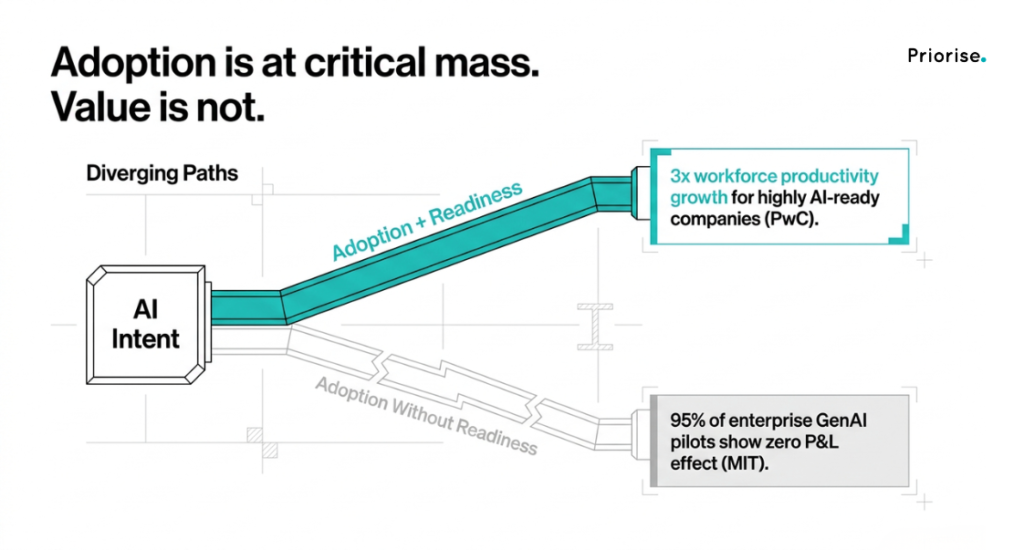
Adoption itself is no longer the challenge; most companies have started. The real test is turning early activity into lasting value, and the data on that front is sobering.
Data quality remains one of the biggest blockers. Gartner predicts that through 2026, organizations will abandon 60% of AI projects unsupported by AI-ready data, and its 2024 survey of 248 data leaders found 63% either lack or are unsure they have the right data practices.
Independent research from MIT tells a similar story. A widely cited 2025 report from MIT’s Project NANDA found roughly 95% of enterprise generative AI pilots showed no measurable effect on profit and loss; only about 5% managed rapid revenue acceleration.
It isn’t all bad news. Companies that get the fundamentals right gain a significant advantage. PwC’s Global AI Jobs Barometer found that since 2022, the most AI-exposed companies have tripled their lead in workforce productivity growth over the least exposed – proof that readiness, not adoption alone, separates winners from the pack.
These numbers point to one conclusion: skipping this groundwork isn’t optional. It’s the difference between a pilot who quietly dies and a strategy that delivers results.
The AI Readiness Checklist: 4 Areas to Evaluate
Use this checklist as a starting point before you invest in any new AI tool, model, or agent.
1. The Data Foundation Is Your Data Actually Ready for AI?
Before you shop for tools, take a close look at your data, AI is only as good as the information it consumes.
- Data Quality: Is your data clean, accessible, and structured? ‘Garbage in, garbage out’ is the golden rule.
- Data Governance: Do you have clear policies on who can access what? A February 2025 Gartner survey of 360 organizations found that companies running dedicated AI governance platforms are 3.4 times more likely to reach high governance effectiveness.
- Centralized Storage: Are your data silos broken down? With the average enterprise running thousands of scattered SaaS and AI tools, poor visibility is often the biggest failure point.
2. Defining Your Adoption Path Where Should It Actually Start?
Many businesses stumble by trying to “do AI” everywhere at once. Once your AI adoption checklist flags the gaps, a successful plan starts small: pick one or two high-impact use cases where automation saves time or sharpens decisions.
Industry reports back this up; companies moving beyond simple experiments into production report revenue uplifts of 10–20% and cost reductions of 5–10%. Before committing, ask what’s bottlenecking your team, where you’re missing insights due to data overload, and whether you have a measurable goal for the project.
3. The Human Factor Why Do Most AI Rollouts Fail on People, Not Technology?
Technology is the easy part. Changing culture is the hard one, your implementation plan needs a real approach to training and change management.
If your internal team lacks the technical depth to pull the project off, it’s often smarter to hire an AI consultant than learn every lesson the expensive way. Outside expertise helps sidestep pitfalls and shortens time-to-market. Professional AI consulting services bring the objective oversight that keeps projects on budget.
4. Evaluating Your Tech Stack Is It Ready to Support AI?
As you work through this checklist, audit the technology underneath it, do your systems expose APIs for AI integration, or are legacy tools blocking your data from flowing freely?
Security also needs careful attention. CrowdStrike’s 2026 Global Threat Report found AI-enabled attacks rose 89% year-over-year in 2025, so security built into your enterprise AI strategy from day one matters as much as the models themselves. A modular, scalable stack lets you plug in new capabilities as they evolve, instead of rebuilding your infrastructure each time.
Turning the Checklist into an AI Adoption Strategy
An AI readiness checklist tells you where you stand today; an AI adoption strategy tells you how to move forward. The two are closely linked, and pilots often fail because teams skip straight to implementation without finishing the checklist first.
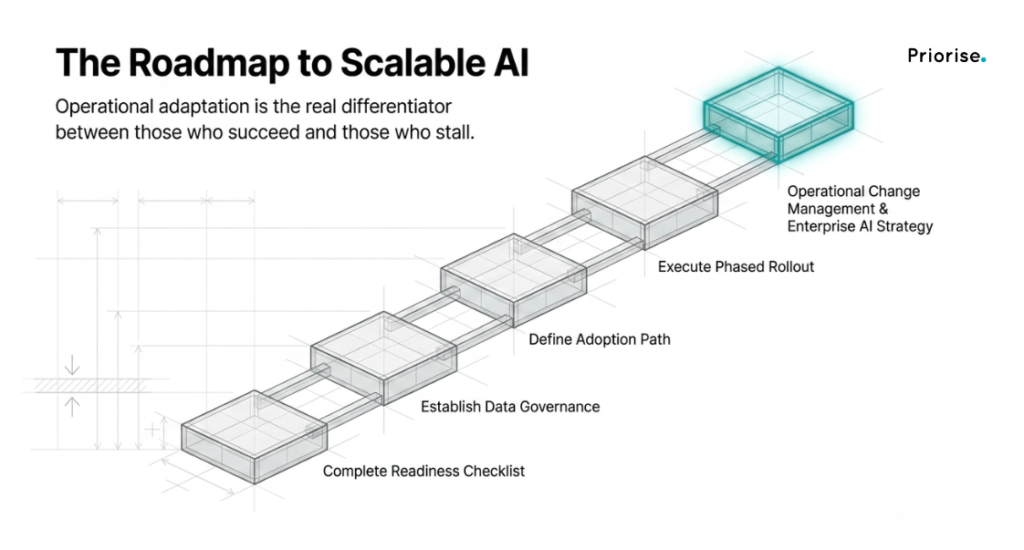
A solid roadmap typically includes a prioritized list of use cases tied to business outcomes and a realistic data readiness plan (most implementation failures trace back to poor data foundations); governance roles set before deployment; a phased rollout with clear checkpoints; and change management so employees trust and use the tools.
Change is the operative word here, as enterprises move from experimentation to daily use, operational adaptation, not the technology itself, is becoming the real differentiator between companies that succeed and those that stall.
From AI Readiness to AI Results
AI readiness isn’t a one-time checkbox. It’s an ongoing discipline combining data quality, skilled talent, strong governance, and a clear adoption path tied to business outcomes. The organizations winning with AI in 2026 aren’t the ones that moved fastest, they got the fundamentals right before they scaled.
If you’re unsure where your business stands, don’t guess. Work through your AI readiness checklist with Priorise, our AI consulting services can help you build a strategy, so your next investment delivers.
FAQs
What does an AI readiness checklist actually measure?
It evaluates four core areas: data quality and governance, your adoption plan, workforce skills, and whether your tech stack can support AI without a full rebuild.
How long does it take to become “AI ready”?
t depends on your starting point, but most companies need several months to fix data foundations before any pilot can scale. Skipping these steps is why so many efforts stall after the pilot phase.
Do we need to hire an AI consultant, or can we do this in-house?
If your team can honestly complete the checklist and already has strong data governance, in-house may work. If pilots have stalled or you lack expertise, it’s usually faster to bring in outside help than to relearn these lessons through failed projects.
What’s the difference between an AI adoption strategy and an AI implementation strategy?
An AI adoption strategy sets the direction which use cases to prioritize and why. An AI implementation strategy is the execution plan: data pipelines, governance, tooling, and rollout.
How do AI consulting services fit into a broader enterprise AI strategy?
They bridge the gap between isolated pilots and a coordinated program that spans departments, with shared governance and ROI tracking instead of scattered experiments.