


How are AI Loyalty Programs transforming retail customer retention in a market where customer expectations change faster than traditional loyalty models can keep up?
Retailers can no longer rely on points and periodic discounts to secure long-term loyalty. Today’s customers expect brands to anticipate their needs, personalize every interaction, and deliver value at the right moment. AI Loyalty Programs make this possible. By using predictive analytics, behavioral segmentation, and real-time personalization, retailers can identify churn risks early, optimize rewards intelligently, and increase lifetime value. The result is stronger retail customer retention, higher profitability, and loyalty programs that evolve as dynamically as the customers they serve.
The Limitations of Traditional Loyalty Models
Conventional loyalty programs typically rely on points of accumulation, periodic discounts, and tier thresholds. While these mechanisms can stimulate short-term activity, they rarely deliver sustainable retail customer retention.
The limitations are structural:
- Uniform rewards regardless of predicted customer value
- Static demographic segmentation rather than behavioral intelligence
- Delayed churn detection after revenue decline
- Limited cross-channel integration
AI Loyalty Programs resolve these structural weaknesses.
What Defines AI Loyalty Programs
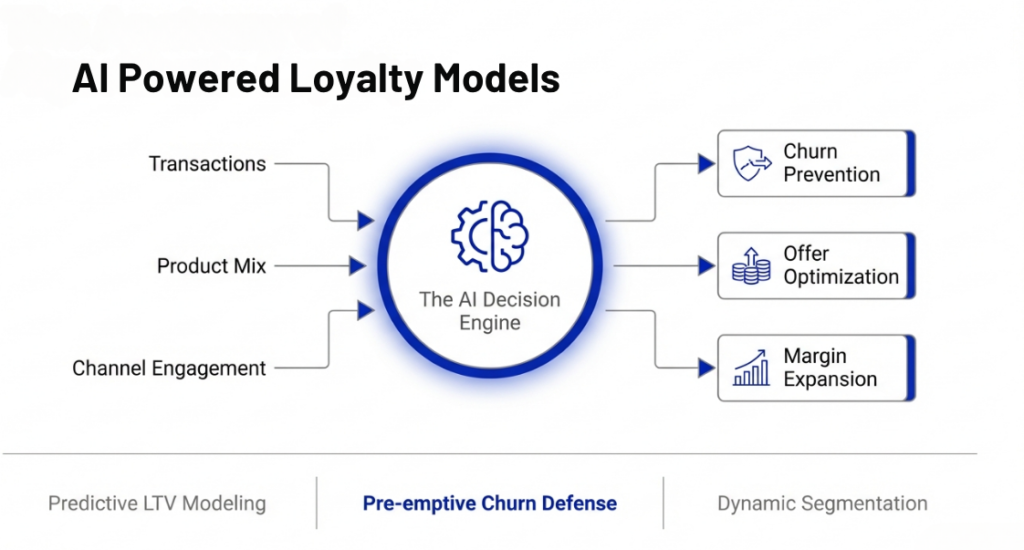
AI Loyalty Programs integrate machine learning, predictive analytics, and real-time decision systems into loyalty architecture. Instead of rewarding past transactions alone, these systems anticipate future behavior and dynamically optimize engagement.
Key capabilities include:
- Predictive Lifetime Value Modeling
AI models evaluate historical transactions, recency, frequency, product mix, and channel engagement to forecast customer lifetime value. This allows retailers to prioritize investment toward high-potential customers rather than relying solely on historical spend.
- Churn Prediction Algorithms
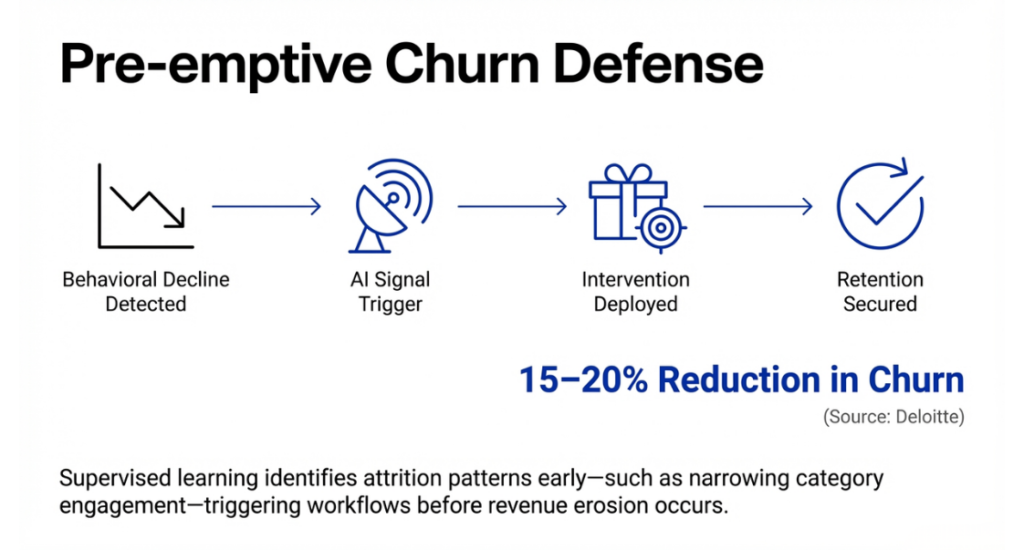
Supervised learning models identify patterns that precede attrition, such as declining purchase cadence or narrowing category engagement. Early detection enables targeted interventions before revenue erosion accelerates. Predictive analytics can identify customers at risk before attrition occurs. Deloitte research indicates that advanced analytics can reduce churn by 15 to 20 percent in retail and consumer sectors. Early detection enables targeted interventions that preserve lifetime value.
- Behavioral Segmentation at Scale
Clustering algorithms group customers based on real purchasing patterns, promotion responsiveness, and browsing behavior. Unlike static segments, AI-driven clusters continuously evolve as new data is introduced. Accenture reports that 91 percent of consumers are more likely to shop with brands that recognize and remember them. AI clustering algorithms group customers by actual purchasing behavior, responsiveness to promotions, and channel preference. These segments evolve continuously, unlike static demographic tiers.
- Real-Time Personalization Engines
AI systems process live behavioral signals to deliver contextual offers. Rather than distributing generic promotions, AI Loyalty Programs recommend incentives based on predicted responsiveness and margin impact.
- Dynamic Offer Optimization
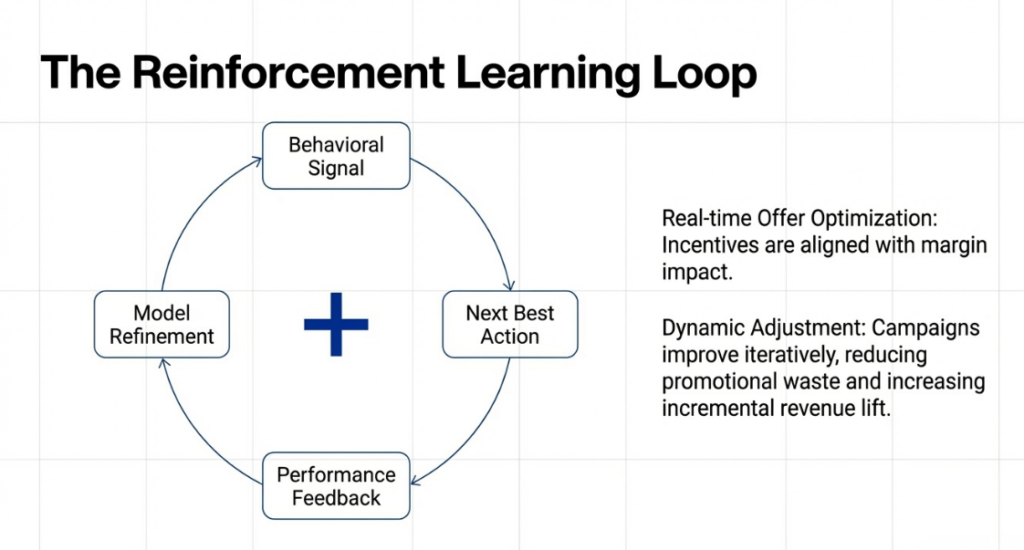
Using reinforcement learning techniques, offers are adjusted based on continuous performance feedback. Campaigns improve iteratively, reducing promotional waste and increasing incremental revenue lift.
Together, these capabilities shift loyalty from a rules-based framework to an adaptive intelligence system.
AI and Retail Customer Retention Strategy
Retail customer retention requires anticipating needs rather than reacting to churn. AI enhances retention strategies across multiple dimensions.
- Early Risk Detection
Predictive churn models flag customers exhibiting behavioral decline. Automated workflows trigger personalized retention campaigns tailored to the customer’s purchasing profile.
- Next Best Action Recommendations
AI systems determine the optimal engagement strategy for each customer. This may involve a targeted incentive, product recommendation, loyalty tier upgrade, or content-based interaction. The decision is driven by predicted incremental value.
- Optimized Reward Structures
AI Loyalty Programs evaluate which rewards increase profitable behaviors rather than simply increasing transaction volume. Incentives are aligned with margin expansion, cross-category purchasing, and sustained frequency.
- Omnichannel Journey Integration
AI integrates customer interactions across digital and physical touchpoints. Customers expect seamless experiences across channels. According to Harvard Business Review, omnichannel customers spend 4% more in-store and 10% more online than single-channel customers. AI synchronizes engagement across email, mobile, ecommerce, and in-store systems to maintain a consistent retention impact.
- Demand Forecasting and Promotion Timing
Machine learning models forecast purchase cycles and demand fluctuations. Promotions are timed to influence behavior at high leverage moments rather than distributed arbitrarily.
The measurable outcomes include improved retention rates, increased lifetime value, reduced promotional inefficiency, and stronger revenue predictability.
Embedding AI Into Loyalty Infrastructure
The success of AI Loyalty Programs depends on data integration and model governance. Transactional data, customer profiles, promotional history, and behavioral signals must be unified within a scalable architecture. Models must be validated regularly to prevent drift and ensure predictive accuracy.
Retailers that treat AI as an experimental overlay often fail to capture its full impact. Sustainable retail customer retention requires embedding predictive intelligence into campaign planning, budgeting, and performance evaluation.
Conclusion: AI as the New Foundation of Loyalty Economics
Loyalty programs are no longer defined by points and rewards alone. The competitive advantage lies in predictive intelligence. AI Loyalty Programs redefine retail customer retention by anticipating behavior, optimizing incentives, and aligning engagement with long term profitability. Retailers that adopt AI-driven strategies gain clarity, efficiency, and sustained revenue growth.
Priorise enables this transformation through structured analytics and advanced machine learning frameworks that convert loyalty data into a strategic advantage.
To build AI-powered loyalty programs that deliver measurable retail customer retention impact, partner with Priorise and redefine how loyalty drives growth.
Related Posts
AI Readiness Checklist: Is Your Business Ready for AI?
Determining whether a business is ready for AI involves examining key readiness pillars: data quality and…
Using AI and Machine Learning for Customer Retention Analytics
Acquiring a new customer is an expensive endeavor. According to recent software performance metrics published by Searchlab, average…

AI App Development: From Idea Validation to Enterprise Deployment
The modern business environment has shifted from asking if artificial intelligence should be used to…
How Custom AI Models Solve Industry Specific Business Challenges
Artificial intelligence is no longer a future technology. It has become an essential part of…