
Aviation has always operated at the intersection of complexity and precision. Every flight depends on thousands of variables working in sync. Today, artificial intelligence is becoming the layer that connects and optimizes them all.
The rapid rise of AI in aviation industry operations is not just about automation. It is about building intelligent, adaptive systems that can predict, learn, and improve continuously. To achieve this, airlines and aviation stakeholders are increasingly relying on AI consulting to design scalable and high-impact solutions.
At Priorise, the focus is on turning AI potential into measurable operational and commercial value.
Modern aviation ecosystems generate vast, real-time data streams from aircraft systems, ground operations, and passenger interactions. However, without the right frameworks, this data remains underutilized.
This is where AI consulting becomes critical. It helps organizations:
With AI, aviation companies can move from reactive operations to predictive and prescriptive decision-making.
1. Predictive Maintenance and Asset Intelligence
Aircraft maintenance is shifting from reactive to predictive.
AI models analyze sensor data, historical failures, and operational patterns to forecast potential issues before they occur.
This enables:
With expert AI consulting, airlines can deploy predictive systems that enhance reliability across the AI in aviation industry.
2. AI-Driven Flight Optimization
Flight efficiency directly impacts profitability and sustainability.
AI systems process weather patterns, air traffic data, and fuel consumption metrics to recommend optimal routes.
Key benefits include:
Organizations leveraging AI consulting can integrate these capabilities seamlessly into AI in aviation industry operations.
3. Personalized Passenger Experience
Passenger expectations are evolving toward seamless, real-time, and personalized journeys.
AI enables airlines to deliver:
With the support of AI consulting, aviation companies can design scalable personalization engines that enhance engagement across the AI in aviation industry.
4. Enhanced Security and Baggage Handling
Security and baggage operations are critical touchpoints in aviation.
AI is transforming these areas by enabling:
Advanced analytics models improve both accuracy and speed, ensuring safer and more efficient operations. Through strategic AI consulting, organizations can implement these solutions to strengthen reliability and trust in the AI in aviation industry.
5. Autonomous Air Traffic Control
Air traffic management is becoming increasingly complex due to rising flight volumes.
AI-powered autonomous systems are redefining how airspace is managed.
Capabilities include:
Autonomous air traffic systems reduce human error and improve operational efficiency.
With strong AI consulting support, aviation authorities can scale these innovations and modernize infrastructure across the AI in aviation industry.
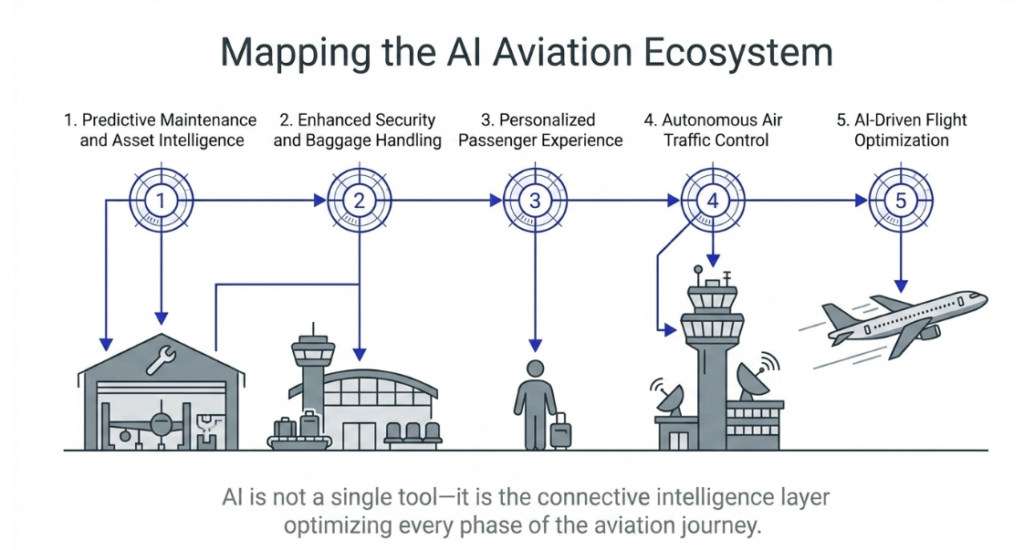
Implementing AI in aviation is not just a technology upgrade. It is a systemic transformation.
This is where AI consulting becomes essential.
A structured AI consulting approach helps organizations:
Without the right expertise, AI initiatives often remain limited in scope and impact.
Summary:
AI is fundamentally reshaping aviation by enhancing efficiency, safety, and customer experience. From predictive maintenance to autonomous air traffic control, the use cases highlight the growing impact of AI in aviation industry operations. With the right AI consulting strategy, businesses can unlock scalable innovation and long-term value.
Do not let your competitors fly ahead. Contact Priorise today and let our AI consulting experts transform your operations with AI in aviation industry solutions that work.