


Acquiring a new customer is an expensive endeavor. According to recent software performance metrics published by Searchlab, average customer acquisition costs have spiked by 60 percent compared to recent years, while the capital required to retain an existing client has risen by only 12 percent. This steep financial gap is causing modern companies to adjust their focus. Growth is no longer just about filling the sales funnel; it relies heavily on protecting and cultivating your existing customer base.
To achieve this, data-driven companies are moving away from reactive support models. Instead, they use advanced customer retention analytics to study behavioral footprints, predict user frustrations, and stop account cancellations before they happen. This tactical framework details how modern companies leverage machine learning architectures to maximize customer lifetime value, protect ongoing subscription revenues, and build defensible market advantages.
Why Customer Retention Matters More Than Ever
Many organizations invest heavily in customer acquisition while overlooking retention. However, retaining existing customers is often more cost-effective and profitable than continuously acquiring new ones.
According to Harvard Business Review, increasing customer retention by just 5% can increase profits by 25% to 95%, depending on the industry. This is why customer retention analytics has become a strategic priority for businesses across industries.
Organizations that understand customer behavior can:
- Reduce churn
- Increase repeat purchases
- Improve customer loyalty
- Enhance customer satisfaction
- Increase revenue
- Strengthen brand trust
The Strategic Shift: Moving from Post-Mortem to Predictive Analytics
Traditional business intelligence frameworks look backward. They calculate your churn numbers at the end of the month, giving leadership a clear view of the customers who have already left. While this data is clean, it is also unactionable; you cannot save a client who has already canceled their account and moved to a competitor.
Integrating proactive AI in customer retention strategy shifts your analytics pipeline from historical reviews to real-time risk mitigation. Instead of waiting for a cancellation request, machine learning platforms constantly monitor user signals to identify account instability early.
Reactive Pipeline: [Customer Experiences Friction] ──> [Months of Silence] ──> [Account Cancellation] ──> [Data Review]
Predictive Pipeline: [Customer Experiences Friction] ──> [AI Spots Signal] ──> [Automated Win-Back Offer] ──> [Account Renewed]
According to data insights shared by AmplifAI, retaining your existing buyers is a highly effective way to grow your bottom line, as a minor 5 percent increase in customer retention can boost overall business profits anywhere from 25 percent to 95 percent. Proactive modeling uncovers the hidden friction points that drive users away, turning basic behavioral data into a powerful tool for customer loyalty.
Key Pillars: Designing Smart Customer Retention Strategies with AI
Building an automated mitigation pipeline requires more than just launching an out-of-the-box algorithm. A successful setup relies on a structured, multi-layered data infrastructure designed to turn complex data points into targeted customer interactions.
1. Unified 360-Degree Data Ingestion
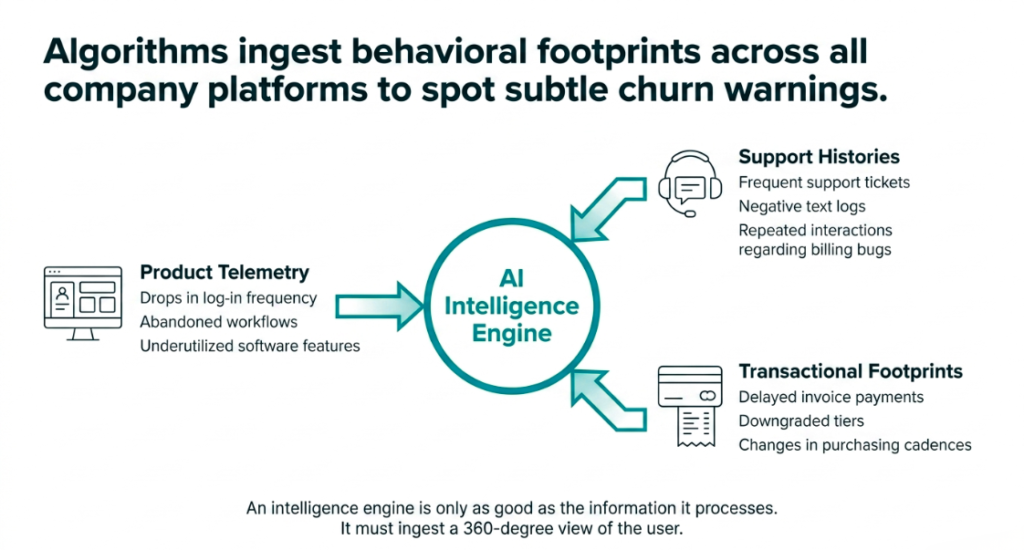
An intelligence engine is only as good as the information it processes. To spot subtle churn warnings, algorithms must ingest data from multiple company platforms:
- Product Telemetry: Drops in log-in frequency, abandoned workflows, or underutilized software features.
- Support Histories: Frequent support tickets, negative text logs, or repeated interactions regarding billing bugs.
- Transactional Footprints: Delayed invoice payments, downgraded tiers, or changes in historical purchasing cadences.
2. Behavioral Clustering and Intent Recognition
Instead of grouping your audience into broad demographic buckets like age or region, machine learning frameworks group accounts by live behavior. For example, a customer who logs in daily but experiences frequent software errors requires a completely different retention approach than an inactive user who hasn’t opened your application in a month.
3. Dynamic Automated Intervention
When an algorithm flags an account as high-risk, it immediately launches automated playbooks. The system can prompt an autonomous workflow to email a targeted feature tutorial, alert an account manager to call the client, or surface an exclusive discount directly inside the application interface.
| Analytical Focus | Legacy Retention Methods | AI-First Retention Analytics | Key Business Advantage |
| Risk Detection | Manual exit surveys after a client leaves | Automated, live behavioral tracking | Catches account frustration before cancellation occurs |
| User Segmentation | Broad demographic buckets | Real-time behavioral clusters | Delivers highly relevant outreach messages |
| Response Timelines | Delayed, manual support reviews | Instant, automated win-back playbooks | Mitigates account attrition risks instantly |
Core Operational Benefits of AI for Customer Retention
Deploying automated machine learning analytics across your data stack provides major competitive advantages for enterprise brands:
- Substantial Reduction in Churn: Algorithms spot early warning indicators weeks before a human analyst would, giving customer success managers plenty of time to save the account.
- Higher Customer Lifetime Value: Personalized product recommendations and well-timed upgrades encourage buyers to spend more over time, maximizing the revenue generated by each account.
- Lower Service Overheads: Automated diagnostics address routine user issues before they become support tickets, keeping your help desk free to focus on high-priority client challenges.
Enterprise data research by Enjo AI shows that personalized experiences driven by machine learning can lead to up to a 200 percent improvement in customer retention across loyalty and post-sale programs. Moving past generic communication methods makes customers feel valued, which naturally builds long-term brand loyalty.
Why Businesses Need Professional AI Services
Building an AI-powered retention platform requires more than software implementation.
Professional AI services include:
- AI strategy consulting
- Data engineering
- Machine learning model development
- Customer behavior analytics
- Predictive modeling
- Cloud deployment
- Integration with CRM platforms
- Ongoing optimization
Working with experienced AI services providers helps businesses deploy reliable retention systems faster while reducing implementation risks.
Business Benefits of AI-Powered Customer Retention
Organizations using intelligent customer retention analytics consistently achieve measurable improvements such as:
- Lower customer acquisition costs
- Higher repeat purchase rates
- Improved loyalty
- Better customer lifetime value
- Increased revenue
- Reduced churn
- Personalized engagement
- Smarter marketing campaigns
Summary:
Customer retention is no longer driven by guesswork. Businesses need intelligent, data-driven strategies to understand customer behavior, reduce churn, and build lasting relationships. With advanced customer retention analytics, Customer Retention Strategies with AI, Generative AI for Customer Retention, and expert AI services, organizations can deliver personalized experiences that drive loyalty and sustainable growth.
Ready to turn customer insights into long-term business success? Partner with Priorise to build smarter retention strategies that keep your customers engaged and your business growing.
FAQs
1. How do machine learning models predict customer churn before it actually happens?
Machine learning models track real-time behavioral data across your platforms, searching for patterns like drops in log-in frequency, high volumes of support tickets, or late payments. By comparing these signs to historical data from past cancellations, the system flags at-risk accounts weeks before they make a final decision.
2. What types of data sources are required to build a customer retention analytics engine?
A high-performance retention engine requires three main types of data: product telemetry data (usage rates and feature engagement), transactional data (billing logs and purchase histories), and engagement data (support chats, emails, and satisfaction surveys).
3. How does Generative AI improve customer retention compared to legacy approaches?
Legacy systems rely on rigid, pre-written templates that often alienate frustrated users. Generative models study an individual’s specific issue, analyze past support interactions, and instantly write highly personalized response messages that directly address the user’s current situation.
4. Can small businesses benefit from AI services for customer retention?
Yes, modern cloud infrastructures allow companies of any size to leverage predictive technology. Small businesses can connect pre-trained foundational architectures to their internal data hubs via secure APIs, gaining deep analytical insights without needing a massive engineering budget.
5. How do you measure the financial return of an AI-driven retention strategy?
You can measure performance by tracking core business metrics over time, including your overall Customer Retention Rate (CRR), Churn Rate, Customer Lifetime Value (CLV), and average support resolution times, comparing these figures against your historical baselines.