
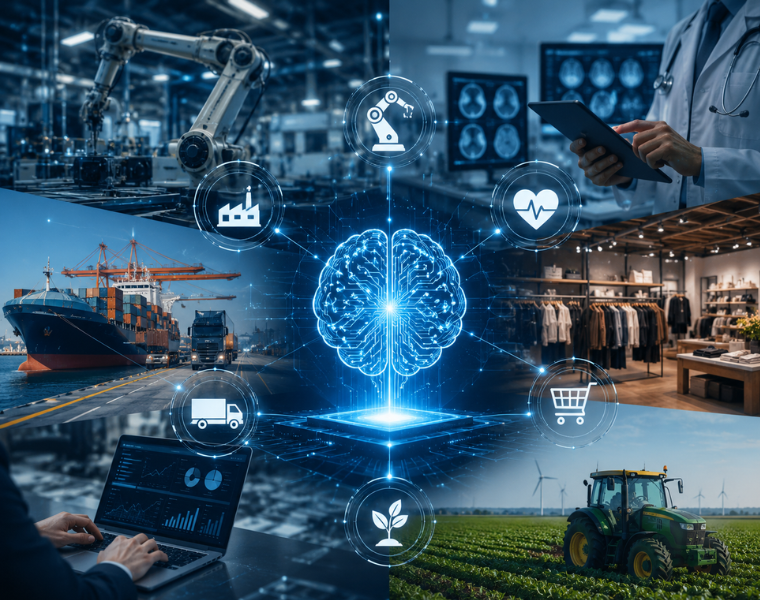
The modern business environment has shifted from asking if artificial intelligence should be used to figuring out how quickly it can be safely integrated into core operations. From startups launching innovative products to enterprises modernizing operations, AI App Development has become a strategic investment. According to recent market analysis published on Enterprise DNA, global investments in intelligent systems are projected to reach 2.59 trillion dollars this year. This historic surge reflects a major transition from basic experimentation to production-grade deployment.
However, moving a complex system from a loose conceptual idea to a hardened, compliant enterprise application is a challenging journey. Navigating this pipeline requires structured governance, robust engineering, and an experienced development partner. This tactical playbook explores how a progressive AI development company structures the product lifecycle, handles data complexities, and builds high-performance AI solutions that deliver clear financial returns.
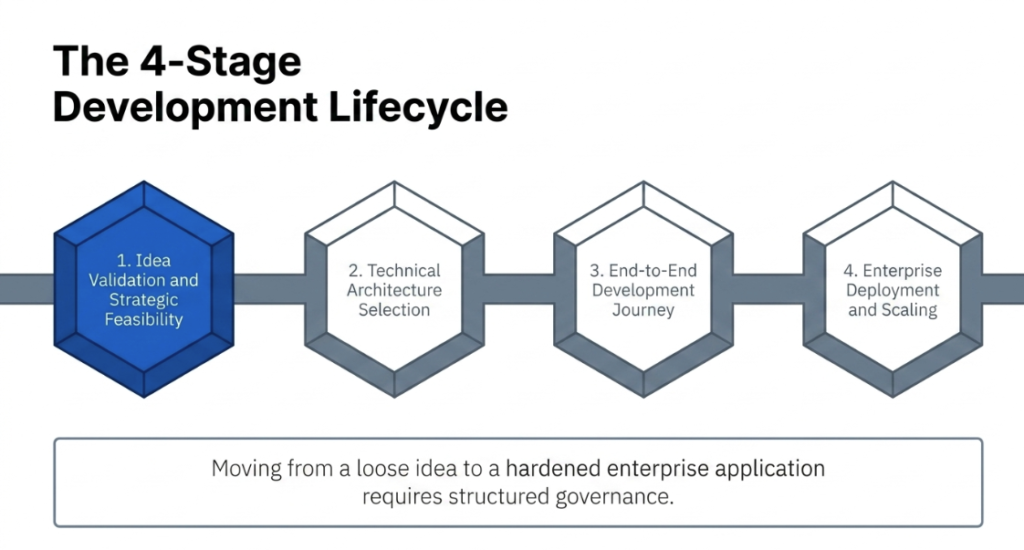
Stage 1: Idea Validation and Strategic Feasibility
Every successful software lifecycle begins with a basic question: does this feature actually solve a real business problem? Many projects stumble early on because they chase technology trends instead of addressing specific operational friction.
During the discovery phase, elite engineers run feasibility checks across three critical business dimensions:
- Value Alignment: Does automating this workflow directly save employee hours, lower risk, or open up new revenue streams?
- Technical Viability: Does the underlying data exist to support the required outputs? A model cannot predict asset failure or consumer churn without high-volume historical logs.
- Financial Reality: Will the projected productivity gains comfortably outweigh the ongoing processing, infrastructure, and inference costs?
Data insights shared by Seasia Infotech show that organizations integrating intelligent enterprise applications achieve an average 35 percent increase in operational efficiency alongside a 40 percent drop in manual processing costs. Validating these exact metrics early on protects your budget and helps you avoid empty tech experimentation.
Stage 2: Choosing Your Technical Architecture
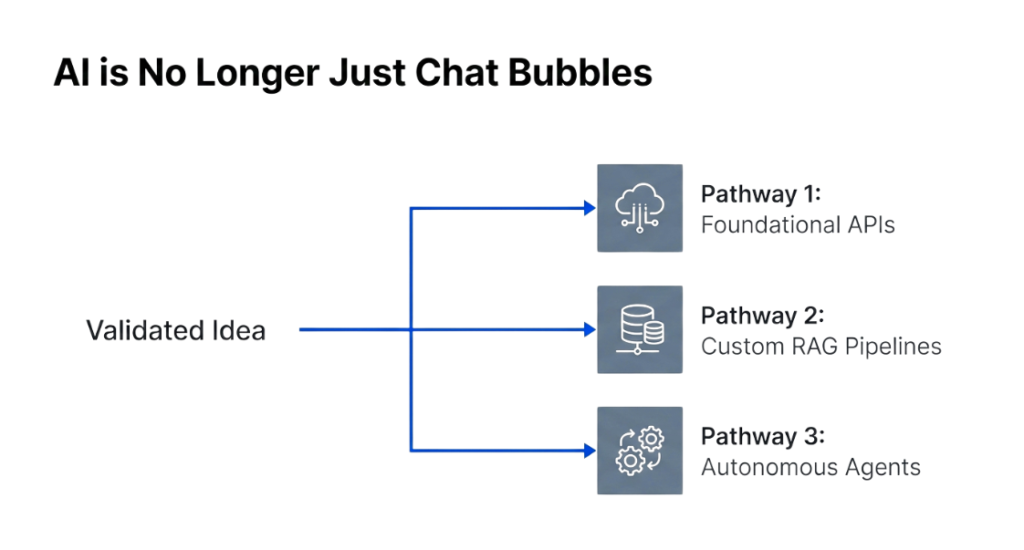
Once an idea is validated, your team must select the right software architecture. Modern AI App Development has moved past basic, text-only chat bubbles. Today, development pipelines focus on three distinct technical frameworks.
1. Ready-Made APIs vs. Custom Pipelines
For general language processing, sentiment classification, or basic data summaries, connecting to public foundational APIs like OpenAI, Gemini, or Claude is highly cost-effective. However, when your system must understand highly complex engineering blueprints, proprietary compliance rules, or specialized medical records, you need a dedicated partner to design tailored machine learning software.
Foundational API Path: [App Interface] ──> [Public API Endpoint] ──> [Generic Outputs]
Custom Pipeline Path: [App Interface] ──> [Secure Private Cloud] ──> [Proprietary Insights] └─ RAG + Vector DB ─┘
Foundational API Path: [App Interface] ──> [Public API Endpoint] ──> [Generic Outputs]
2. Retrieval-Augmented Generation (RAG)
RAG connects a secure language model to your company’s internal databases and private servers. When a user asks a question, the application pulls context directly from your secured internal documents before generating an answer. This keeps the output rooted in true corporate facts and eliminates the hallucination risks common to general models.
3. The Shift to Autonomous Agents
The modern technology frontier centers around autonomous workflows that complete multi-step tasks without needing constant human prompts. Research highlighted by Gartner indicates that 40 percent of enterprise applications will embed task-specific AI agents by the end of this year, up from less than 5 percent just a year ago. These advanced systems do not simply answer text queries; they actively run network security scans, update live database inventories, and route field service requests completely on their own.
| Development Architecture | Primary Functional Use Case | Main Strategic Advantage |
|---|---|---|
| Foundational APIs | Basic text editing, summaries, and customer chat | Low initial engineering costs and immediate deployment |
| RAG Pipelines | Querying internal knowledge hubs and policy sheets | Keeps answers completely accurate using internal facts |
| Autonomous Agents | Complex, multi-step actions across different systems | Runs operational workflows without human bottlenecks |
Stage 3: The End-to-End Development Journey
Building a reliable, production-ready system requires a structured, iterative framework. Skipping key steps or ignoring data quality usually leads to broken code, security vulnerabilities, or major cost overruns.
An experienced AI development company will guide your project through this step-by-step pipeline:
1.Data Cleaning and Curation:
Consolidate, scrub, and structure your internal data records. This involves deduplicating entries, standardizing document formats, and labeling key variables. High-quality data is the foundational fuel for any accurate system.
2.Setting Up Private Vector Databases:
Convert your unstructured records into mathematical vectors. Store these embeddings in optimized enterprise vector databases to enable instant, context-aware information retrieval.
3.Fine-Tuning and Model Adaptation:
Adapt your selected foundational architectures using your curated internal datasets. This step teaches the application your specific company terminology, historical logic, and internal workflows.
4.UI/UX Interface Engineering:
Build intuitive, human-centric application screens. Design conversational dashboards, simple feedback buttons, and clear data visualization panels that allow your team to work seamlessly alongside the technology.
5.Deploying Safety Guardrails:
Add automated evaluation layers, prompt filters, and hallucination checks. This prevents the application from processing toxic inputs or exporting unauthorized sensitive data.
Stage 4: Enterprise Deployment, Scaling, and Optimization
Launching an application across an entire enterprise requires much stricter security, latency, and compliance controls than standard consumer software.
A successful enterprise deployment relies on three main pillars:
- Robust Hybrid Infrastructure: Enterprise architectures use optimized cloud environments alongside on-device processing. Running smaller models directly on modern hardware chips reduces API costs, eliminates data transit lag, and enhances user privacy.
- Sturdy Security Auditing: Public systems often introduce dangerous data vulnerabilities. According to security updates on Gartner, roughly 25 percent of all enterprise generative applications are projected to face minor security issues annually if they lack proper governance. Protecting your systems requires strict data encryption, identity access management, and regular pen-testing.
- Continuous Performance Monitoring: Models naturally experience drift as real-world market data changes over time. Your engineering teams must track key metrics like query latency, API token usage, and user accuracy ratings to keep the software running optimally.
[User Request] ──> [API Gateway / Auth] ──> [Guardrail Layer] ──> [Enterprise Model]
│
[User Interface] <── [Audit Logging] <── [Output Validation] <─────────────┘
To navigate these engineering hurdles smoothly, forward-thinking enterprises partner with specialized tech teams like Priorise. By aligning advanced AI development services with clear business goals, Priorise helps companies transform unorganized internal records into secure, high-performance automated software.
Conclusion
The journey from an AI idea to an enterprise-ready application requires careful planning, quality data, robust engineering, and continuous improvement. Organizations that follow a structured AI App Development approach are better positioned to create intelligent products that deliver measurable business value.
From idea validation and custom AI development to enterprise deployment, AI software development, intelligent AI agents, and scalable AI solutions, every stage contributes to long-term success.
If your business is ready to build secure, scalable, and intelligent AI applications, Priorise is your trusted AI development company. Our experienced team delivers end-to-end AI development services that help organizations innovate faster, improve efficiency, and stay ahead in an increasingly AI-driven world.
FAQs
1. What are the primary stages of the enterprise AI app development lifecycle?
The deployment process follows five core phases: idea validation and feasibility checking, data cleaning and structuring, choosing the right technical architecture, UI/UX in
2. How do modern AI agents differ from traditional software assistants?
Standard software assistants require clear, step-by-step human inputs and can only handle single, simple tasks. By contrast, autonomous agents break down broad goals, use external APIs independently, and complete complex multi-step workflows without needing constant human intervention.
3. How does a custom AI development approach protect sensitive corporate data?
Bespoke applications are built inside your company’s private cloud infrastructure. This isolated environment ensures that your proprietary data, customer records, and intellectual property are never leaked or used to train public commercial models.
4. What is the average timeline to build and launch an enterprise AI solution?
A standard enterprise integration typically takes between 6 and 12 weeks. This timeline depends on the quality of your internal data, the complexity of the workflow, and the depth of integration required for your legacy business tools.
5. Why do many enterprise AI software development projects fail before deployment?
Most projects fail because of poor data prep, lack of clear business goals, or missing security guardrails. Partnering with an experienced team ensures that your system stays accurate, secure, and fully aligned with your financial objectives.