
Selecting the right AI consulting partner comes down to evaluating three core areas: data and technical readiness, in-house data science expertise, and governance and security standards. The real differentiator is a partner who assesses your data foundation first and can prove measurable outcomes, not just deliver another tool nobody trusts.
A logistics company once spent nearly a year building an in-house AI forecasting tool. The team was talented, the intentions were good, and the budget was real. But by the time the model was ready, the market had shifted, the underlying data had changed, and the tool was already out of date. Nobody outside the tech team understood how it worked, so it quietly gathered dust.
Stories like this happen because businesses often try to solve AI problems alone, or they pick the wrong AI consulting partner for the job. This guide walks through how to choose AI consulting services that actually deliver results, backed by real numbers on adoption, cost, and outcomes.
Why This Decision Carries So Much Weight
AI adoption has moved from experimental to mainstream in a very short time, which makes the choice of partner more important, not less.
- 88% of organizations now regularly use AI in at least one business function, according to McKinsey’s State of AI research cited by 200 OK Solutions. Most businesses have moved past the question of whether to use AI at all. Budgets are being approved, tools are being purchased, and leadership is under pressure to show results quickly. That pressure is exactly what leads companies to skip the groundwork and jump straight into building something.
The uncomfortable truth is that adoption and success are two different things. Plenty of businesses have rolled out AI tools that never quite deliver on their promise, usually because the underlying data was not ready, the use case was unclear, or the project was handed to a team without the right mix of technical and business expertise. Choosing an AI consulting partner who can turn adoption into actual results, rather than just another tool nobody fully trusts, is where most businesses struggle.
What Good AI Consulting Services Actually Cover
Many business owners picture AI services as simply building a chatbot or a model. In reality, strong AI consulting services usually span a much wider set of work, including:
- Assessing whether your current data can even support AI use cases
- Building and integrating machine learning models into daily workflows
- Setting up scalable AI infrastructure in the cloud, so systems can scale without constant rework
- Providing data services such as predictive modeling and forecasting
- Training internal teams to maintain and improve AI systems after launch
- Establishing governance so AI outputs remain accurate and auditable
When AI services only cover the flashy parts and skip the unglamorous groundwork, projects tend to fail quietly, the same way that logistics company’s forecasting tool did.
The Role of Data Science Services in AI Success
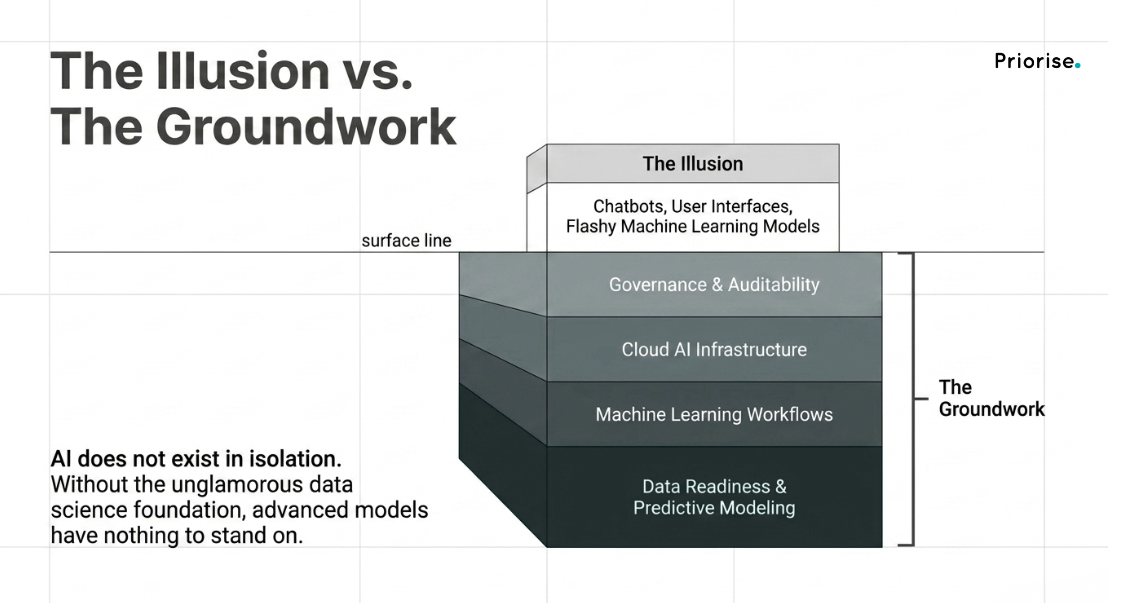
AI does not exist in isolation. It sits on top of data science services such as data cleaning, statistical modeling, and pattern analysis. Without this foundation, even the most advanced AI tool has nothing solid to stand on.
The scale of this discipline is growing fast:
That talent gap is a major reason business look outside their own walls for data services rather than trying to hire a full team from scratch. A capable AI consulting partner should already have this expertise in place, rather than needing to build it during your project.
7 Questions to Ask Before Choosing Your AI Consulting Partner
Use these questions to evaluate any AI consulting partner before signing a contract:
1. Do you assess data readiness before building anything?
A trustworthy AI consulting partner checks your data foundation first, rather than jumping straight to a flashy demo.
2. What data science services do you provide in-house?
Ask whether modeling, statistics, and data engineering are handled internally or outsourced further, which can add delays and cost.
3. Which cloud AI services do you recommend, and why?
The answer should be tied to your specific workload and budget, not a one-size-fits-all recommendation.
4. Can you show measurable results from past projects?
Companies report a 3.7x average return for every dollar invested in generative AI when projects are properly scoped, according to Netguru’s 2026 AI research. Ask for proof your prospective partner can hit similar numbers.
5. How do you handle governance and compliance?
This matters even more as AI service adoption accelerates across regulated industries like finance and healthcare.
6. What happens after launch?
AI models drift and need maintenance. A good AI consulting partner offers ongoing support, not a one-time handoff.
7. How do you price your AI consulting services?
Understand whether pricing is tied to outcomes, hours, or a fixed project scope, so there are no surprises later.
Common Mistakes When Choosing an AI Consulting Partner
Even well-meaning businesses fall into a few predictable traps:
- Picking a partner based on price alone instead of technical depth
- Assuming all an implementation partner cover data services and cloud AI services equally well
- Ignoring data quality issues and jumping straight into model building
- Failing to plan for what happens after the initial project ends
- Underestimating how fast AI adoption is moving inside their own industry
Avoiding these mistakes early can save months of wasted budget and a project nobody trusts by the time it launches.
How Priorise Approaches AI Consulting Differently
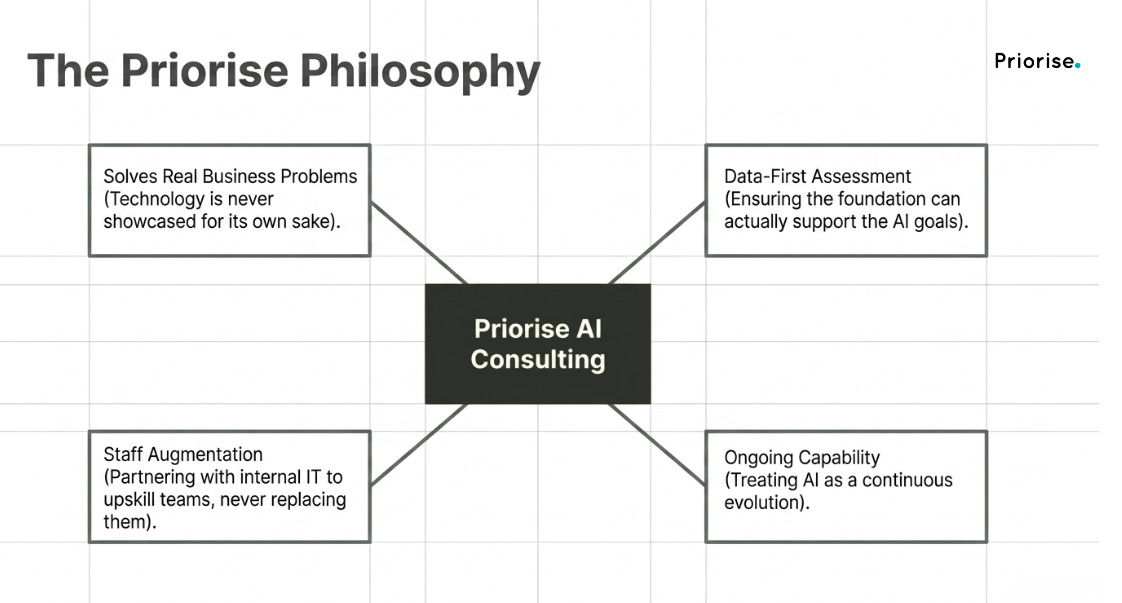
Priorise was built around one core belief: AI consulting services should solve real business problems, not showcase technology for its own sake. As an AI consulting partner, Priorise typically starts every engagement with a data and infrastructure assessment before any model gets built.
A typical Priorise engagement includes:
- A clear evaluation of whether your data can actually support your AI goals
- Access to dedicated data services for modeling, forecasting, and analysis
- Guidance on which cloud AI services fit your budget and workload
- Ongoing support so results keep improving well after launch, not just on day one
This approach reflects how fast AI adoption is reshaping entire industries, and why businesses need a partner that treats AI as an ongoing capability rather than a single deliverable.
Choosing an AI Partner for Long-Term Business Impact
Choosing the right AI consulting partner is one of the most consequential technology decisions a modern business will make. With AI adoption now touching nearly every industry, and with data services and AI services forming the backbone of every successful project, the stakes of getting this choice wrong keep climbing.
If your business is ready to move past pilots and failed experiments, Partner with Priorise today to unlock your business’s true potential.
Frequently Asked Questions
How do I know if my company is ready to hire an AI consultant?
If you have identified clear bottlenecks but lack the technical expertise to solve them, you are ready. Priorise can help you assess your current environment and build the necessary AI-ready data foundations to ensure you are prepared for success.
What is the difference between general data consulting and AI consulting services?
Data consulting focuses on organizing and storing information for reporting, while AI consulting services leverage that data to build predictive models and automated systems that drive future-oriented business decisions.
Will hiring an AI consultant replace my internal IT team?
No. A consultant acts as a partner to augment your current staff, fill knowledge gaps, and upskill your team. They ensure your people can fully manage the new technology long-term.
How long does it take to see an ROI on AI initiatives?
By focusing on high-impact, short-term projects, many businesses see measurable improvements in efficiency within 3 to 6 months. Priorise prioritizes these “quick wins” to demonstrate value early in the engagement.
What is the biggest mistake companies make with generative AI consulting?
The biggest error is ignoring data security. Engaging in generative AI consulting without a strict governance framework can expose proprietary data. A qualified partner ensures all solutions comply with your privacy and security policies from day one.

Related Posts

Should You Hire an AI Consultant? 7 Questions to Ask
Hiring an AI consultant is worth it when your data isn’t AI-ready, goals feel undefined, or past…
AI Readiness Checklist: Is Your Business Ready for AI?
Determining whether a business is ready for AI involves examining key readiness pillars: data quality and…

Using AI and Machine Learning for Customer Retention Analytics
Acquiring a new customer is an expensive endeavor. According to recent software performance metrics published by Searchlab, average…

AI App Development: From Idea Validation to Enterprise Deployment
The modern business environment has shifted from asking if artificial intelligence should be used to…