

Hiring an AI consultant is worth it when your data isn’t AI-ready, goals feel undefined, or past pilots haven’t scaled. Key questions to ask to cover their generative AI track record, measurable results, security and governance practices, and post-rollout support, so you choose outcomes over hype.
Artificial intelligence isn’t just for companies with nine-figure tech budgets anymore. Businesses of every size are experimenting with it, better customer service, leaner operations, less manual grunt work, faster calls made with better information. The excitement is real. So is the fact that most of these projects never make it past the pilot stage.
In 2026, the global AI market is valued at over $390 billion, and while 78% of organizations have begun using AI, many remain trapped in “pilot purgatory”, unable to translate experiments into real bottom-line impact.
If your team is stuck scaling an AI project or just feels like the pace of change is outrunning your ability to keep up, that’s usually the point where outside expertise starts to make sense. Before you commit to anyone, though, here are seven questions worth asking before you hire an AI consultant.
Why This Question Matters Right Now
many organizations are moving ahead with AI before they have the expertise and infrastructure needed to scale it successfully. This is where a skilled business AI consultant can help identify gaps, prioritize practical use cases, and create a clear path from experimentation to implementation.
Before making that decision, ask these seven questions.
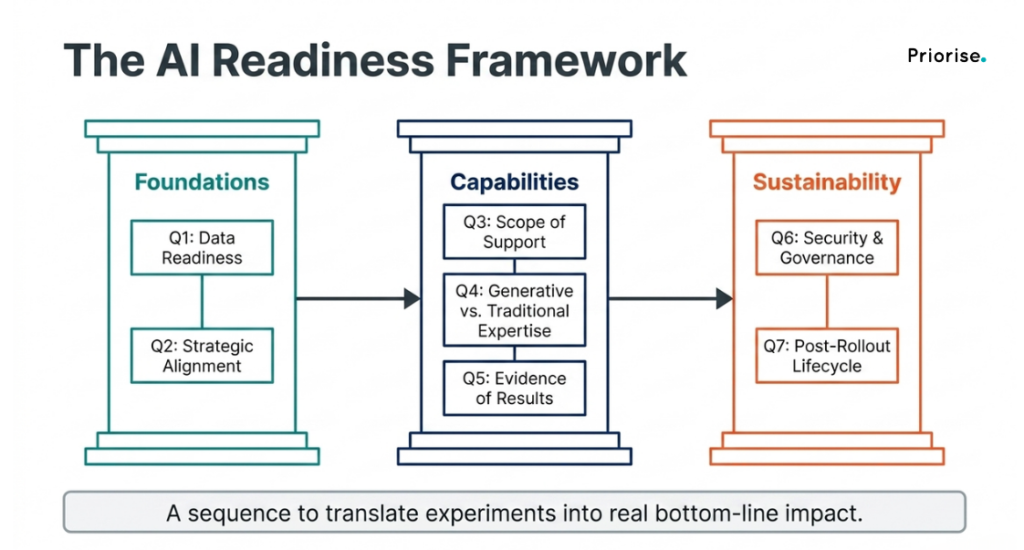
Question 1: Is Our Data Actually Ready for AI?
One common misconception is that AI will clean up messy data on its own. It won’t. AI learns from whatever it’s fed. Duplicate customer records, gaps in operational data, reporting standards that differ from one department to the next, AI doesn’t fix any of that. It just repeats the same problems at a bigger scale.
Before spending a rupee on AI, it’s worth taking an honest look at whether your organization has AI-ready data in the first place.
A few warning signs to watch for:
- Duplicate customer records scattered across different systems
- Missing or inconsistent information
- Reporting that still runs through manual spreadsheets
- Teams pulling from conflicting numbers
- No one clearly owning the data
Companies that deal with these issues before an AI rollout tend to see smoother implementations and results they can actually trust.
Question 2: Are We Solving a Real Problem, or Just Chasing a Trend?
A lot of organizations start with the technology instead of the business need. A chatbot sounds impressive on paper, but does it actually bring support costs down? Predictive analytics has a nice ring to it, but does it genuinely sharpen your forecasts? Generative AI can churn out content fast, but does it actually address a problem you had?
Before you hire an AI consultant, get specific about the outcome you’re after. That might be:
- Cutting customer response times
- Improving sales forecasts
- Automating the repetitive admin work nobody wants to do
- Catching operational risks earlier
- Boosting employee productivity
A consultant worth their fee will push back on assumptions, help you prioritize, and point you toward projects with a real return, not just whatever’s newest.
Question 3: What Kind of Support Do We Actually Need?
Not every business needs the same thing from a consultant. Some need help mapping out strategy. Others need hands-on implementation or ongoing governance once something’s already live.
Typical AI consulting services cover the following:
- AI readiness assessments
- Data strategy and governance
- Workflow automation
- Machine learning implementation
- Integration with the systems you’re already running
- Employee training and change management
Rather than buying the full package because it’s on offer, focus on the pieces that actually map to your goals. Keeping the scope tight tends to keep both the budget and the project manageable.
Question 4: Do They Actually Have Generative AI Experience?
Generative AI has changed how businesses write, summarize, code, and support employees day to day. But doing it responsibly takes a different skill set than traditional analytics work.
Generative AI consulting brings its own set of considerations:
- Prompt engineering
- Model evaluation
- Managing hallucinations
- Responsible AI practices
- Data privacy
- Governance policy
Worth asking directly:
- Have they actually shipped generative AI projects before?
- How do they check whether a model’s outputs are accurate?
- What governance framework do they recommend?
- How do they keep your confidential data confidential?
A consultant who cannot clearly answer these questions may lack the experience needed for enterprise AI adoption. The generative AI market is valued at roughly 67 billion dollars in 2026 and is projected to reach 1.3 trillion dollars by 2032, according to Bloomberg Intelligence data.
Question 5: Can They Show Results, Not Just Promises?
Every consultant can promise innovation, but successful AI projects deliver business outcomes rather than technical achievements. Before you hire an AI consultant, ask for case studies that demonstrate tangible improvements, such as reduced operating costs, faster decision-making, increased productivity, or improved customer satisfaction.
Don’t stop at the polished slide deck. Push on the details:
- What problem was the client actually dealing with?
- How was success measured?
- How long did implementation take?
- Did the gains stick around after launch, or fade?
IDC and Microsoft research found generative AI projects return an average of $3.70 for every dollar invested when the scope is set up properly. Future Market Insights has also tracked cases where AI-driven automation pushed operational efficiency up by 40%.
A consultant who’s actually good at this can walk you through how past projects created measurable value, not just recite a list of technical skills.
Question 6: How Do They Handle Security and Governance?
AI projects tend to touch sensitive material, customer records, financial data, employee information, proprietary business knowledge. Without solid governance in place, that opens the door to compliance issues, privacy risks, and reputational damage.
Before signing on, get clarity on how a consultant approaches:
- Data access controls
- Regulatory compliance
- AI governance frameworks
- Model monitoring
- Responsible AI practices
- Security testing
This matters even more if you’re in healthcare, finance, or legal services. Good governance isn’t about slowing things down — it’s what lets you scale AI with confidence instead of crossing your fingers.
Question 7: What Happens After the Rollout?
Launching an AI tool isn’t the finish line. Business priorities shift, customer behavior changes, new data keeps flowing in, and without ongoing monitoring, AI performance quietly degrades over time.
Before you hire an AI consultant, get clear answers on what happens after go-live:
- Will the models actually be monitored?
- How often are performance reviews done?
- Who’s responsible for updating prompts or workflows?
- What support exists if your needs change?
- Is training for your team included?
Long-term success comes from ongoing improvement, not a one-and-done implementation. The best consulting relationships end up building your internal capability, not just delivering a finished product and walking away.
How Priorise Helps Businesses Get Past the Pilot Stage
Plenty of organizations know AI could help them, the hard part is knowing where to start. Instead of leading with technology, Priorise starts by looking at business readiness, existing processes, and where you’re actually trying to go.
Our approach centers on:
- Checking whether your existing data can actually support AI before touching implementation
- Identifying practical AI opportunities with a clear, measurable payoff
- Delivering AI consulting services built around your specific goals
- Supporting implementation and ongoing optimization, not just the launch
That structure keeps project risk low and gets you to real value faster.
Know What You Need Before You Hire an AI Consultant
AI is changing how organizations operate, but doing it well takes more than picking the newest tool on the market. Before you hire an AI consultant, take the time to look honestly at your data, get specific about your business goals, understand what governance you’ll need, and choose a partner who cares more about outcomes than technical flash.
Companies that slow down enough to plan properly tend to come out ahead of the ones that rush straight into implementation.
If your organization is ready to move past experimentation and build something that actually shows up in the numbers, Priorise brings together strategic planning, implementation expertise, and ongoing support to help you get there.
Frequently Asked Questions
How do I know when it’s the right time to hire an AI consultant?
What do AI consulting services typically include?
What’s the difference between traditional analytics and generative AI?
How long does it take to see measurable AI results?
Why does governance matter for AI projects?

Related Posts
AI Consulting Services: How to Select the Right Partner
Selecting the right AI consulting partner comes down to evaluating three core areas: data and…
AI Readiness Checklist: Is Your Business Ready for AI?
Determining whether a business is ready for AI involves examining key readiness pillars: data quality and…

Using AI and Machine Learning for Customer Retention Analytics
Acquiring a new customer is an expensive endeavor. According to recent software performance metrics published by Searchlab, average…

AI App Development: From Idea Validation to Enterprise Deployment
The modern business environment has shifted from asking if artificial intelligence should be used to…