
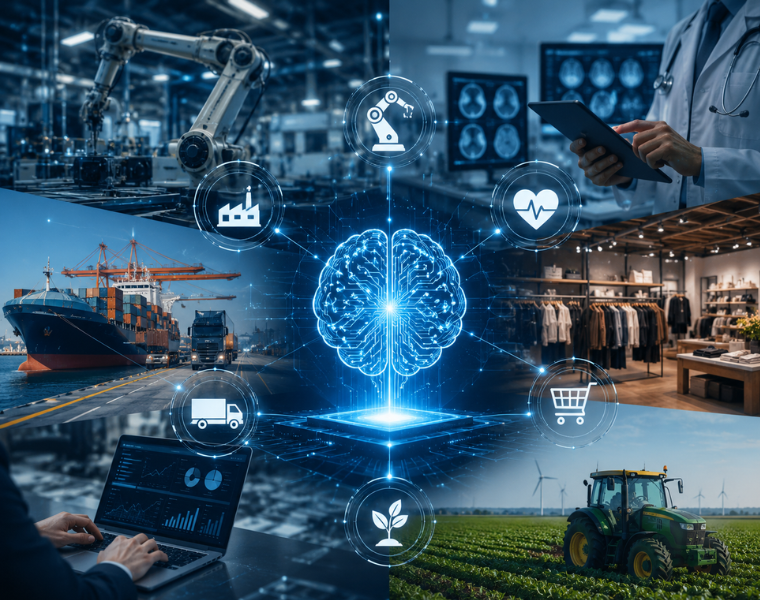
Artificial intelligence is no longer a future technology. It has become an essential part of modern business operations. However, many organizations quickly realize that generic AI tools often fail to address their unique business needs. Every industry has different workflows, regulations, customer expectations, and operational challenges. This is where Custom AI Models make a significant difference.
Imagine a healthcare provider trying to improve patient diagnosis, a retailer forecasting seasonal demand, or a manufacturing company reducing equipment downtime. While each organization wants to use AI, they all face completely different problems. A one size fits all AI platform cannot deliver the same level of accuracy and efficiency across these industries.
Businesses today require custom AI solutions that understand their data, business logic, and industry requirements. Through custom AI model development, organizations can build intelligent systems that deliver measurable business value rather than generic recommendations.
At Priorise, we help businesses unlock the true potential of AI by delivering tailored AI and ML services that solve real business problems with precision.
Why Generic AI Models Are Not Enough
Most pre trained AI models are built using publicly available datasets. While they perform well for common tasks, they often struggle with industry specific terminology, specialized workflows, and proprietary business processes.
For example:
- A banking institution needs fraud detection models trained on financial transaction patterns.
- A healthcare organization requires diagnostic models that understand medical records.
- A logistics company needs route optimization based on real time operational data.
- An insurance company requires risk assessment models based on policy history.
These challenges cannot be solved effectively using generic AI models.
This is why organizations increasingly invest in Custom AI Models designed specifically for their business environment.
What Are Custom AI Models?
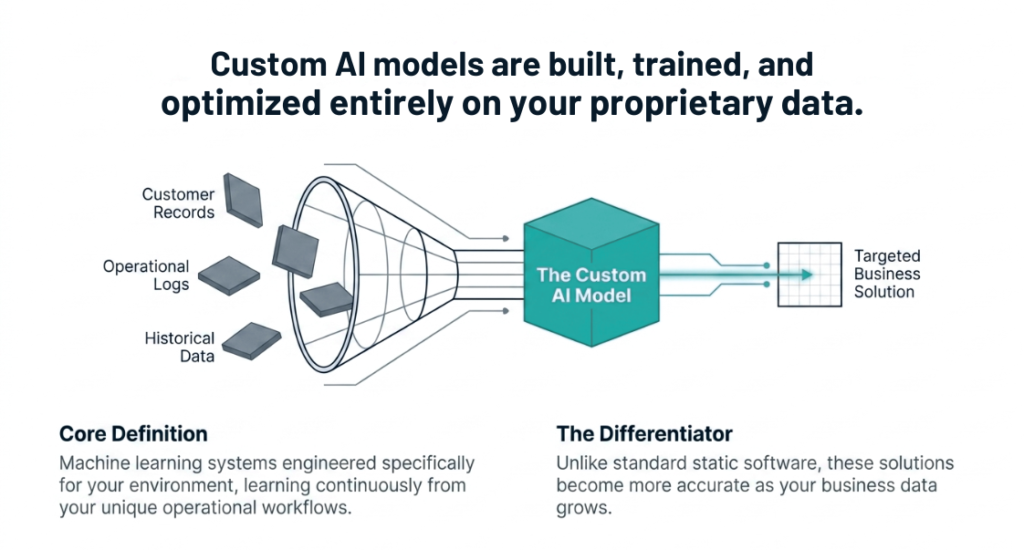
Custom AI Models are machine learning systems built and trained using an organization’s own business data. Instead of relying only on general datasets, these models learn from company specific information, customer interactions, historical records, and operational workflows.
Unlike standard software, custom AI solutions continuously improve as more business data becomes available.
Through professional custom AI model development, businesses create intelligent systems that become more accurate over time while adapting to changing business conditions.
Why Businesses Are Choosing Custom AI Solutions
Modern organizations are adopting custom AI solutions because they offer measurable advantages over off the shelf AI products.
Some key benefits include:
- Higher prediction accuracy
- Better data privacy
- Industry specific intelligence
- Improved customer experiences
- Faster decision making
- Lower operational costs
- Greater competitive advantage
With reliable AI and ML services, companies can deploy AI systems that align perfectly with their business goals.
How Custom AI Models Solve Industry Specific Challenges
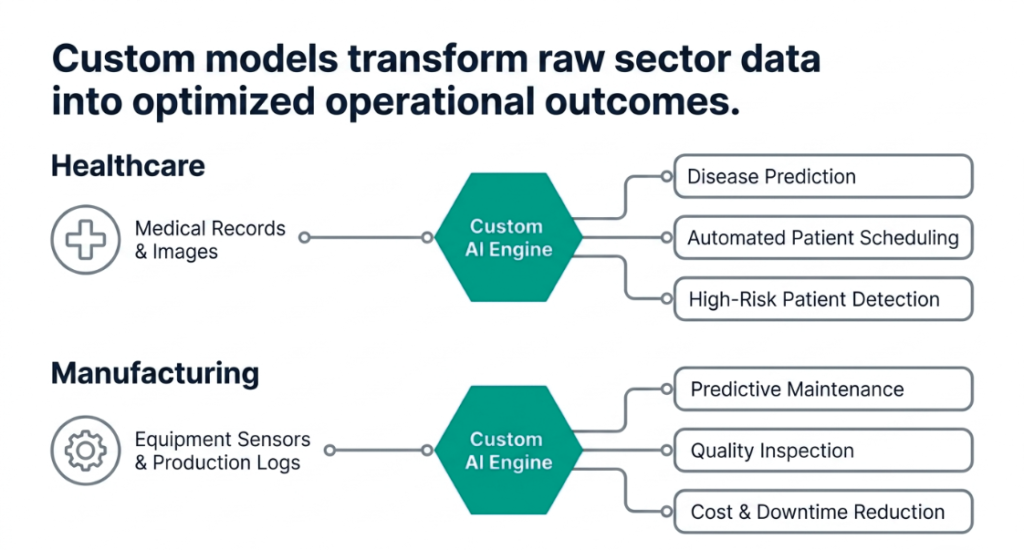
Healthcare
Healthcare organizations generate enormous amounts of patient data every day.
Using Custom AI Models, hospitals can:
- Improve disease prediction
- Analyze medical images
- Automate patient scheduling
- Detect high risk patients earlier
- Optimize resource allocation
Healthcare providers using specialized AI models achieve significantly higher diagnostic accuracy than general purpose systems because the models understand medical terminology and clinical workflows.
Manufacturing
Manufacturers constantly work to reduce downtime and improve production quality.
With custom AI solutions, manufacturers can:
- Predict machine failures
- Improve quality inspections
- Monitor production lines
- Reduce maintenance costs
- Optimize inventory planning
Advanced custom AI model development enables factories to identify equipment failures before they occur, reducing expensive production interruptions.
Retail and Ecommerce
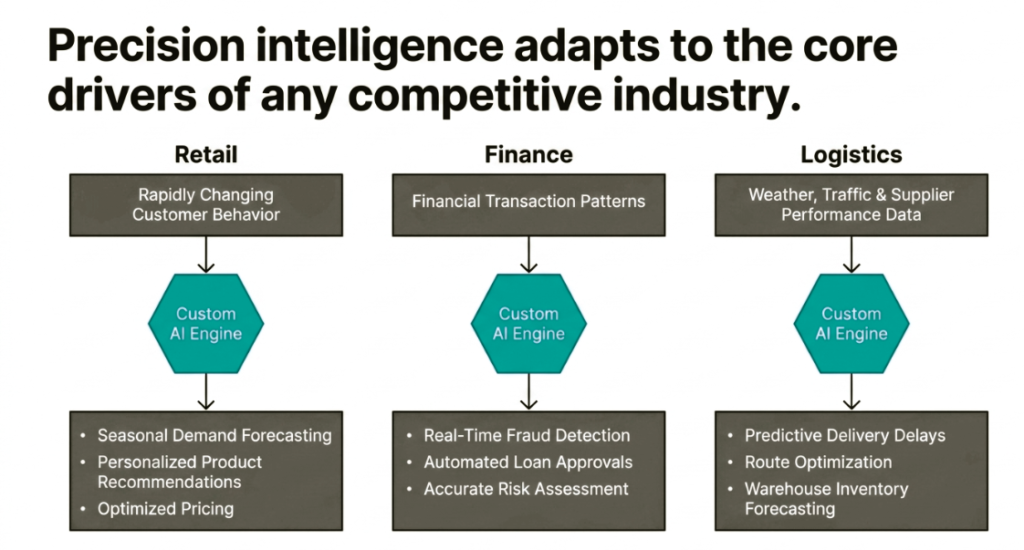
Retail businesses operate in highly competitive markets where customer behavior changes rapidly.
Custom AI Models help retailers:
- Predict customer demand
- Recommend personalized products
- Optimize pricing
- Improve inventory management
- Detect fraudulent transactions
Through tailored AI solution strategies, retailers improve customer satisfaction while increasing sales and reducing waste.
Financial Services
Banks and financial institutions rely on accurate risk analysis.
Using Custom AI Models, financial organizations can:
- Detect fraud in real time
- Automate loan approvals
- Assess financial risk
- Improve customer support
- Strengthen compliance monitoring
Professional expert AI services ensure these systems remain secure, explainable, and compliant with industry regulations.
Logistics and Supply Chain
Supply chain disruptions can significantly impact profitability.
Businesses use custom AI solutions to:
- Predict delivery delays
- Optimize delivery routes
- Forecast inventory demand
- Improve warehouse operations
- Reduce transportation costs
Modern AI models analyze weather, traffic, supplier performance, and customer demand simultaneously to improve operational efficiency.
Step-by-Step: The Custom AI Model Development Journey
Building a high-performing system requires a structured, iterative framework. Misordering these phases often results in broken code, bloated development costs, or models that fail to address the core problem.
Successful enterprise deployments typically follow this strategic path:
Phase 1: Define the Operational Bottleneck:
Identify the specific high-friction business problem. Focus closely on a high-value process that relies on repetitive, data-heavy decisions, such as processing insurance claims or triaging incoming support tickets.
Phase 2: Consolidate and Curate Proprietary Data:
Gather, clean, and structure your internal data assets. This includes scrubbed transaction records, historical customer interactions, or operational logs. High-quality data is the foundational fuel for any accurate model.
Phase 3: Select the Base Model Architecture:
Choose an efficient open-source base framework or a specialized foundational model. This eliminates the massive expense of training an entire system completely from scratch.
Phase 4: Fine-Tune and Train the System:
Expose the base architecture to your curated, private datasets. This process teaches the system your company terminology, internal policies, and unique operational logic.
Phase 5: Establish Sturdy Safety Guardrails:
Deploy content filters, validation checking layers, and strict data privacy boundaries. This ensures the output remains completely secure, reliable, and compliant with all local industry regulations.
Phase 6: Deploy and Continually Monitor Performance:
Integrate the tailored system directly into your existing enterprise software environment. Track key performance indicators continuously to fine-tune accuracy and prevent software drift over time.
Strategic Success Metrics: Measuring Your Return on AI Investment
An enterprise technology integration must always justify its budget through clear financial metrics. Custom machine learning architectures generally prove their value across three distinct key performance areas:
The Productivity Metric: Vention Teams research shows that enterprises deploying specialized operational models routinely lower their administrative and operational costs by 5 percent or more, while driving substantial revenue growth.
- Drastic Processing Speedups: Calculate the time required to complete high-volume tasks before and after deployment. For instance, reducing contract review cycles from days to minutes saves substantial manual labor.
- Direct Error Reduction: Track the reduction of processing mistakes, regulatory issues, and manufacturing defects compared to your previous human-only or legacy software baselines.
- Accelerated Employee Output: Monitor how effectively your staff handles complex tasks when augmented by targeted systems. Custom tools should act as a force multiplier, free from the distractions of generic platforms.
Summary:
Artificial intelligence delivers the greatest business value when it is built around your organization’s unique challenges. Generic software can automate basic tasks, but it cannot fully understand your industry, customers, or business processes.
By investing in Custom AI Models, businesses gain intelligent systems that improve efficiency, enhance customer experiences, reduce operational costs, and support smarter decision making. Through professional custom AI solutions, strategic custom AI model development, reliable AI solution implementation, comprehensive AI and ML services, and trusted expert AI services, organizations position themselves for sustainable long term growth.
Contact Priorise today to discover how our customized AI expertise can transform your operations, accelerate innovation, and deliver measurable business results.
FAQs
1. What are Custom AI Models?
Custom AI Models are AI systems trained using an organization’s own data to solve industry specific business problems with greater accuracy than generic AI models.
2. Why are custom AI solutions better than generic AI tools?
Custom AI solutions are designed around unique business workflows, making them more accurate, scalable, secure, and effective for industry specific use cases.
3. What industries benefit most from custom AI model development?
Healthcare, finance, manufacturing, retail, logistics, insurance, education, and telecommunications benefit significantly from custom AI model development.
4. What is included in AI and ML services?
AI and ML services typically include AI consulting, data preparation, model development, deployment, monitoring, optimization, and ongoing support.
5. Why should businesses work with expert AI services providers?
Expert AI services help organizations reduce implementation risks, improve model performance, ensure compliance, and maximize return on AI investments.

-
Previous Post
How Data Science Powers Revenue Growth Management
Related Posts
AI Consulting Services: How to Select the Right Partner
Selecting the right AI consulting partner comes down to evaluating three core areas: data and…

Should You Hire an AI Consultant? 7 Questions to Ask
Hiring an AI consultant is worth it when your data isn’t AI-ready, goals feel undefined, or past…
AI Readiness Checklist: Is Your Business Ready for AI?
Determining whether a business is ready for AI involves examining key readiness pillars: data quality and…
Using AI and Machine Learning for Customer Retention Analytics
Acquiring a new customer is an expensive endeavor. According to recent software performance metrics published by Searchlab, average…