Artificial Intelligence has matured far beyond simple task automation. What began as workflow scripting and robotic process automation has evolved into something far more consequential. AI now has the capacity to reshape how businesses design, absorb, and optimize costs at a structural level.
Many organizations still approach AI as a tool for incremental efficiency. They deploy chatbots to reduce call volumes or automate invoice processing to save labor hours. While these initiatives create value, they rarely transform the underlying cost architecture of the business. True impact occurs when AI changes how decisions are made, how volatility is managed, and how resources are allocated. This is the transformation Priorise enables through strategic AI consulting services designed to reengineer cost structures, not just automate tasks.
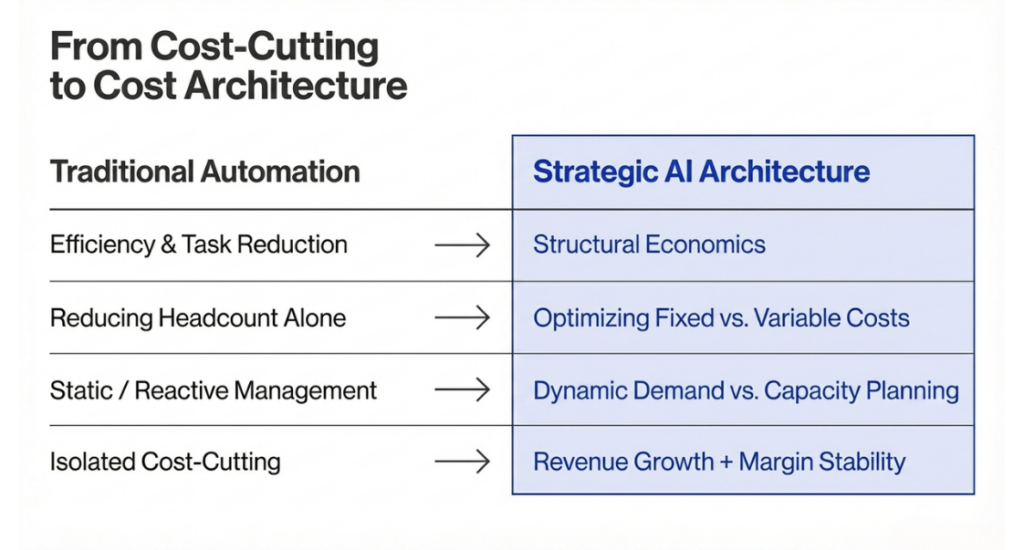
From Cost-Cutting to Cost Architecture Redesign
Traditional automation focuses on efficiency. AI focuses on structural economics. Instead of reducing headcount alone, AI modifies the relationship between:
- Fixed and variable costs
- Capital expenditure and operational expenditure
- Demand volatility and capacity planning
- Revenue growth and margin stability
For example:
- Predictive maintenance reduces downtime costs by forecasting failure patterns before breakdown occurs.
- AI-driven demand forecasting lowers inventory carrying costs by aligning supply with real-time market signals.
- Intelligent workforce planning tools dynamically optimize labor allocation based on volume forecasts.
The result is greater cost predictability. Predictable costs improve financial modeling accuracy. Accurate modeling strengthens strategic decision-making. Organizations that leverage structured AI consulting services approach AI implementation as a financial transformation initiative, not an isolated IT upgrade.
AI as a Margin Expansion Engine
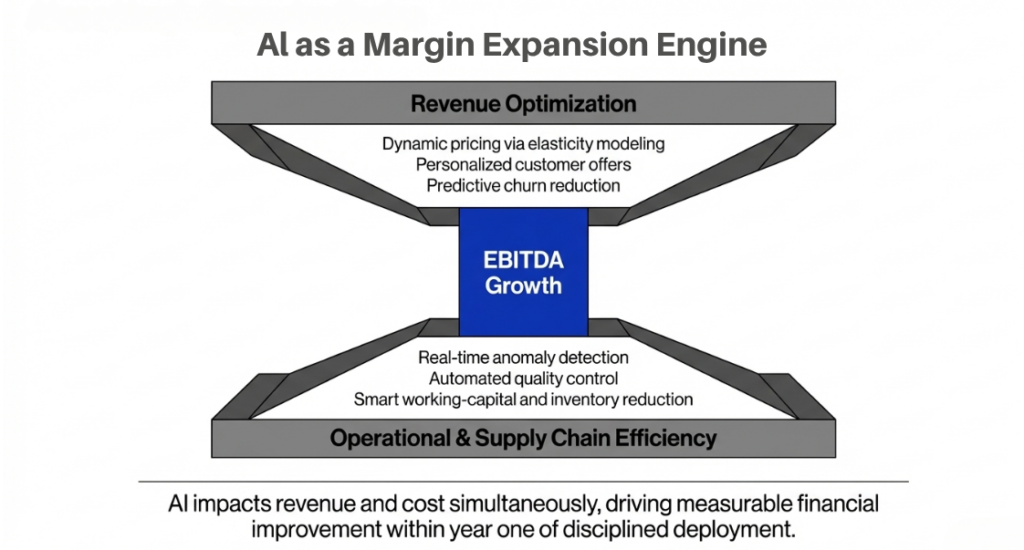
AI does more than reduce expenses. It expands the margin. Consider how AI impacts revenue and cost simultaneously:
Revenue Optimization
- Dynamic pricing based on elasticity modeling
- Personalized offers that increase customer lifetime value
- Predictive churn modeling that reduces customer acquisition cost
Operational Efficiency
- Real-time anomaly detection to reduce fraud and revenue leakage
- Process orchestration that eliminates redundant workflows
- Automated quality control that reduces rework and warranty expenses
Supply Chain Intelligence
- Lower excess inventory and reduced working capital strain
- Smarter vendor negotiation through predictive procurement analytics
These gains directly influence EBITDA. Companies adopting mature AI consulting services frequently report measurable financial improvement within the first year of disciplined deployment.
Infrastructure and Capital Optimization
Cloud transformation created scalability, but it also introduced cost sprawl. Many enterprises overprovision resources and underestimate long-term infrastructure costs. AI-driven optimization tools continuously analyze:
- Compute utilization rates
- Storage redundancy
- Network inefficiencies
- Idle infrastructure assets
This enables:
- Reduction in unnecessary capital expenditure
- Real-time cloud spend control
- Smarter capital allocation across projects
AI-supported financial intelligence turns cost centers into data-driven decision engines.
Implementing AI Consulting Services for Maximum Cost Reduction
Structural transformation requires disciplined execution. Organizations that succeed treat AI implementation as an enterprise redesign initiative rather than a standalone IT deployment.
1. Start With a Friction Audit
Identify processes that are high volume, error-prone, and time-intensive. Quantify labor hours, rework costs, and downstream impact. Prioritize initiatives where variability directly inflates expenses.
2. Sequence for Early ROI
Select use cases with clear financial return and manageable complexity. Early wins create internal confidence and fund more ambitious transformations.
3. Design End-to-End Integration
AI must be directly directed into ERP, CRM, or operational systems. Insight without automation preserves manual bottlenecks and limits savings.
4. Build Lean Architectures
Fine tune pretrained models where possible instead of building from scratch. Optimize model size and inference requirements to control compute expenses.
5. Govern Data Quality
High-quality, curated datasets reduce retraining frequency and improve accuracy. Data discipline directly lowers operational costs.
6. Monitor Total Cost of Ownership
Track API usage, cloud computing, storage growth, and model drift. Implement FinOps practices to ensure performance improvements outweigh infrastructure expenses.
7. Establish Hybrid Ownership
Leverage external expertise for architecture design while developing internal oversight capabilities. This balances speed with long-term sustainability.
Priorise embeds these principles into every engagement, ensuring AI initiatives translate into measurable financial impact rather than experimental pilots.
The Strategic Role of AI Consulting Services
Deploying AI without strategic oversight introduces execution risk. Data silos, governance gaps, and cultural resistance can erode projected returns. This is where AI consulting services become indispensable.
A structured consulting approach includes:
- Financial impact modeling before implementation
- Roadmap development aligned with corporate strategy
- Governance and compliance frameworks
- Change management programs to ensure adoption
- Continuous performance measurement against defined KPIs
The objective is not tool deployment but enterprise-level cost transformation.
Heads Up:
Automation improves productivity. AI reshapes financial architecture.
Modern businesses operate in environments defined by volatility, competition, and margin pressure. Leaders who treat AI as a strategic cost engineering tool gain a durable advantage. Those who treat it as a software upgrade remain constrained by legacy economics.
If you are ready to move beyond automation and fundamentally redesign your cost structure through expert AI consulting services, partner with Priorise to build an intelligent, margin-focused enterprise.