

A national retailer had invested heavily in one of the most visible retail loyalty programs in its category. Enrollment numbers were growing. Points were being redeemed. Campaign emails were being opened. Yet revenue growth remained flat; repeat purchase rates were unpredictable, and promotional costs continued to rise.
Leadership believed the loyalty program was working because engagement metrics looked healthy. However, a deeper examination revealed a different story. Discounts were driving short-term transactions rather than sustained behavioral loyalty. High-value customers were not necessarily the most frequent redeemers. And some of the most profitable segments were receiving the least targeted engagement.
This is where loyalty analytics shift the narrative. It moves the focus from surface-level participation metrics to the true drivers of retention, lifetime value, and incremental growth.
Moving Beyond Traditional Retail Loyalty Programs
Many retail loyalty programs are designed around points, tiers, and rewards. While these mechanisms encourage sign-ups and transactional frequency, they often fail to explain why customers stay, why they leave, and which interactions genuinely influence long term value.
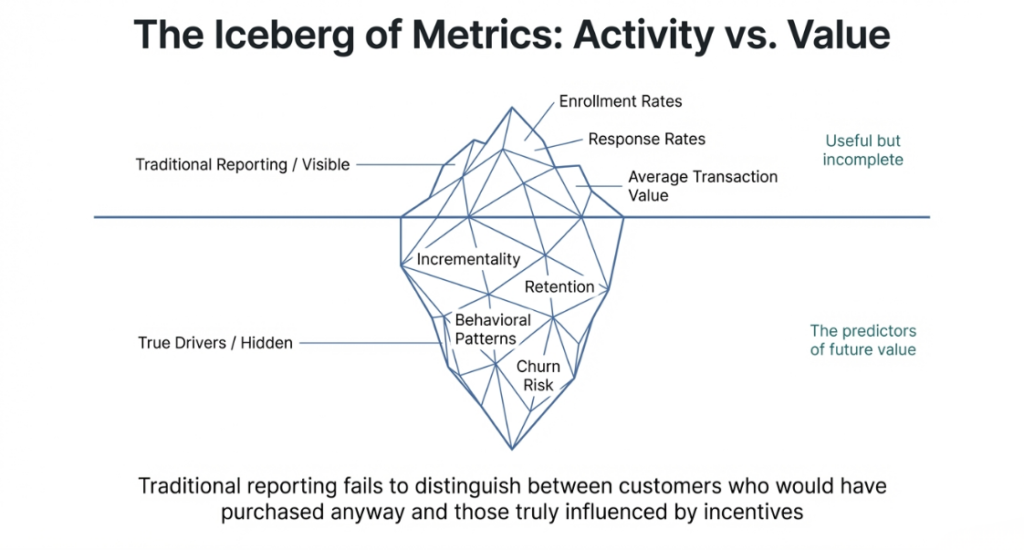
Traditional reporting typically focuses on:
- Enrollment rates
- Redemption frequency
- Campaign response rates
- Average transaction value
These indicators are useful but incomplete. They do not reveal incrementality. They do not distinguish between customers who would have purchased anyway and those influenced by incentives. Most importantly, they do not identify the behavioral patterns that predict future values.
Loyalty analytics provides the framework to answer these questions with statistical rigor.
Defining Loyalty Analytics in a Retail Context
Loyalty analytics refers to the application of advanced data science, statistical modeling, and behavioral analysis to understand, predict, and optimize customer loyalty outcomes. In the context of retail loyalty programs, it connects transactional data, promotional exposure, channel interactions, and customer attributes to measurable business impact.
At its core, loyalty analytics answers three strategic questions:
- Which customer behaviors correlate with high lifetime value
- Which program elements drive incremental revenue
- Which customers are at risk of churn, and why
This requires moving from descriptive dashboards to predictive and prescriptive models.
Advanced Metrics That Reveal True Drivers
To uncover meaningful drivers, retailers must deploy analytical techniques that go beyond aggregate reporting.
- Customer Lifetime Value (CLV) Modeling: Segments customers not by past spend, but by predicted future value, guiding strategic investment.
- Cohort Analysis: Tracks groups of customers who joined at the same time, revealing whether program changes improve long-term retention.
- Predictive Churn Modeling: Uses machine learning to identify customers at high risk of lapsing, enabling proactive, personalized retention efforts.
- Behavioral Segmentation: Goes beyond demographics to group customers by actions like buying frequency, category affinity, or engagement with content.
- Basket Analysis: Uncovers product affinities and cross-selling opportunities by analyzing purchase combinations.
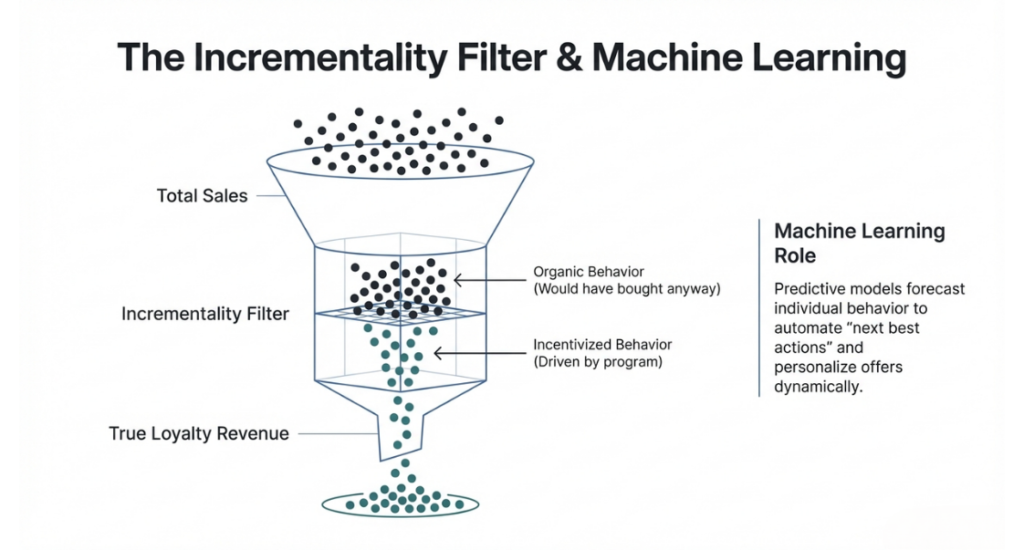
- Incrementality Measurement: Crucially, determines which sales are truly driven by the loyalty program versus those that would have happened anyway.
Machine learning supercharges this process. Predictive models can forecast individual customer behavior, automate next best action recommendations, and dynamically personalize offers. This enables a fundamental shift from transactional loyalty to behavioral and emotional loyalty. The goal is to reward and encourage the behaviors that indicate a deeper connection, such as writing reviews, attending events, or purchasing new categories first. Together, these techniques transform loyalty analytics into a strategic decision engine.
How Priorise Enables Measurable Impact
Priorise serves as the strategic analytics partner for retailers who are ready to evolve their retention strategies. We do not just provide dashboards; we deliver the infrastructure required to turn raw data into a growth engine. By applying deep expertise in loyalty analytics, Priorise enables brands to optimize their retail loyalty programs for maximum ROI.
Our approach focuses on three core pillars:
- Revenue Uplift: Identifying untapped opportunities within the existing customer base to drive higher frequency and average order value.
- Churn Mitigation: Implementing automated, predictive triggers that re-engage at-risk customers with precision.
- Efficiency: Reducing “wasteful” discounting by targeting rewards only to those segments where an incentive is required to change behavior.
Conclusion: Turning Insight into Sustainable Growth
Retail loyalty programs alone do not guarantee retention or profitability. Without rigorous loyalty analytics, they risk becoming expensive engagement mechanisms with limited strategic impact. By uncovering the true behavioral and economic drivers of customer loyalty, organizations can design programs that generate measurable growth rather than temporary activity.
Priorise enables this shift by embedding advanced loyalty analytics into the core of retail decision-making. The impact is measurable: improved retention, higher lifetime value, and more efficient marketing investment.
Ready to unlock the true value hidden within your loyalty program data? Partner with Priorise to build a loyalty strategy driven by insight, not instinct.
-
Previous Post
Is Your Organization Ready to Adopt Generative AI?
Related Posts

How Predictive Analytics Improves Sales Forecasting and Strategy
How can predictive analytics solutions transform uncertain sales forecasts into a reliable revenue strategy? Many…

Understanding Data Migration: Types, Use Cases, Costs & Risks
Enterprise transformation does not fail because of strategy. It fails because of incorrect execution at the data layer. As organizations…

4 Ways to Identify, Classify, and Activate Dark Data in 2026
How much of the data your organization collects actually delivers business value? Dark data—information that is stored and…

The Hidden Compliance Risks in Dark Data (and How to Mitigate Them)
Have you ever stopped thinking about what’s lurking in your organization’s data archives? It might…