
Data engineering tools are driving a major shift in how organizations make decisions. Imagine an online retailer during a flash sale. Thousands of customers are browsing products, placing orders, and interacting with support channels every second. If the business waits hours for reports, it may miss critical opportunities and risks. Inventory shortages, payment issues, and changing customer behaviors require immediate action.
This demand for speed has fueled the rise of real-time analytics. Organizations across industries now rely on continuous data streams to improve operations, enhance customer experiences, and gain competitive advantages. According to Apache Kafka, event-streaming technologies are used by thousands of organizations worldwide, including more than 80% of Fortune 100 companies, to process and analyze data in real time.
To support these initiatives, businesses need modern data engineering tools that can handle data pipeline development, workflow automation, advanced analytics, and MLOps solutions. In this article, we explore the top tools powering real-time analytics and examine why they have become essential for modern enterprises.
Data engineering tools are technologies used to collect, process, transform, orchestrate, and store data throughout its lifecycle. They enable organizations to move information from multiple sources into analytics platforms, dashboards, and machine learning systems efficiently and reliably.
As businesses generate increasing volumes of data from websites, mobile applications, IoT devices, and cloud services, manual data handling becomes impractical. Modern data engineering platforms automate the movement and transformation of data, ensuring stakeholders have access to timely and accurate information.
These tools support key functions such as:
The growth of digital transformation initiatives has increased the demand for scalable data engineering services that help organizations build robust and future-ready data architectures.
Data has become one of the most valuable business assets. However, data only creates value when organizations can collect, process, and act on it effectively. Without modern data engineering tools, companies often struggle with fragmented systems, inconsistent reporting, poor data quality, and delayed insights.
Real-time analytics enables businesses to monitor events as they occur. Leaders can respond to operational issues, customer behavior changes, and market trends immediately rather than relying on outdated reports.
Automation reduces manual intervention across data workflows. Through effective workflow automation, organizations can eliminate repetitive tasks and reduce the risk of human error.
Businesses can leverage real-time customer data to personalize recommendations, optimize service delivery, and improve engagement.
Reliable data pipelines are fundamental to successful MLOps solutions. Data engineering platforms ensure machine learning models receive clean, accurate, and timely data.
Modern business intelligence solutions depend on trustworthy data. Well-designed engineering processes ensure dashboards and analytics platforms deliver accurate insights that support strategic decisions.
For organizations seeking to accelerate digital transformation, partnering with providers offering data engineering consulting services can help streamline implementation and reduce risk.
The modern data ecosystem consists of several categories of tools, each addressing a specific stage of the data lifecycle.
These platforms capture and transport data from source systems into processing environments.
Examples include:
They are commonly used for real-time event streaming, clickstream analytics, and IoT applications.
These tools convert raw data into analytics-ready datasets.
Examples include:
They play a critical role in developing modern data pipelines.
Orchestration platforms coordinate complex workflows across multiple systems.
Examples include:
These technologies provide the workflow automation capabilities required to maintain reliable operations.
These systems store large volumes of structured and semi-structured data.
Examples include:
They provide scalable environments for analytics and reporting workloads.
These tools transform data into dashboards, reports, and visual insights.
Examples include:
They support enterprise-grade business intelligence solutions that enable informed decision-making.
Organizations increasingly require platforms that streamline model development, deployment, and monitoring.
Examples include:
These tools serve as foundational components of modern MLOps solutions.
Best for Event Streaming and Real-Time Data Ingestion
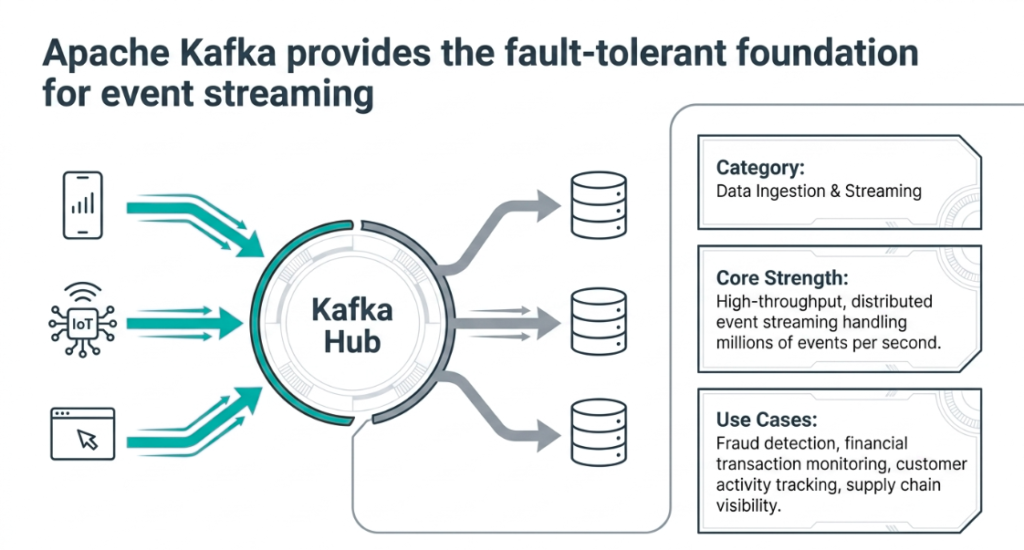
Apache Kafka is one of the most widely adopted data engineering tools for handling high-volume data streams. Its distributed architecture enables organizations to publish, subscribe, and process events in real time.
Kafka often serves as the foundation of enterprise data pipeline development strategies because it can reliably handle millions of events per second.
Best for Stream Processing
Apache Flink specializes in real-time data processing and analytics. It allows organizations to perform stateful computations on streaming data with extremely low latency.
For organizations implementing advanced MLOps solutions, Flink can also support continuous feature engineering pipelines.
Best for Workflow Automation
Apache Airflow has become one of the most popular orchestration platforms for managing complex data workflows.
Using Directed Acyclic Graphs (DAGs), Airflow allows teams to schedule, monitor, and automate data processes across multiple systems.
Many organizations rely on Airflow as a central component of their workflow automation strategy.
Best for Analytics Engineering
dbt has transformed how organizations approach data transformations within modern cloud architectures.
Unlike traditional ETL approaches, dbt allows teams to perform transformations directly within cloud data warehouses while applying software engineering principles such as testing and version control.
dbt simplifies data pipeline development while improving transparency and maintainability across analytics workflows.
Best for Cloud Data Warehousing
Snowflake has become a leading cloud-native platform for storing and analyzing large-scale datasets.
Its architecture separates compute and storage resources, allowing organizations to scale efficiently without significant infrastructure complexity.
Snowflake integrates seamlessly with many leading data engineering tools, making it a preferred choice for modern analytics ecosystems.
Best for Unified Data and AI Platforms
Databricks combines data engineering, analytics, and artificial intelligence within a single platform.
Built on Apache Spark, Databricks enables large-scale processing and collaborative analytics while supporting advanced machine learning workflows.
Organizations implementing enterprise AI initiatives frequently use Databricks to streamline MLOps solutions and accelerate model deployment.
Best for Business Intelligence Solutions
Analytics only create value when insights are accessible to decision-makers. Tableau remains one of the leading business intelligence solutions for transforming data into meaningful visualizations.
Organizations can connect Tableau directly to modern data platforms and gain near real-time visibility into operations, customer behavior, and financial performance.
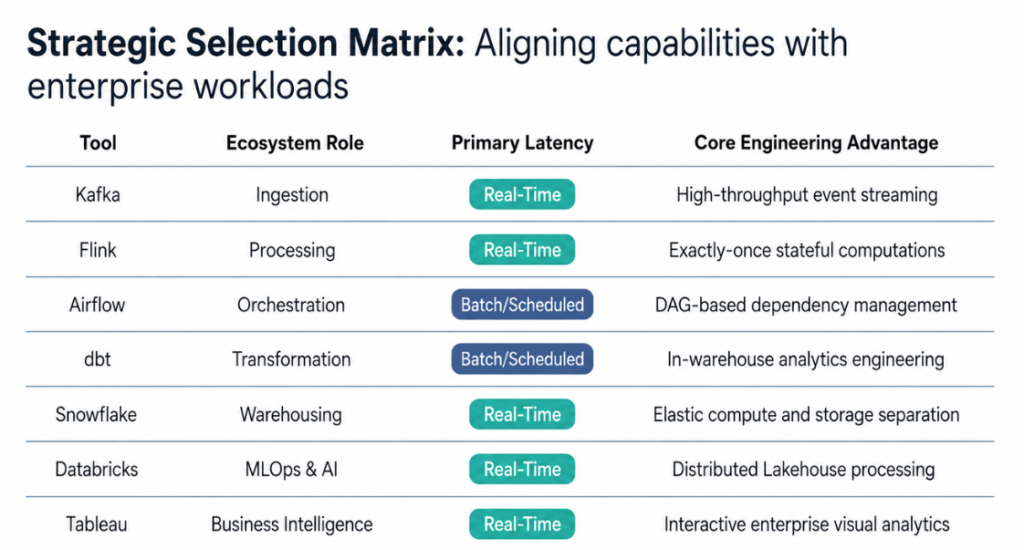
Choosing the right technology stack requires careful evaluation of business goals, technical requirements, and future scalability needs.
Select platforms capable of handling growing data volumes and evolving analytics requirements.
The best data engineering tools work seamlessly with existing cloud platforms, databases, and analytics environments.
Some platforms offer extensive functionality but require specialized expertise. Organizations should assess internal capabilities before implementation.
As AI adoption increases, organizations should choose tools that support modern MLOps solutions and machine learning workflows.
Working with specialists offering data engineering services and data engineering consulting services can help organizations avoid costly implementation mistakes and accelerate value realization.
Companies such as Priorise help businesses design scalable architectures, optimize pipelines, and build reliable analytics ecosystems that support long-term growth.
From detecting fraud in milliseconds to delivering instant recommendations, the right data engineering tools transform raw data into real-time business value. As the race for faster, smarter analytics intensifies, organizations must invest in scalable solutions, expert guidance, and seamless integrations. Brands like Priorise empower enterprises to overcome complexity and unlock the full potential of modern data pipeline development, MLOps solutions, and business intelligence.
Ready to future-proof your data strategy? Explore innovative data engineering services and connect with Priorise to accelerate your real-time analytics journey.
Data engineering tools help collect, process, transform, and manage data for analytics, reporting, and AI applications.
Popular options include Apache Kafka, Apache Flink, Apache Airflow, dbt, Snowflake, Databricks, and Tableau.
They automate data pipelines, improve data quality, and deliver reliable data for machine learning models.
Data engineering services help businesses build scalable data pipelines, improve data reliability, and accelerate analytics initiatives.
They ensure accurate, real-time data is available for dashboards, reports, and business intelligence solutions.