

Customer Loyalty Analytics sits at the heart of every modern growth story. Imagine a retail brand struggling with declining repeat purchases. Transactions are happening; promotions are running, but loyalty feels fragile. This is where Customer Loyalty Analytics changes the narrative, turning fragmented customer data into actionable insights that strengthen relationships and maximize lifetime value. For brands running retail loyalty programs, analytics is no longer optional; it is the competitive advantage.
At Priorise, we work with brands navigating this exact challenge: moving from reactive loyalty tactics to predictive, insight-led strategies powered by customer loyalty analytics.
Understanding Customer Loyalty Analytics
Customer loyalty analytics refers to the analytical framework used to measure, predict, and optimize customer retention and engagement. It combines transactional data, behavioral signals, and engagement history to reveal patterns that explain why customers stay, spend more, or disengage.
In the context of retail loyalty programs, customer loyalty analytics enables businesses to:
- Identify high-value and at-risk customers
- Evaluate reward effectiveness beyond redemption rates
- Predict future purchasing behavior
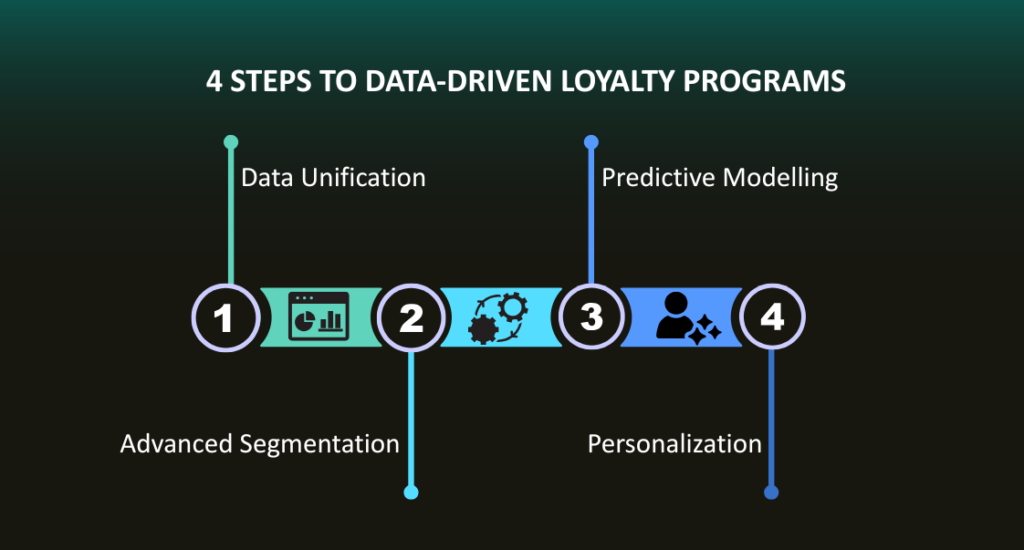
The Four-Step Playbook for Analytical Success
Building a world-class loyalty strategy isn’t guesswork. It’s a disciplined process. At Priorise, we guide our clients through a proven playbook to operationalize customer loyalty analytics.
- Data Unification: The first step is to break down data silos. Consolidate point-of-sale (POS) data, online shopping behavior, customer service interactions, and app engagement into a single customer view. Without this holistic perspective, your analysis will be fundamentally flawed.
- Advanced Segmentation: Move beyond basic demographics. Employ behavioral segmentation models like RFM (Recency, Frequency, Monetary) to group customers based on their actions. This allows you to identify your “Champions,” “At-Risk” customers, enabling tailored communication for each segment.
- Predictive Modeling: This is where analytics become proactive. Use machine learning models to forecast future behavior. Predict which customers are likely to churn in the next 90 days or identify those with the highest potential for lifetime value growth. This allows you to intervene before you lose a valuable customer.
- Personalization and Optimization: With predictive insights, you can launch hyper-personalized campaigns. A customer predicted to be price-sensitive receives a targeted discount, while a high-frequency shopper gets an exclusive early-access offer. Continuously A/B test these rewards and communications to refine your approach, ensuring your retail loyalty programs are always evolving.
Why Retail Loyalty Programs Fail Without Analytics
Many retail loyalty programs are built on static rules—earn points, redeem rewards, repeat. While simple, this structure ignores customer diversity. Not all customers are motivated by the same incentives, nor do they exhibit loyalty in the same way.
Customer loyalty analytics introduces precision. For example, a specialty retailer discovered through analytics that frequent shoppers valued early access more than discounts. By adjusting its retail loyalty programs accordingly, the brand increased engagement without increasing promotional spend. This is the tangible impact of customer loyalty analytics when applied strategically.
Core Metrics That Power Customer Loyalty Analytics
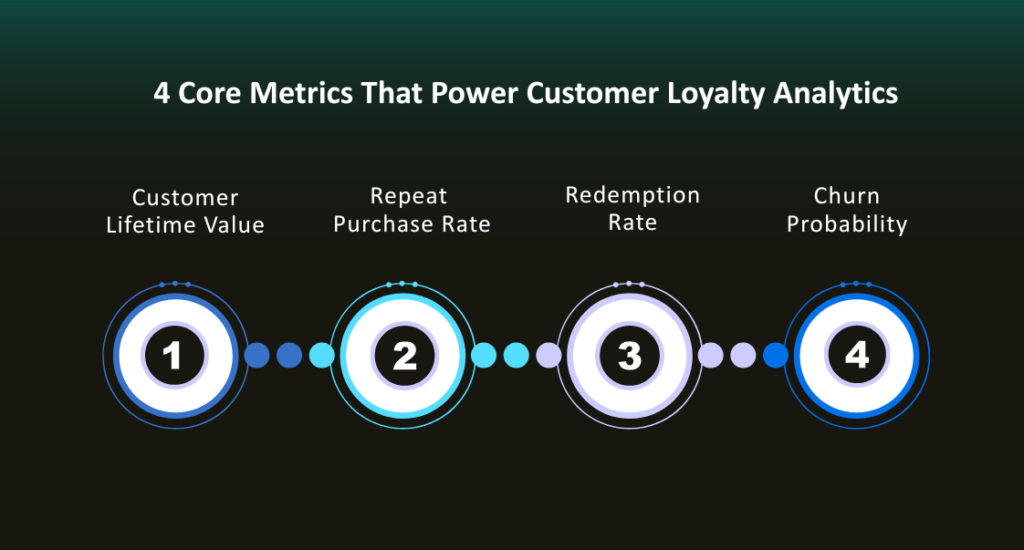
To master Customer Loyalty Analytics, organizations must focus on a core set of metrics:
- Customer Lifetime Value (CLV): Predicts long-term revenue contribution.
- Repeat Purchase Rate: Measures consistency of engagement in retail loyalty programs.
- Redemption Rate: Indicates the perceived value of rewards.
- Churn Probability: Identifies customers at risk before they disengage.
By tracking these metrics, Customer Loyalty Analytics becomes a proactive tool rather than a retrospective report.
Building a Scalable Customer Loyalty Analytics Framework
To operationalize Customer Loyalty Analytics, retailers should follow a structured playbook:
- Unified Data Architecture: Integrate POS, eCommerce, CRM, and loyalty systems.
- Behavior-Based Segmentation: Go beyond demographics to intent-driven cohorts.
- Predictive Modeling: Anticipate churn, upsell potential, and reward effectiveness.
- Continuous Optimization: Refine retail loyalty programs using real-time insights.
Summary: Loyalty That Compounds Over Time
Customer Loyalty Analytics is the foundation of loyalty strategies that grow stronger with every interaction. Retailers that invest in analytics-driven retail loyalty programs are not just retaining customers; they are building a durable competitive advantage.
If your loyalty strategy is generating data but not direction, it is time to rethink the approach. Priorise helps brands convert loyalty insights into decisive action, because the future of loyalty belongs to those who understand it best.
Related Posts
6 Metrics That Define Effective Experience Analytics
Most organizations collect experience data. Very few can translate it into measurable outcomes. Clicks, sessions,…

How Predictive Analytics Improves Sales Forecasting and Strategy
How can predictive analytics solutions transform uncertain sales forecasts into a reliable revenue strategy? Many…

Understanding Data Migration: Types, Use Cases, Costs & Risks
Enterprise transformation does not fail because of strategy. It fails because of incorrect execution at the data layer. As organizations…
Uncovering the True Drivers of Revenue Growth with Customer Loyalty Analytics
A national retailer had invested heavily in one of the most visible retail loyalty programs…