
Revenue management analytics is rapidly becoming the cornerstone of profitable growth in modern enterprises.
Imagine a global consumer goods executive sitting in a boardroom, staring at a quarterly performance report. Volume sales have increased by 8%, yet net revenue has declined by 2%. The company is selling more products but generating less profit. This is a challenge facing organizations across retail, consumer packaged goods (CPG), manufacturing, hospitality, and e-commerce sectors.
For decades, commercial teams relied on historical intuition, spreadsheets, and broad promotional discounts to drive growth. Today, that approach is no longer sufficient. Markets are increasingly volatile, customer expectations are changing faster than ever, and competitors can adjust prices in real time.
According to McKinsey, organizations that implement advanced Revenue Growth Management (RGM) capabilities can achieve gross margin improvements of 4%–7% annually while significantly improving pricing effectiveness.
This shift has elevated revenue management analytics from a reporting function to a strategic business capability. Through advanced data science services, predictive modeling, and AI-powered forecasting, companies can determine exactly who is buying, what they are buying, at what price, through which channel, and under what promotional conditions.
The result is a new era of data-driven decision making, where every pricing strategy, promotion, assortment decision, and trade investment is optimized to maximize revenue and profitability
Revenue growth has become increasingly difficult in today’s competitive environment. According to the U.S. Bureau of Labor Statistics, consumer prices increased by approximately 2.4% year-over-year in May 2025, creating continued pressure on pricing strategies and profitability.
Meanwhile, Gartner reports that organizations are accelerating investments in AI, analytics, and decision intelligence to improve commercial performance and operational resilience.
These market conditions make revenue management analytics a critical capability for organizations seeking sustainable growth through data-driven decision making.
Historically, Revenue Growth Management was largely reactive. Commercial teams analyzed quarterly sales results, reviewed market trends, and adjusted pricing strategies after revenue opportunities had already been missed.
Today’s revenue management analytics environment is fundamentally different.
Modern RGM combines machine learning, predictive analytics, business intelligence solutions, and generative AI solutions to continuously evaluate market conditions and recommend optimal actions in real time.
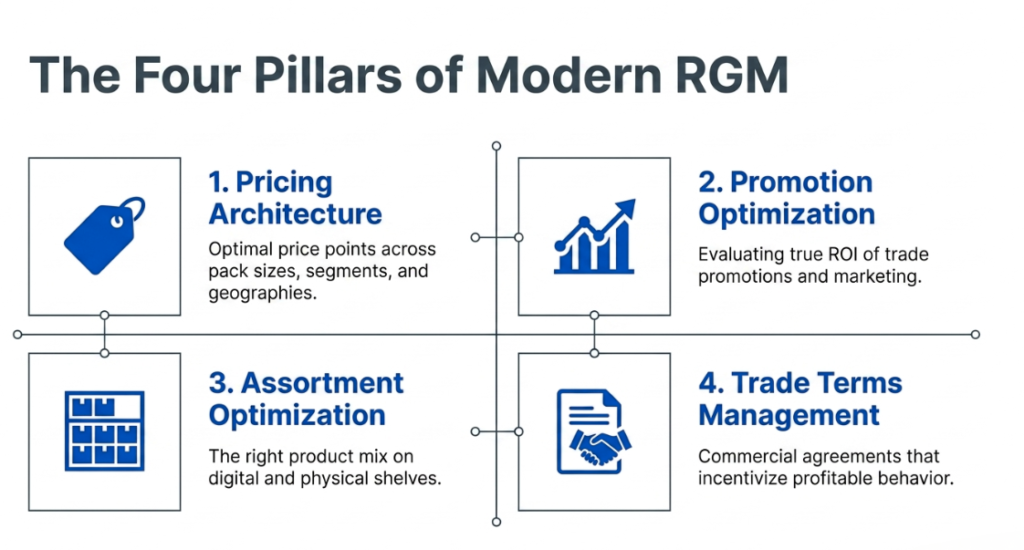
Modern RGM operates across four critical pillars:
Without a robust underlying data infrastructure, executing these pillars effectively is impossible. This is where the intersection of business intelligence and data science becomes critical. While traditional business intelligence solutions excel at telling businesses what happened in the past, data science uncovers why it happened and predicts what will happen next.
Implementing an algorithmic approach to RGM requires specialized infrastructure and expertise. Organizations increasingly invest in specialized data science services because traditional reporting systems cannot manage the complexity of modern commercial environments.
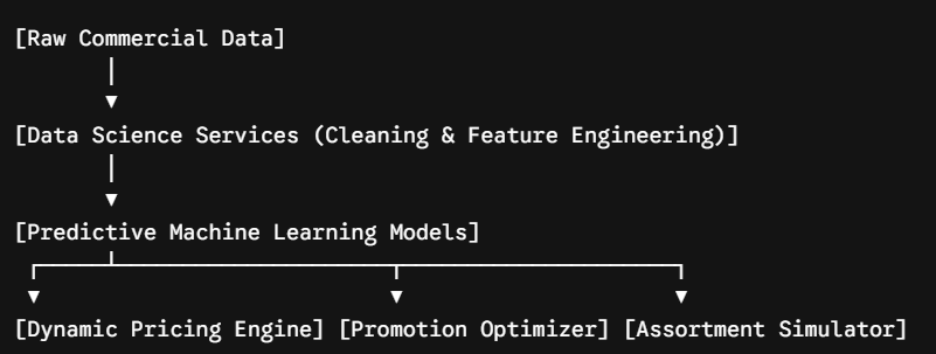
At the core of pricing architecture is the concept of Price Elasticity of Demand (PED). Traditional models calculate a static elasticity figure for an entire product category. Data science, however, allows for localized, dynamic elasticity modeling.
By deploying advanced regression models and machine learning algorithms (such as Gradient Boosting and Random Forests), data science teams can calculate elasticity at a store-SKU level. These models account for hundreds of moving variables simultaneously, including:
This granularity allows businesses to implement dynamic pricing strategies that optimize margins without alienating price-sensitive customer segments.
A major pitfall of traditional trade promotions is the “illusion of growth.” A brand might run a 20% discount on a premium item, resulting in a massive sales spike. However, a deeper look often reveals that this spike came at the expense of their own mid-tier product (cannibalization) or simply pulled forward demand that would have happened anyway (forward buying).
Through sophisticated data science services, enterprises can build promotional simulation engines. These engines isolate the true “incremental lift” of a promotion by decoupling baseline demand from promotional noise, accounting for cross-elasticity effects across the entire product portfolio.
An optimized price is useless if the product is out of stock. By blending RGM with predictive supply chain analytics, data science models forecast demand velocity with incredible accuracy. This ensures that assortment mixes are optimized tailored to specific regional preferences, maximizing shelf space profitability.
The technology stack powering RGM is undergoing a massive transformation. The journey from descriptive analytics to autonomous decision-making requires a deliberate integration of different analytical layers.
| Analytical Layer | Primary Capability | RGM Application |
| Business Intelligence Solutions | Descriptive & Diagnostic | Tracking historical margin performance, volume sales, and promotional spend compliance across regions. |
| Predictive Analytics (ML) | Forecasting & Simulation | Calculating price elasticity, predicting promotional lift, and identifying churn risks. |
| Generative AI Solutions | Synthesis & Autonomous Execution | Generating natural language summaries of commercial performance, automating contract drafting, and simulating negotiation scenarios. |
While business intelligence solutions provide the necessary dashboarding to track historical key performance indicators (KPIs), the cutting edge of RGM lies in the deployment of generative AI solutions.
According to research by McKinsey & Company, consumer goods companies that successfully deploy advanced analytics and AI within their RGM programs consistently realize a 2% to 5% increase in net revenue, alongside significant margin improvements.
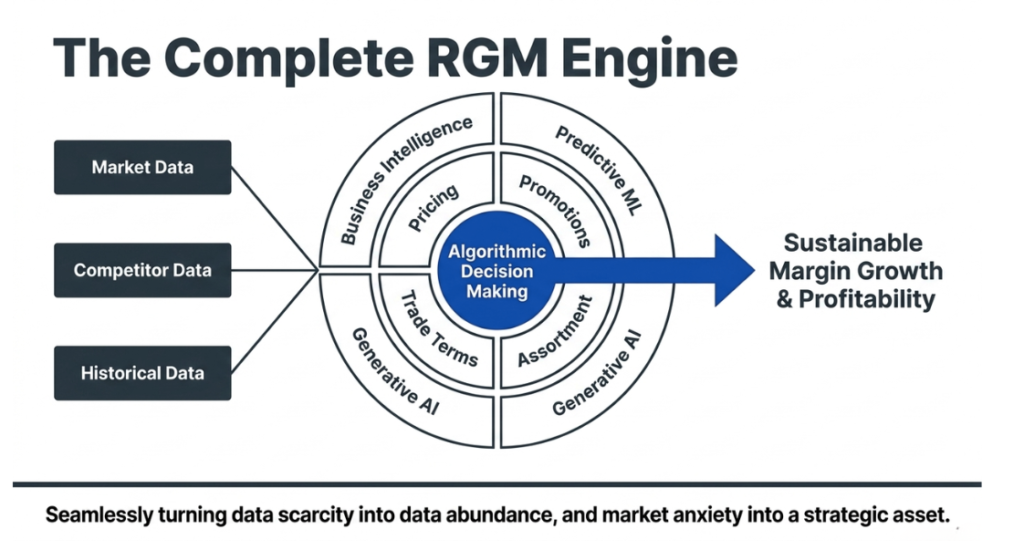
The next evolution of revenue management analytics is being driven by generative AI solutions.
While traditional analytics focuses on identifying patterns, generative AI actively helps decision-makers understand, simulate, and act on those patterns.
According to PwC, AI technologies could contribute up to $15.7 trillion to the global economy by 2030, with significant value generated through productivity and commercial optimization.
Executives can now ask:
Generative AI can instantly simulate multiple revenue scenarios and provide recommendations supported by predictive models.
Modern generative AI solutions automatically generate:
This dramatically reduces the time required to extract insights from complex datasets.
One of the most powerful advantages of generative AI solutions is accessibility.
Instead of relying solely on analysts, commercial leaders can interact directly with data through natural language interfaces, accelerating data-driven decision making across the organization.
Implementing revenue management analytics at an enterprise scale requires more than technology.
Organizations need:
This is where data science consulting becomes invaluable.The gap often exists because organizations focus on technology before building the necessary processes and capabilities.
Experienced data science consulting partners help bridge this gap by accelerating deployment, reducing implementation risk, and aligning analytics initiatives with measurable business outcomes.
The journey from data scarcity to data abundance has changed the rules of competition. The ability to capture, analyze, and act on data in real-time defines market leaders. Revenue management analytics sits at the heart of this capability, turning pricing and inventory decisions from a source of anxiety into a strategic asset. By leveraging advanced business intelligence solutions, generative AI, and expert guidance, organizations can unlock hidden value and build resilience. The intelligence gathered through these tools not only optimizes revenue but also creates a deeper understanding of the customer, fostering loyalty and long-term growth.
Ready to transform your data into a revenue engine? Connect with Priorise to explore how we can help you build a tailored analytics strategy that drives measurable results.
Revenue management analytics uses data and AI to optimize pricing, promotions, and product strategies for higher revenue and profitability.
Data science services turn business data into insights that enhance pricing, forecasting, and promotional performance.
Business intelligence solutions provide real-time visibility into sales, margins, and KPIs to support better commercial decisions.
Generative AI solutions automate insights, simulate revenue scenarios, and help teams make faster, data-driven decisions.
Data science consulting helps businesses implement scalable analytics strategies that drive revenue growth and operational efficiency.