



The integration of artificial intelligence into healthcare has ushered in a new era of medical innovation and patient care. AI in healthcare is no longer a futuristic concept but a present-day reality that’s reshaping how medical professionals diagnose, treat, and manage diseases. As healthcare systems worldwide grapple with increasing complexity and demand, AI-driven analytics has emerged as a powerful tool to improve outcomes, reduce costs, and enhance operational efficiency. This article explores how advanced analytics powered by artificial intelligence is revolutionizing healthcare delivery and examines the key players driving this transformation.
The Impact of AI-Driven Analytics on Patient Care
AI in healthcare has fundamentally transformed how patient data is analyzed and utilized to improve clinical outcomes. Machine learning algorithms can process vast amounts of medical data, including patient histories, laboratory results, imaging scans, and genetic information, far beyond the capacity of humans. These systems can identify patterns and correlations that might otherwise go unnoticed, enabling earlier disease detection and more accurate prognoses.
For example, AI models can predict patient deterioration hours before it becomes clinically apparent, allowing healthcare providers to intervene proactively. Similarly, AI-driven analytics can personalize treatment plans by considering individual patient characteristics, lifestyle factors, and genetic predispositions, moving healthcare from a one-size-fits-all approach to truly personalized medicine.
The Mechanics of AI-Driven Analytics in Healthcare
At its core, AI in healthcare leverages machine learning algorithms to analyze electronic health records (EHRs), medical imaging, and wearable device data. These systems process petabytes of information far beyond human capability, identifying patterns that signal disease progression or treatment efficacy. A McKinsey report estimates broader AI adoption could save the U.S. healthcare system between $200-360 billion annually by reducing errors and streamlining workflows
Healthcare AI companies are pioneering tools like natural language processing (NLP) to extract insights from unstructured doctor notes, enabling faster diagnoses.
Key Applications of AI in Healthcare Settings
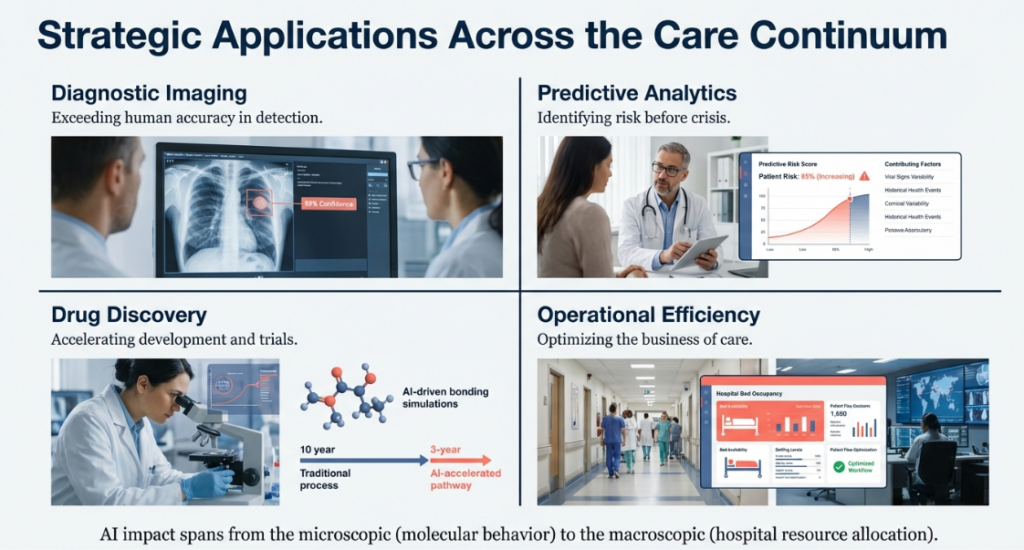
The applications of AI in healthcare span across various domains:
- Diagnostic Imaging: AI algorithms can analyze medical images with remarkable accuracy, detecting abnormalities that might be missed by human observers. Studies have shown that AI can match or even exceed radiologists in identifying certain conditions like diabetic retinopathy, skin cancer, and lung nodules.
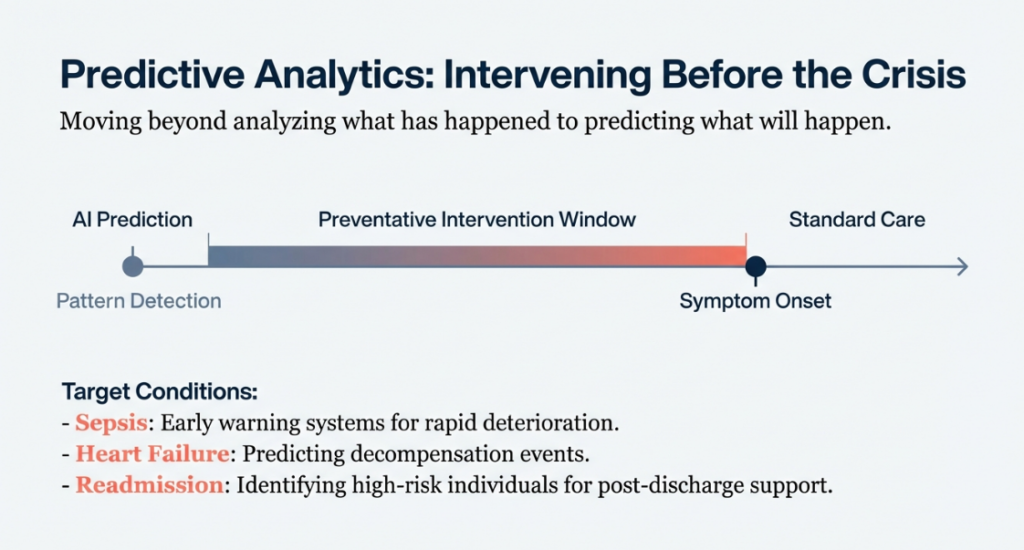
- Predictive Analytics: By analyzing patient data, AI can identify individuals at high risk for conditions like sepsis, heart failure, or readmission, enabling preventive interventions.
- Drug Discovery and Development: AI accelerates the drug development process by predicting molecular behavior, identifying potential drug candidates, and optimizing clinical trial design.
- Operational Efficiency: AI-driven analytics helps hospitals optimize resource allocation, staff scheduling, and patient flow, reducing wait times and improving the overall patient experience.
Leading Healthcare AI Companies Making a Difference
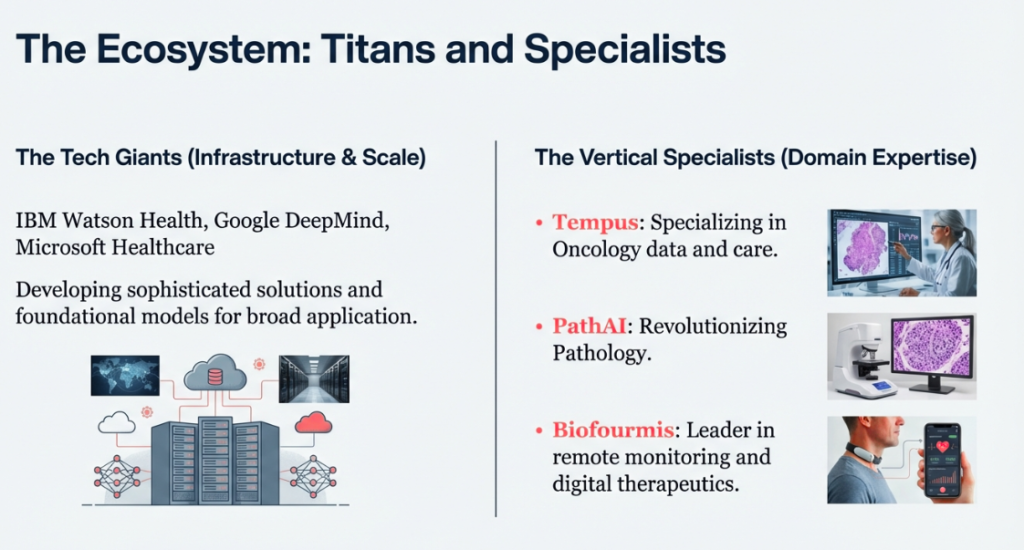
The landscape of healthcare AI companies has expanded dramatically in recent years, with both established tech giants and innovative startups contributing to the field. Companies like IBM Watson Health, Google DeepMind, and Microsoft Healthcare are developing sophisticated AI solutions for various healthcare applications.
Meanwhile, specialized healthcare AI companies like Tempus (oncology), PathAI (pathology), and Biofourmis (remote monitoring) are focusing on specific domains within healthcare. These organizations are partnering with medical institutions to validate and deploy AI solutions that address real-world clinical challenges.
The Future Horizon for AI in Healthcare
AI in healthcare will integrate with IoT for real-time care; the WHO envisions it advancing Sustainable Development Goals and preventing millions of deaths by 2030. Healthcare AI companies drive this, projecting markets to $110 billion . AI in healthcare propels better outcomes. AI companies turn data into hope.
Ready to harness AI-driven analytics? Visit Priorise for tailored solutions. Contact us today to learn how our solutions can transform your healthcare delivery systems.
Related Posts
Beyond Automation: How AI Reshapes Cost Structures in Modern Businesses
Artificial Intelligence has matured far beyond simple task automation. What began as workflow scripting and…

How AI Is Redefining Loyalty Programs and Customer Retention
How are AI Loyalty Programs transforming retail customer retention in a market where customer expectations…
Your Data Fuels AI: Steps to Build Strong Data Foundations
Artificial intelligence is only as powerful as the data that drives it. Every model output, automated decision,…
Is Your Organization Ready to Adopt Generative AI?
Generative AI has moved from experimentation to board-level priority. Enterprises across industries are exploring Generative…