


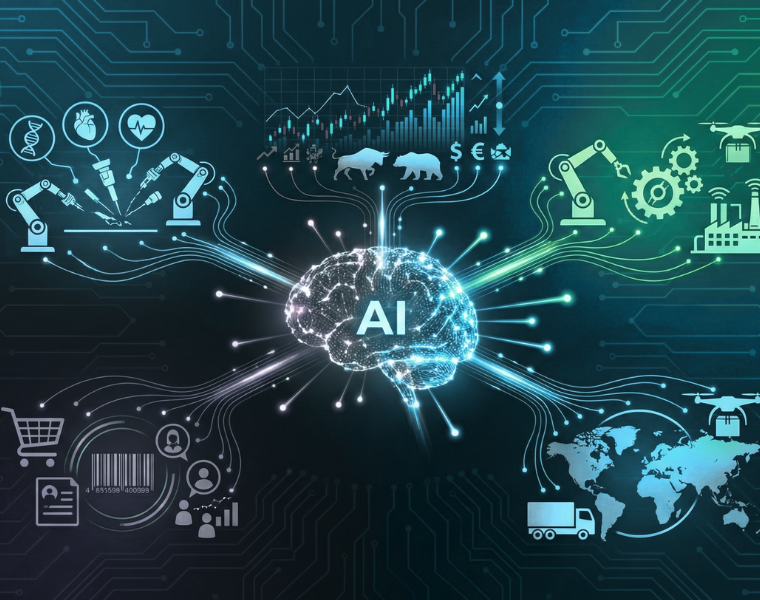
Organizations today face a paradox: they are rich in data but often poor in actionable insight. Data lakes, dashboards, and analytics pipelines continue to expand, yet decision quality does not automatically improve. The limiting factor is no longer access to data; it is the ability to translate data into decisions at speed and scale.
This is where AI use cases become critical. Rather than viewing artificial intelligence as a generalized capability, organizations achieve value by defining concrete use cases that map data inputs to specific decision outcomes. AI use cases to operationalize intelligence, embedding it directly into workflows where decisions are made. As decision complexity increases, AI-driven decision systems are replacing static analytics with dynamic, adaptive intelligence.
How AI Use Cases Convert Data into Decisions
Every effective AI use case starts with a decision problem: what choice needs to be made, under what constraints, and with what impact. From there, AI systems ingest relevant data: structured, semi-structured, and unstructured, through automated pipelines. Preprocessing, normalization, and feature engineering transform raw inputs into decision-ready signals.
Critically, AI use cases aligns with decision intent. Predictive use cases forecast outcomes, prescriptive use cases recommend actions, and decision-augmentation use cases surface insights that guide human judgment. Some are fully automated, while others intentionally keep humans in the loop to ensure accountability and trust.
AI Use Cases Across Key Industries
Use Case #1: Healthcare
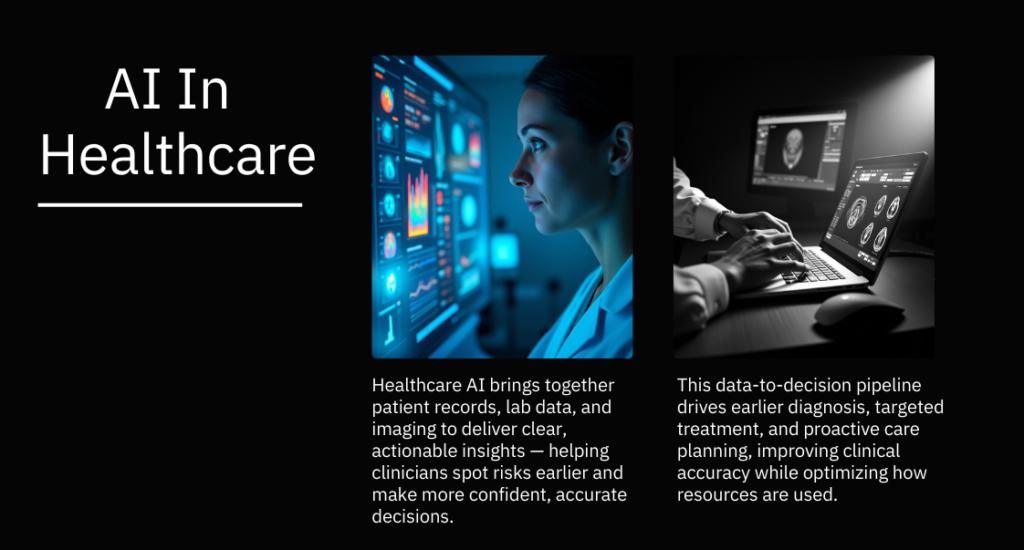
Healthcare AI use cases to support high-stakes clinical and operational decisions by converting complex patient data into actionable guidance. Hospitals generate vast amounts of structured and unstructured patient data, including electronic health records, lab results, imaging scans, and physician notes. Traditional analytics struggle to integrate these sources fast enough to influence urgent clinical decisions. AI models bridge this gap by detecting patterns, prioritizing high-risk cases, and surfacing insights that clinicians can act on immediately.
Data → Model → Decision:
Patient records and diagnostics → predictive and deep learning models → earlier diagnosis, targeted treatment, and proactive care planning.
Decision outcome: Improved clinical accuracy, faster interventions, and more efficient use of healthcare resources.
Use Case #2: Finance and Banking
In finance and banking, AI use cases to enable real-time, risk-aware decision-making at scale. Financial institutions must process high volumes of transaction data while managing regulatory compliance and fraud risk. Traditional rules-based systems are often reactive and cannot detect sophisticated patterns. AI systems ingest both structured transaction logs and unstructured market data to identify anomalies, evaluate creditworthiness, and model portfolio risk dynamically.
Data → Model → Decision:
Transactions, behavioral data, market signals → anomaly detection and risk models → approve, block, price, or rebalance financial exposure.
Decision outcome: Reduced risk, faster financial decisions, and improved regulatory and capital efficiency.
Use Case #3: Retail and E-commerce
Retail AI use cases focus on aligning inventory, pricing, and personalization with demand signals. Retailers deal with massive volumes of point-of-sale, online behavior, and external trend data. Predicting demand and personalizing customer experiences manually is slow and error prone. AI models analyze these diverse data streams to anticipate buying patterns, recommend products, and optimize pricing in near real time.
Data → Model → Decision:
Sales history, customer behavior, external signals → forecasting and optimization models → stock, recommend, and price products dynamically.
Decision outcome: Higher availability, stronger customer engagement, and improved revenue and margin performance.
Use Case #4: Manufacturing and Supply Chain
Manufacturing and supply chain AI use cases drive operational reliability and resilience. Factories and logistics networks produce streams of machine, sensor, and operational data that are too complex for manual analysis. Equipment failures, production of bottlenecks, and supply disruptions can cause major financial loss. AI models integrate these data sources to predict failures, optimize production schedules, and assess supplier risks proactively.
Data → Model → Decision:
Sensor data, production metrics, supplier signals → predictive and optimization models → maintain, schedule, reroute, or reallocate resources.
Decision outcome: Reduced downtime, improved throughput, and more resilient supply chain operations.

Use Case #5: Marketing and Sales
Marketing and sales AI use cases prioritize customers, prospects, and actions to maximize revenue impact. Companies track customer interactions across websites, CRM systems, social media, and support channels, generating vast datasets that are difficult to interpret manually. AI models analyze behavior patterns and engagement signals to segment audiences, score leads and predict churn. These insights enable teams to allocate effort efficiently and tailor interactions for maximum effect.
Data → Model → Decision:
Customer interactions and engagement data → scoring and predictive models → target, prioritize, retain, or upsell customers.
Decision outcome: More efficient go-to-market execution and increased customer lifetime value.
Use Case #6: Enterprise Strategy and Operations
At the enterprise level, AI use cases support strategic prioritization and coordinated execution. Organizations collect diverse performance metrics, project plans, financial reports, and market intelligence, making it challenging to align initiatives across functions. AI models integrate these inputs to simulate scenarios, evaluate trade-offs, and rank projects based on impact and feasibility. Platforms like Priorise demonstrate how these insights can be structured into actionable priorities for leadership.
Data → Model → Decision:
Portfolio data, performance metrics, strategic inputs → prioritization and simulation models → invest, defer, sequence, or reallocate initiatives.
Decision outcome: Clear strategic focus, faster alignment, and more confident enterprise-level decision-making.
Summary:
AI use cases turn complex data into actionable insights, enabling faster, smarter, and strategically aligned decisions across organizations. By embedding intelligence into workflows, enterprises gain operational efficiency, risk awareness, and long-term agility. Scaling these decision-centric capabilities creates a foundation for innovation and sustained growth.
Explore how Priorise can help structure and prioritize AI use cases to convert insights into measurable business impact.
Related Posts
Beyond Automation: How AI Reshapes Cost Structures in Modern Businesses
Artificial Intelligence has matured far beyond simple task automation. What began as workflow scripting and…

How AI Is Redefining Loyalty Programs and Customer Retention
How are AI Loyalty Programs transforming retail customer retention in a market where customer expectations…

Your Data Fuels AI: Steps to Build Strong Data Foundations
Artificial intelligence is only as powerful as the data that drives it. Every model output, automated decision,…

Is Your Organization Ready to Adopt Generative AI?
Generative AI has moved from experimentation to board-level priority. Enterprises across industries are exploring Generative…