


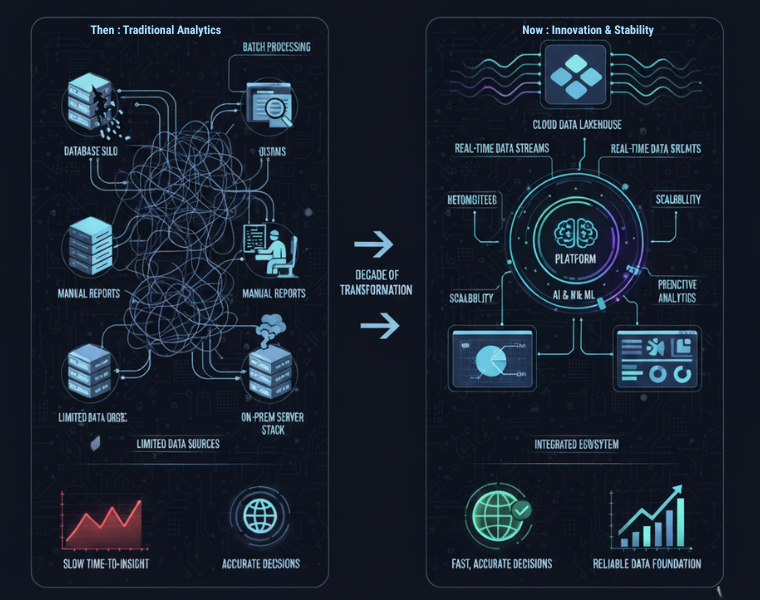
Ten years ago, Data & Analytics meant static dashboards, manual ETL jobs, and delayed insights, tools that explained the past but couldn’t predict the future. Data was fragmented, slow-moving, and reactive. Today, Advanced Analytics has redefined that paradigm. With AI-driven models, scalable cloud infrastructures, and real-time processing, businesses can now transform raw data into predictive, actionable intelligence. Decision-making is faster, smarter, and more continuous.
At Priorise, we view this evolution as more than a technological leap. It’s a shift toward a data-first mindset where analytics drive innovation, operational efficiency, and competitive advantage across every layer of the enterprise.
A Decade Ago: Data Was Informative, Not Transformative
Ten years back, analytics primarily answered one question: What happened? Organizations relied on descriptive metrics like monthly sales, quarterly performance, and customer churn, but lacked predictive foresight.
Common challenges in the past included:
- Isolated data systems that made integration difficult.
- Limited visualization tools that offer static dashboards.
- Manual processes for ETL (extract, transform, load) operations.
- Reactive decision-making, driven by hindsight rather than foresight.
For example, an e-commerce business in 2015 might have tracked total sales by category but couldn’t predict which products were about to trend or which customers were likely to churn. The absence of real-time, Advanced Analytics meant decisions were made too late to capitalize on emerging patterns.
Now: The Era of Advanced Analytics
Modern Advanced Analytics has redefined how organizations extract value from data. With cloud infrastructure, machine learning, and real-time data processing, companies can now forecast, simulate, and automate decisions with remarkable precision.
Key Innovations Shaping the New Era
- AI-Driven Predictive Analytics: Algorithms forecast demand, detect anomalies, and recommend personalized offers.
- Cloud Data Platforms: Tools like Snowflake, BigQuery, and Databricks provide on-demand scalability and unified data access.
- Automated Pipelines: ETL has evolved to ELT, enabling near real-time ingestion and transformation
- Self-Service Analytics: Business users can explore, visualize, and share insights without relying on IT teams.
- Data Governance and Security: Enhanced frameworks ensure consistency, compliance, and trust across data ecosystems.
- For Example, an online retailer today can analyze browsing patterns, past purchases, and demographic data to predict what products a customer will buy next week. Through Advanced Analytics, the same retailer can dynamically adjust promotions, inventory, and even delivery routes, something impossible a decade ago.
Advanced Analytics: The Bridge Between Innovation and Stability
The most significant advantage of Advanced Analytics lies in balancing innovation with stability. As businesses adopt AI-driven models, they also require reliable data pipelines, governance, and consistent frameworks for data quality.
How Priorise supports this balance:
- Data Strategy Consulting: Aligning analytics goals with business outcomes.
- Predictive Modelling Solutions: Empowering teams with AI-driven insights.
- Data Infrastructure Modernization: Migrating legacy systems to agile, cloud-native architectures.
- Governance Frameworks: Ensuring trust and transparency in every decision.
- This structured approach ensures innovation doesn’t compromise reliability, an essential factor for sustainable growth.
| Then | Now | |
| Data Storage | On-premises Data Warehouses (EDW) and cumbersome Hadoop/MapReduce clusters. | Cloud-native Data Lakes (S3, ADLS) and flexible Data Mesh architectures. |
| Processing | Primarily Batch Processing, often taking hours to run large jobs. | Dominantly Stream Processing (Kafka, Spark Streaming) for real-time insights and low-latency decision-making. |
| Tools & Code | Proprietary, expensive software (e.g., SAS, SPSS) and specialized language use (Java/Scala for MapReduce). | Democratized, open-source ecosystems (Python/R, Spark, dbt) with simpler cloud integration. |
Future Landscape of Advanced Analytics
Looking ahead, advanced analytics will increasingly integrate with real-time decision engines, edge computing, and generative AI systems. The next phase will shift from insight delivery to autonomous decision-making, where analytics continuously optimize outcomes.
Key trends shaping the next decade include:
- Growth of self-service analytics empowering wider user adoption.
- Real-time predictive modeling combined with live data streams.
- Federated analytics ensuring privacy-preserving collaboration.
- These innovations reaffirm that analytics is becoming a living system that is adaptive, continuous, and intelligently interconnected.
Conclusion: The Future Belongs to the Data-Driven
The last decade has proven that businesses thriving today are those that embraced Advanced Analytics early. As we move forward, the gap between data-rich and data-smart organizations will only widen.
Ready for future-proof your data strategy? Partner with Priorise to build a resilient, innovation-driven analytics foundation that delivers measurable business impact.
Related Posts
6 Metrics That Define Effective Experience Analytics
Most organizations collect experience data. Very few can translate it into measurable outcomes. Clicks, sessions,…

How Predictive Analytics Improves Sales Forecasting and Strategy
How can predictive analytics solutions transform uncertain sales forecasts into a reliable revenue strategy? Many…

Understanding Data Migration: Types, Use Cases, Costs & Risks
Enterprise transformation does not fail because of strategy. It fails because of incorrect execution at the data layer. As organizations…
Uncovering the True Drivers of Revenue Growth with Customer Loyalty Analytics
A national retailer had invested heavily in one of the most visible retail loyalty programs…