
For years, retailers depended on historical sales reports and intuition to forecast demand. It worked until it didn’t work. Sudden demand spikes, shifting customer preferences, and external disruptions exposed the limits of traditional forecasting methods.
Then came the turning point: data.
With the rise of AI-driven Retail Predictive Analytics, retailers can now decode patterns hidden within massive datasets. Through intelligent retail sales data analysis, forecasting is no longer reactive: it’s predictive, adaptive, and remarkably accurate.
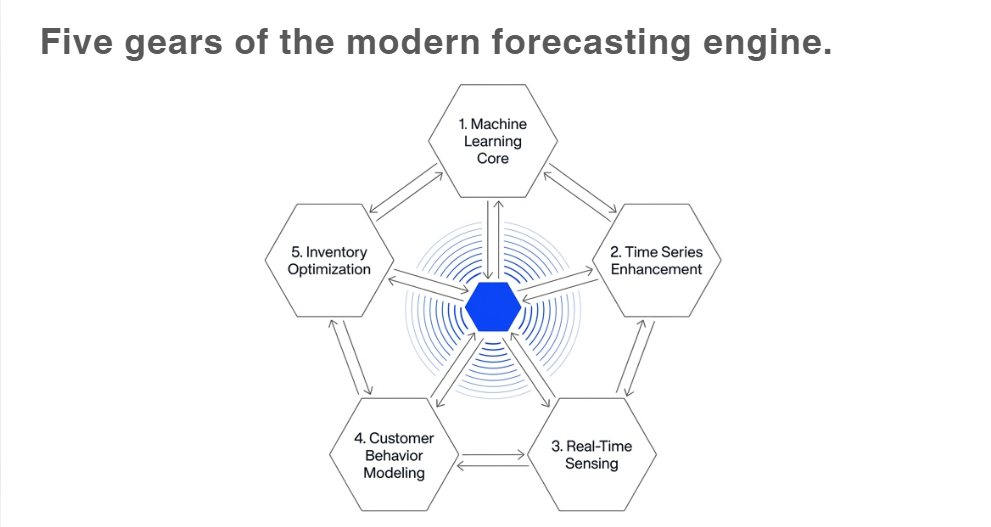
1. Machine Learning-Based Demand Forecasting
Machine learning models analyze historical sales data and continuously learn from new inputs. Unlike traditional methods, they adapt to:
- Seasonal trends
- Customer behavior changes
- Market fluctuations
These models improve over time, delivering increasingly accurate forecasts. With Retail Predictive Analytics, retailers can predict demand at a granular level—by product, location, or even customer segment.
2. Time Series Analysis with AI Enhancement
Time series forecasting examines historical patterns over time. AI enhances this technique by identifying hidden patterns that humans often miss.
Key advantages include:
- Detecting recurring demand cycles
- Adjusting for anomalies (e.g., sudden spikes)
- Improving forecast accuracy during volatile periods
Combined with retail sales data analysis, time series models become more robust and reliable.
3. Demand Sensing Using Real-Time Data
Demand sensing uses real-time inputs such as:
- Point-of-sale transactions
- Online browsing behavior
- Weather and local events
AI processes this data instantly, allowing retailers to adjust forecasts dynamically. This ensures inventory decisions are always aligned with current demand conditions. For example, a sudden surge in online searches for umbrellas can trigger immediate stock adjustments in specific regions.
4. Predictive Customer Behavior Modeling
Understanding customer intent is critical for accurate forecasting. AI models analyze:
- Purchase history
- Browsing patterns
- Demographics and preferences
This helps retailers anticipate what customers are likely to buy next. When integrated with Retail Predictive Analytics, businesses can align inventory with actual customer demand rather than assumptions.
5. AI-Powered Inventory Optimization Algorithms
Forecasting is only effective when paired with execution. AI-driven inventory optimization ensures:
- Right products are stocked
- Stock levels match predicted demand
- Supply chain inefficiencies are minimized
These algorithms use retail sales data analysis to recommend optimal reorder points, safety stock levels, and distribution strategies. Priorise brings these capabilities together, enabling retailers to automate forecasting and inventory decisions with precision.
Why These AI Techniques Matter
Adopting these AI techniques offers measurable benefits:
- Reduced stockouts and overstocking
- Improved customer satisfaction
- Higher operational efficiency
- Better profit margins
How AI Improves Inventory & Demand Forecasting
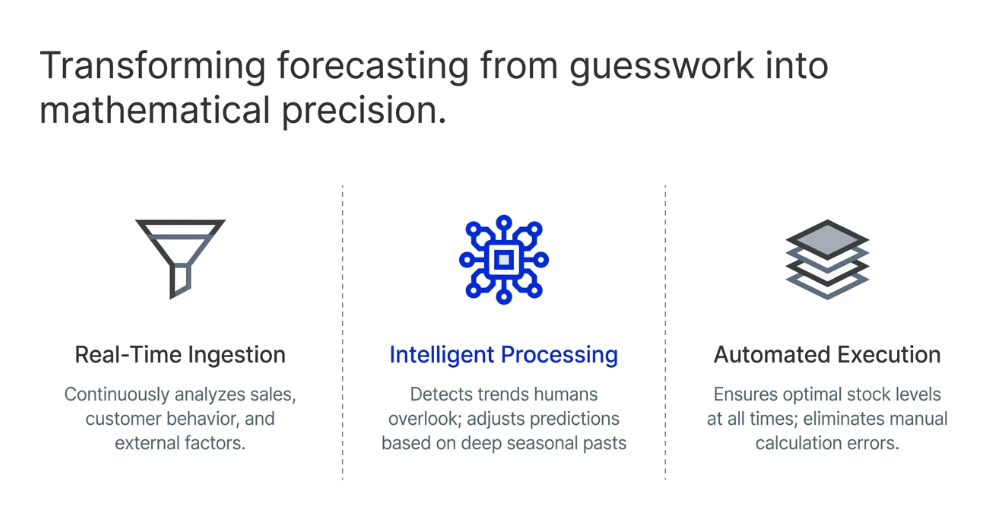
AI-powered retail sales data analysis transforms forecasting from guesswork into precision.
- Real-time data processing: Continuously analyzes sales, customer behavior, and external factors
- Pattern recognition: Detects trends that humans may overlook
- Seasonal forecasting: Adjusts predictions based on past seasonal data
- Automated replenishment: Ensures optimal stock levels at all times
- Reduced human error: Minimizes reliance on manual calculations
These capabilities enable retailers to respond more proactively rather than reactively.
Best Practices for Implementation
Success with Retail Predictive Analytics demands strategy.
Follow these steps:
- Clean and structured data: Audit POS and CRM feeds first.
- Integration with POS systems: Ensure seamless retail sales data analysis flow.
- Continuous model training: Update AI with fresh data quarterly.
- Cross-team collaboration: Align sales, ops, and IT for buy-in.
Summary: From Prediction to Precision
Retail success today depends on the ability to predict demand with accuracy and act on it instantly. These five AI techniques are not just innovations—they are necessities in a competitive landscape.
By adopting advanced Retail Predictive Analytics and leveraging deep retail sales data analysis, retailers can unlock smarter forecasting and stronger business outcomes.
Start using Priorise today to power accurate, AI-driven demand forecasting and elevate your retail strategy.