


Predictive analytics has been part of sales technology conversations for more than a decade. Yet many sales leaders and revenue operations teams still struggle to translate predictions into a consistent revenue impact. Forecasts miss the mark, lead scores fail to align with reality, and dashboards grow more complex while decisions remain slow.
The problem is not whether predictive sales analytics deliver value; it is whether the underlying sales analytics solution is built for today’s buying complexity. Poor data foundations, opaque models, and disconnected tools often undermine even the most sophisticated analytics initiatives.
This article explores what genuinely works in modern predictive sales analytics, what no longer delivers results, and how forward-thinking organizations are redesigning their approach for measurable revenue impact.
The Evolution of Predictive Sales Analytics
At its core, predictive sales analytics uses statistical models and machine learning to forecast sales outcomes such as deal conversion probability, pipeline risk, and revenue timing.
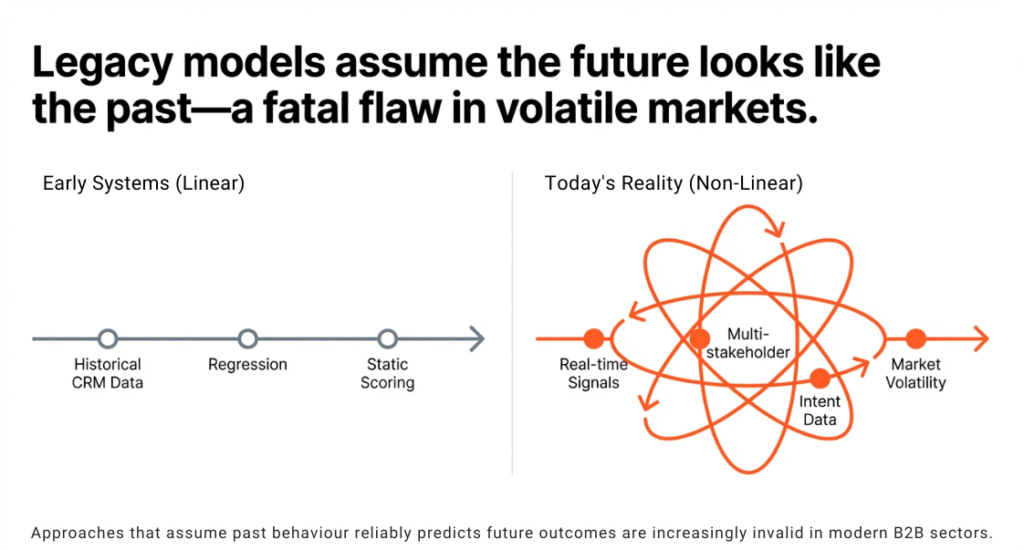
Early systems relied heavily on:
- Historical CRM data
- Simple regression models
- Static scoring mechanisms
While these approaches offered surface-level insights, they assumed that past behavior reliably predicts future outcomes, an assumption increasingly invalid in today’s volatile B2B markets. Modern buying journeys are nonlinear, multi-stakeholders, and influenced by real-time intent signals, exposing the limitations of legacy predictive models.
Common Myths That Hold Teams Back
Several persistent myths undermine the effectiveness of predictive modeling in sales:
- “More data automatically means better predictions.”
Without data quality, governance, and context, volume adds noise rather than signal.
- “A single lead or deal score is enough.”
Composite scores often obscure why a deal is likely to progress or stall.
- “Advanced models don’t need explanation.”
In practice, lack of explainability erodes trust and adoption among sales teams.
These misconceptions frequently lead organizations to invest heavily in analytics tools that look impressive but fail to influence day-to-day sales behavior.
What Actually Works
1. High-Quality, Real-Time Data Pipelines
Effective predictive sales analytics starts with disciplined data foundations:
- Clean, standardized CRM records
- Consistent activity capture
- Reliable enrichment and intent data
Modern sales analytics solutions prioritize real-time ingestion and validation, not quarterly model retraining outdated data.
2. Context-Aware, Dynamic Modeling
High-performing models go beyond static history by incorporating:
- Engagement behavior and response timing
- Deal velocity changes
- Product usage and intent signals
Context-aware predictive sales analytics recognizes that deal risk evolves daily—not quarterly.
3. Human-in-the-Loop Intelligence
The most effective systems augment human decision-making rather than replace it.
By making predictions transparent and allowing feedback from reps and managers:
- Model accuracy improves over time
- Trust and adoption increase
- Insights align with real-world execution
This human-in-the-loop approach separates effective predictive systems from theoretical ones.
4. Action-Oriented Outputs, Not Passive Dashboards
Dashboards alone do not change behavior. Leading teams rely on a sales analytics solution that delivers prescriptive guidance, such as:
- Which deals need attention today
- Which accounts show emerging risk
- What action will move the pipeline forward
The goal is prioritization, not visualization.
What Doesn’t Work Anymore
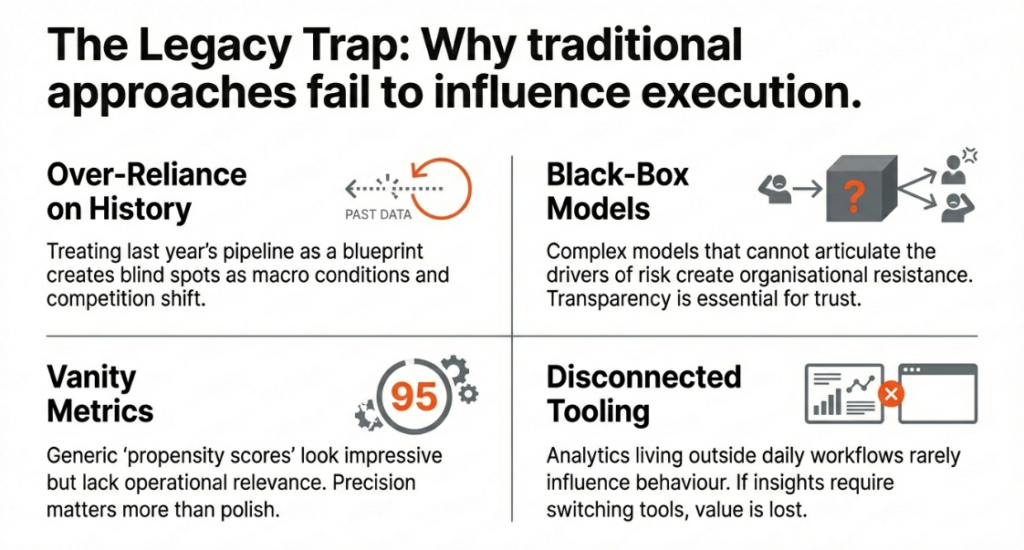
1. Over-Reliance on Historical Data
Models that treat last year’s pipeline as a blueprint for the future systematically fail in dynamic markets. They miss emerging signals and are slow to react to change. As buying behavior, competition, and macro conditions shift, historical-only models create blind spots that compound risk rather than reduce it.
2. Black-Box Models Without Explainability
Highly complex models that cannot articulate drivers of risk or opportunity to create organizational resistance. Transparency is not a “nice to have”; it is essential for trust. When sales teams do not understand why a recommendation exists, they are far less likely to act on it consistently.
3. Vanity Metrics and Generic Lead Scores
Metrics that look impressive but lack operational relevance, such as overly broad propensity scores, do little to improve execution. Precision matters more than polish. Effective predictive sales analytics focuses on narrowly defined, role-specific insights that directly support daily prioritization.
4. Disconnected Tooling
Analytics that live outside daily sales systems rarely influence behavior. A sales analytics solution must integrate tightly with CRM, forecasting, and engagement platforms to remain relevant. If insights require sales teams to change tools or workflows, adoption drops sharply, and value is lost.
Looking Ahead: The Future of Predictive Sales Analytics
The future of predictive sales analytics lies not in increasingly complex models, but in practical decision enablement. By rethinking how predictive sales analytics is designed and deployed, sales leaders can transform data into a durable competitive advantage. The goal is not perfect prediction; it is faster, better decision-making at scale.
Ready to see how intelligent prioritization improves pipeline performance? Discover how Priorise delivers clarity, confidence, and focus across your revenue engine.