

Losing personal belongings at an airport has long been an unavoidable inconvenience. From mobile phones and wallets to passports and travel documents, millions of passengers experience the stress of misplaced items every year. Jaipur International Airport (JIA), recognizing both the operational inefficiencies of traditional lost and found processes and the impact on passenger satisfaction, has implemented an AI-enabled lost and found management system that has achieved an impressive 85% recovery rate. This initiative demonstrates how artificial intelligence can be strategically deployed to optimize airport operations and enhance customer service.
The Operational Challenge
Airports handle complex, high-volume traffic daily. JIA, one of Rajasthan’s busiest airports, serves over six million passengers annually and manages nearly 120 daily flights. Traditional lost and found operations are largely manual, relying on staff to record, categorize, and track items using physical logs or fragmented digital systems. These methods are prone to errors, delays, and inconsistencies, often leaving passengers uncertain about the status of their claims.
The challenges can be summarized as follows:
- High Volume of Lost Items: Thousands of passengers passing through terminals daily inevitably misplace belongings.
- Manual Processing Bottlenecks: Logging items manually is time-consuming and error prone.
- Limited Transparency: Passengers often have little visibility into claim status, creating frustration.
- Resource Intensive: Staff spend significant time on administrative tasks instead of assisting travelers.
These operational limitations created a clear need for a smarter, automated solution capable of addressing scale, speed, and accuracy simultaneously.
AI-Enabled Lost and Found Management System: How It Works
Jaipur Airport has deployed AI-powered cameras and a digital platform to log lost items, creating a smart system that captures item details, location, and time. By digitizing the lost and found management process, passengers can track their belongings online, making JIA India’s first fully automated lost and found service.
Core components of the system:
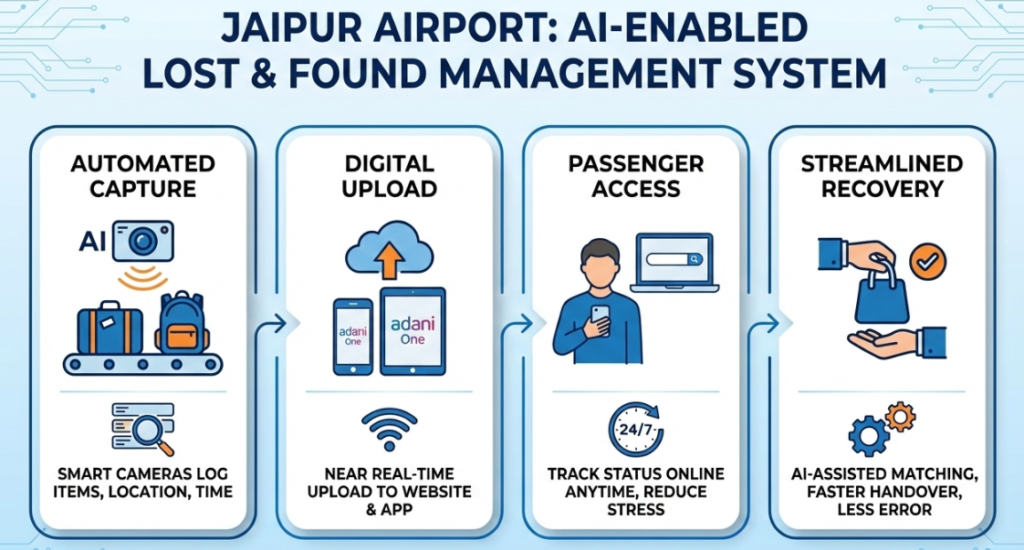
- Automated Capture: AI cameras scan and log images of lost items, automatically recording descriptions, location, date, and time. Machine learning algorithms classify items for accurate matching.
- Digital Upload: Captured details are uploaded in near real-time to the airport’s website and the ‘Adani One’ app, allowing immediate passenger access.
- Passenger Access: Travelers can check the status of lost items 24/7 via the website or app, reducing uncertainty, stress, and wait times.
- Streamlined Recovery: AI-assisted matching ensures faster handover of items, improving transparency and reliability while minimizing human error.
This level of automation allows airport staff to focus on customer service rather than administrative work, creating an agile, efficient environment.
Performance Outcomes and Key Benefits
Initial trials have shown remarkable results:
- High Recovery Rate: Over 85% of lost items were returned to their owners in the first months of operation.
- 24/7 Convenience: The system operates continuously across both terminals, ensuring no downtime.
- Passenger Satisfaction: Real-time updates, automated notifications, and digital tracking reduce anxiety and improve trust in airport services.
- India’s First: JIA is the first airport in India to deploy a fully automated lost and found management system using AI.
- Future-Focused: This innovation sets a benchmark for other airports, with plans to integrate AI into queue management, passenger flow monitoring, and other operational areas.
By combining AI capture, automated classification, and a centralized digital repository, the system ensures both operational efficiency and enhanced passenger experience. Detailed images and metadata improve item identification accuracy, minimizing mismatches and delays.
Strategic Implications
The implementation of AI in lost and found management represents a broader trend in airport operations: leveraging intelligent systems to improve efficiency, reliability, and passenger satisfaction. Key strategic takeaways include:
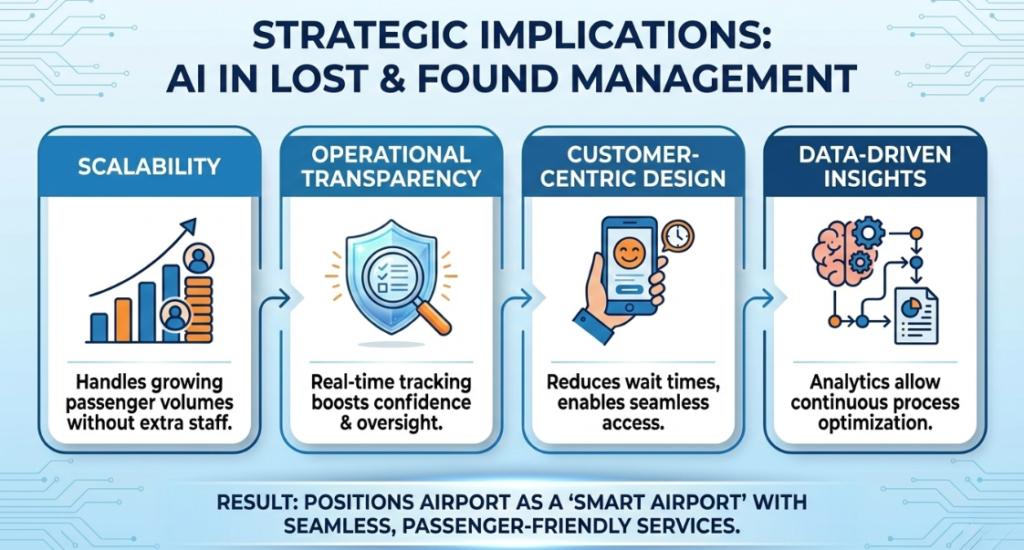
- Scalability: AI systems handle growing passenger volumes without additional staffing.
- Operational Transparency: Real-time tracking and reporting improve both passenger confidence and administrative oversight.
- Customer-Centric Design: Digital platforms reduce wait times and enable seamless access to information.
- Data-Driven Insights: Analytics generated by the system allow continuous optimization of lost item recovery processes.
This innovation positions Jaipur International Airport as a “smart airport,” where technology transforms routine operations into seamless, passenger-friendly services.
Summary:
Jaipur International Airport’s AI-powered lost and found management system is more than a technological upgrade; it is a complete reimagining of passenger service. By digitizing and automating the process, JIA has not only achieved an 85% recovery rate for lost items but has also set a precedent for operational excellence, efficiency, and passenger satisfaction. This approach demonstrates how AI can turn a traditionally frustrating experience into a seamless, reliable service, establishing Jaipur Airport as a pioneer in India’s airport modernization journey.