
Digital twin and AI technologies are redefining how enterprises convert operational data into immediate, high-impact decisions. Organizations today generate unprecedented volumes of data from IoT sensors, enterprise platforms, edge devices, and cyber-physical systems. Yet, data visibility alone no longer delivers a competitive advantage. In fast-moving operational environments, delayed insights translate directly into downtime, inefficiency, and risk. 

By 2026, AI-powered digital twins have evolved into real-time decision intelligence systems. Unlike traditional analytics or static simulations, these living models continuously ingest operational data, apply AI-driven reasoning, and recommend or autonomously execute decisions as conditions change. The convergence of digital twin and AI enables organizations to move from reactive monitoring to continuous, predictive, and prescriptive operations, reinforcing the strategic importance of AI and digital twins across industries. 

What Is AI-Powered Digital Twins? 


A digital twin is a virtual, continuously updated representation of a physical asset, system, or process. When augmented with AI, digital twins move beyond visualization to become active decision engines. The integration of digital twin and AI allows organizations to simulate, predict, and optimize operations in near real time. 

AI-powered digital twins differ from legacy models in three keyways: 
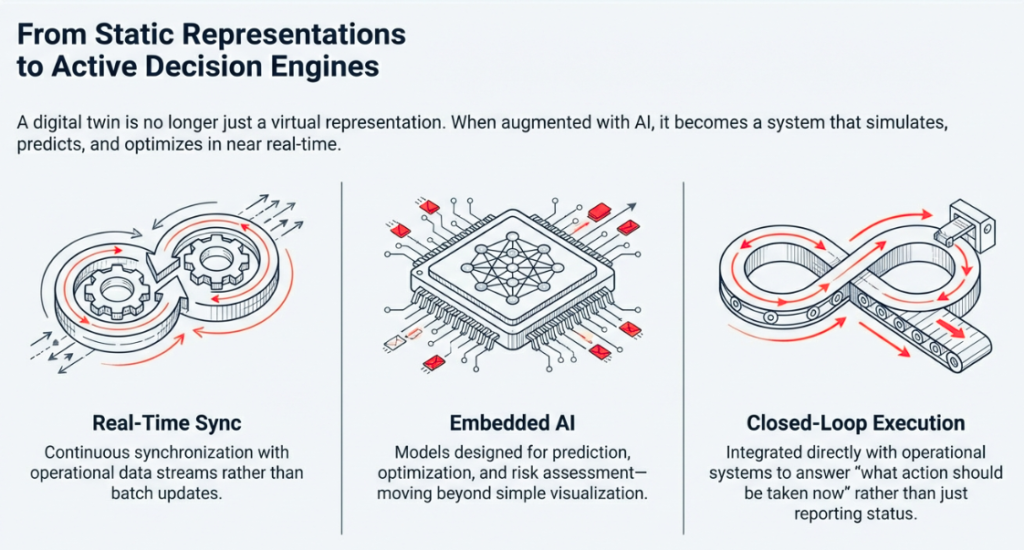
  • Real-time synchronization with operational data streams 
  • Embedded AI models for prediction, optimization, and risk assessment 
  • Closed-loop decision execution, integrated directly with operational systems 
     
    Rather than answering “what happened,” AI-powered digital twins answer, “what will happen next” and “what action should be taken now.” This capability sits at the core of modern AI and digital twins deployments. 


From Static Representations to Active Decisions Engine


Core Architecture of Digital Twin and AI Systems 


AI-powered digital twins operate through an integrated, enterprise-grade architecture: 

  • Real-time data ingestion: IoT sensors, SCADA systems, ERP platforms, edge devices, and cloud applications 
  • AI and machine learning models: Predictive forecasting, prescriptive optimization, anomaly detection, and reinforcement learning 
  • Simulation and scenario intelligence: Continuous “what-if” modeling under live conditions 
  • Decision orchestration layer: Human-in-the-loop or autonomous execution integrated with control systems and workflows 

This architecture demonstrates how digital twin and AI work together to transform operational data into immediate, context-aware decisions at scale. 
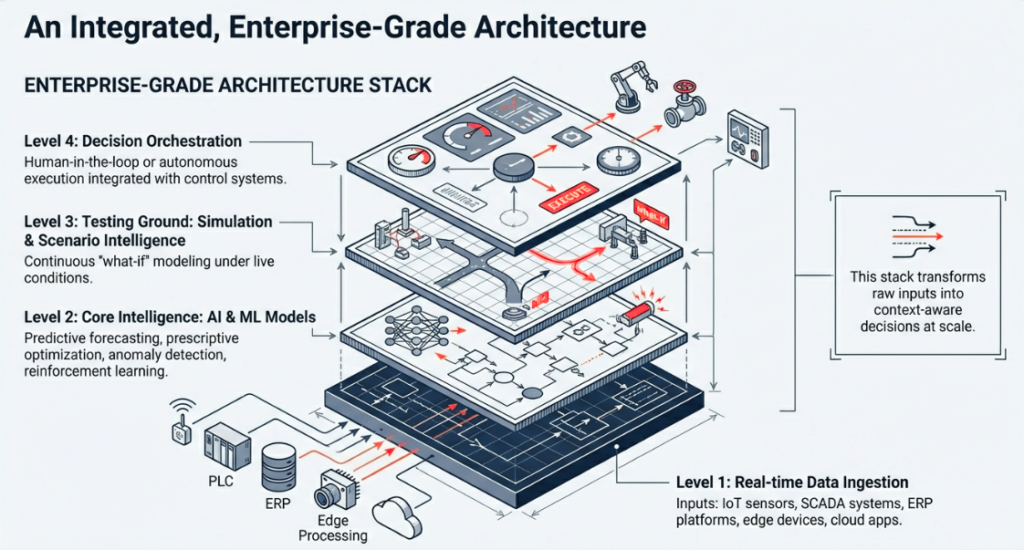
 

An Integrated Entreprise Grade Architecture


How Generative AI Expands Digital Twin Capabilities 

Generative AI plays a pivotal role in advancing AI-powered digital twins beyond deterministic models. 

Key generative AI contributions include: 

  • Dynamic scenario generation at scale, enabling rapid evaluation of thousands of operational outcomes 
  • Self-optimizing systems that continuously refine parameters without manual tuning 
  • Natural language decision interfaces, allowing operators to query complex systems conversationally 
  • Synthetic data generation to train models where real-world failure data is limited 

This deep integration of digital twin and AI significantly reduces decision latency while increasing accuracy. Many enterprises rely on specialized AI consulting services to architect, deploy, and govern these advanced generative AI pipelines within digital twin ecosystems. 
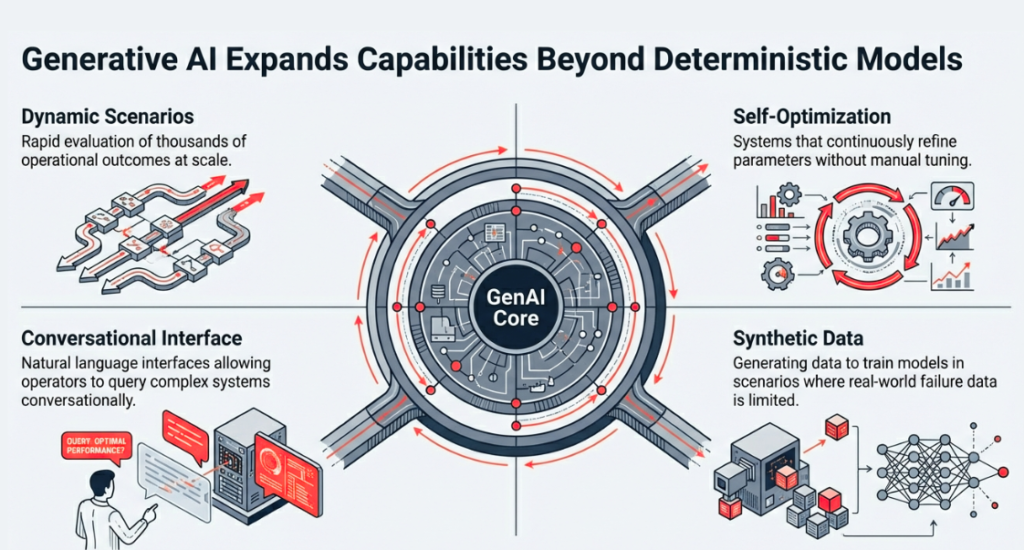
 

Generative AI Expands Capabilities Beyond Deterministic Models


AI Consulting Services for Scaling Digital Twin and AI Solutions 

AI consulting services play a critical role in helping enterprises operationalize AI-powered digital twins at scale. Implementing digital twin and AI solutions requires more than technology—it demands architectural design, data governance, and domain alignment. 

Organizations leverage AI consulting services to: 

  • Design scalable digital twin architectures 
  • Integrate heterogeneous operational data sources 
  • Establish AI model governance and lifecycle management 
  • Align AI and digital twins initiatives with measurable business outcomes 
     

As adoption accelerates, AI consulting services become essential to ensuring that digital twins move from pilots to enterprise-wide decision platforms. 

Turning Operational Data into Real-Time Decisions in 2026 

In 2026, the value of AI-powered digital twins lies not in data collection, but in the execution of decisions. Organizations no longer wait for dashboards, reports, or human interpretation. Instead, operational data is transformed into decisions through an automated, closed-loop intelligence cycle. 

This process follows four decision stages: 

  1. Data Activation (Milliseconds) 
    Operational data from IoT sensors, machines, enterprise systems, and edge devices is continuously streamed into the digital twin. Data is contextualized immediately, mapped to physical assets, workflows, and business objectives. 
  1. AI-Driven Interpretation (Seconds) 
    Machine learning and generative AI models analyze the live data to: 
  1. Detect anomalies and emerging risks 
  1. Predict near-term outcomes 
  1. Quantify impact across cost, performance, and resilience metrics 
  1. Decision Simulation and Validation (Seconds to Minutes) 
    The digital twin runs real-time simulations to evaluate multiple response options simultaneously. Each decision is scored based on operational constraints, regulatory limits, and business priorities. 
  1. Decision Execution and Feedback (Near Real Time) 
    Approved decisions are executed automatically or via human-in-the-loop workflows. The results immediately feed back into the digital twin, enabling continuous learning and refinement. 
     
    This closed-loop approach distinguishes AI-powered digital twins from traditional analytics and underscores why enterprises increasingly invest in Priorise’s AI consulting services to operationalize these systems at scale. 

Summary: 

AI-powered digital twins are redefining real-time decision-making in modern enterprises. By integrating AI with continuously updated digital twins, organizations can transform operational data into actionable insights that drive immediate, high-impact improvements in efficiency, resilience, and performance. 

Partner with Priorise to design and deploy AI-powered digital twin solutions that turn operational data into real-time decisions with measurable business impact. 

 

Post a comment

Your email address will not be published.

Related Posts