

In the era of digital transformation, data has become a cornerstone of business innovation. Companies generate massive volumes of information daily from customer interactions and operational metrics to IoT signals and market intelligence. Yet, despite this abundance, many organizations struggle to derive meaningful insights. The culprit is often not the quantity of data, but the quality and stability of the data foundation underpinning it.
A weak or fragmented data foundation can lead to inconsistent reporting, flawed predictive models, and missed opportunities. In contrast, a strong foundation ensures that data is accurate, unified, and ready for analysis, enabling faster, evidence-based decision-making. Building this foundation is a strategic imperative, requiring a combination of governance, quality assurance, and accessibility measures.
This guide explores three must-do actions that every organization should implement to establish a resilient data foundation, transforming raw data into a strategic asset that drives growth and innovation.
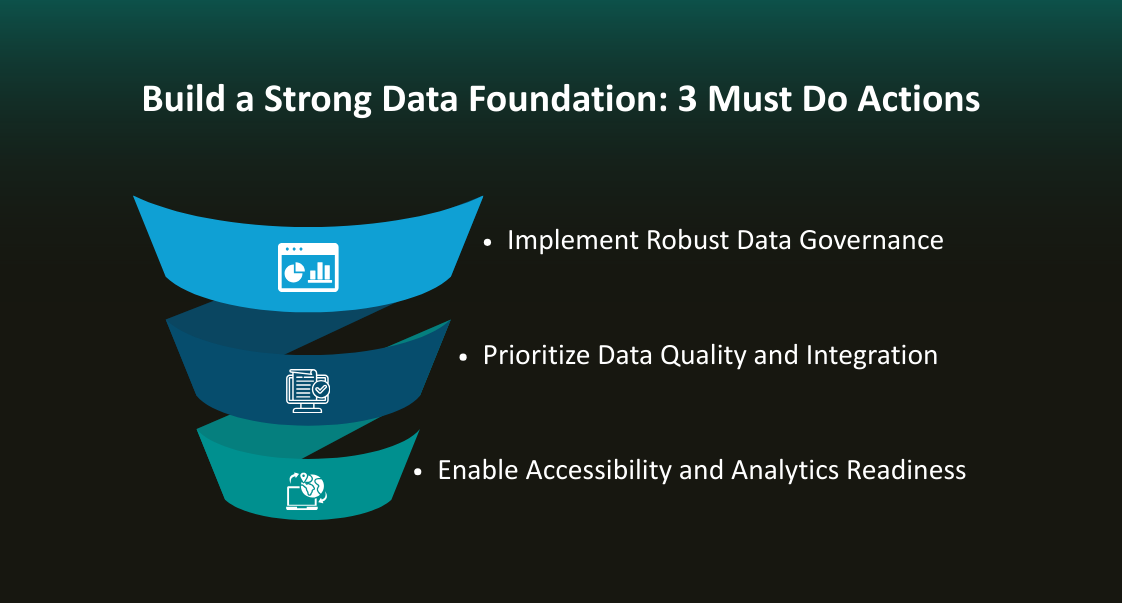
Action #1. Implement Robust Data Governance
The first pillar of a strong data foundation is a comprehensive data governance framework. Governance is more than policy; it’s the architecture that ensures data is accurate, consistent, and compliant across the organization. Without it, even high-quality data can become unreliable, leading to operational inefficiencies and strategic missteps.
Key actions include:
- Define data ownership: Assign accountability for each data asset to specific teams or individuals to maintain oversight and responsibility.
- Establish standards: Enforce consistent naming conventions, formats, and metadata structures to prevent fragmentation.
- Ensure regulatory compliance: Meet industry standards such as GDPR, HIPAA, or CCPA to mitigate legal and financial risk.
By implementing these governance measures, businesses strengthen the integrity of their data foundation, creating a single source of truth that underpins analytics, reporting, and AI initiatives.
Action #2. Prioritize Data Quality and Integration
Even with strong governance, poor-quality or siloed data undermines a data foundation. High-quality data is complete, accurate, timely, and relevant. Integration of data from multiple sources, including CRM, ERP, and IoT systems, is crucial to creating a unified view of organizational operations.
Consider the following approaches:
- Data cleansing and validation: Identify duplicates, errors, and gaps to maintain accuracy.
- Data enrichment: Supplement internal data with external sources for deeper insights.
- Seamless integration: Use ETL pipelines, APIs, and cloud-based solutions to consolidate data into a single repository.
A robust data integration strategy ensures that decision-makers have access to reliable and comprehensive datasets, forming the backbone of a scalable data foundation.
Action #3. Enable Accessibility and Analytics Readiness
A strong data foundation is not just about storing data; it’s about making it actionable. Ensuring accessibility across teams while maintaining security is vital. Organizations should adopt tools and platforms that allow for self-service analytics without compromising governance standards.
Essential steps include:
- Centralized data platforms: Cloud data warehouses and lakes for streamline storage and retrieval.
- Role-based access: Ensure teams can access relevant datasets while maintaining security.
- Analytics-ready infrastructure: Prepare datasets with proper labeling, metadata, and schema design to accelerate AI, machine learning, and business intelligence initiatives.
By enabling accessibility and analytics readiness, organizations maximize the ROI of their data foundation, empowering teams to derive insights faster and make evidence-based decisions.
Limitations and Challenges
Even with strong governance, data quality, and accessibility, organizations may face several challenges:
- Continuous engineering effort
- Maintaining data contracts, pipelines, and monitoring systems requires ongoing development and operational resources.
- Why it matters: Without dedicated effort, data can become stale or inconsistent, reducing trust in analytics.
- Inconsistent or incomplete source data
- Legacy systems or external sources may provide partial, outdated, or irregular data.
- Why it matters: Poor input data can propagate errors downstream, undermining the reliability of models and reports.
- Rapid schema and system changes
- Frequent updates to upstream applications or databases can break pipelines if not managed.
- Why it matters: Interruptions in data flow or compatibility issues delay decision-making and increase remediation costs.
- Security and privacy risks
- Expanding access to analytics or self-service can expose sensitive information if controls are inadequate.
- Why it matters: Compliance violations or data breaches can lead to financial penalties and reputational damage.
- Operational complexity and cost
- Scaling governance, quality, and analytics readiness across large or heterogeneous environments can be resource intensive.
- Why it matters: Without careful planning, costs may outweigh benefits, and teams may struggle to maintain consistency across systems.
Summary:
Building a formidable data strategy requires a deliberate and technical approach. By establishing rigorous data governance, implementing a centralized and scalable architecture, and fostering secure data democratization, you create an ecosystem where data flows freely, safely, and effectively. These three actions are the blueprint for building an unshakable data foundation that turns information into your most powerful competitive asset.
Turn your data into a strategic asset for your business. Partner with Priorise to architect for a data foundation built for the future. Contact us today to transform your data into your greatest asset.