

As organizations accelerate the adoption of artificial intelligence, one foundational truth continues to surface: AI systems are only as reliable as the data that fuels them. While advances in algorithms and compute attract significant attention, AI ready data remains the most critical determinant of whether AI initiatives succeed or fail. Establishing data readiness for AI is not a one-time project, but a structured roadmap that aligns data strategy, governance, and operations to support trustworthy outcomes.
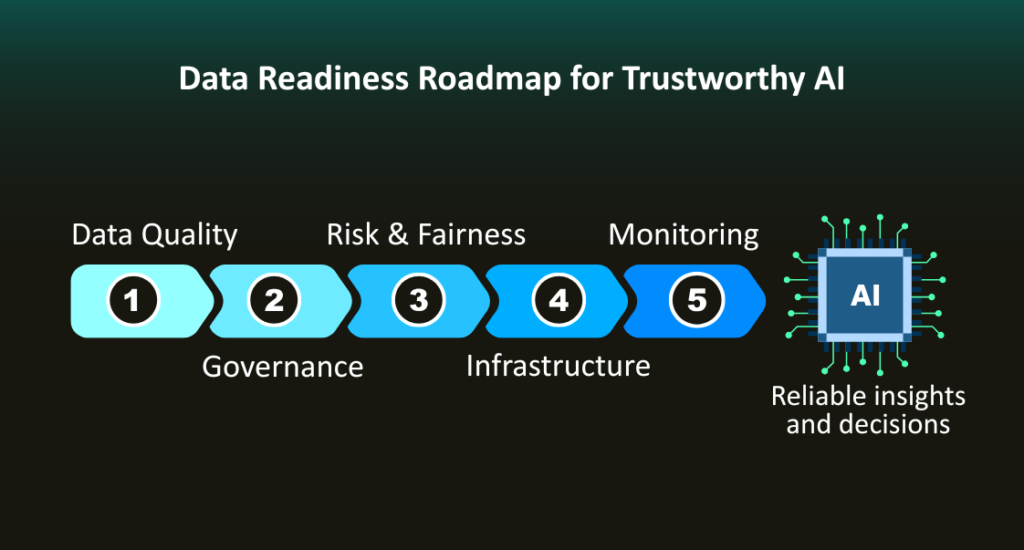
This blog outlines five essential components of a data readiness roadmap designed to enable scalable, reliable, and trustworthy AI.
1. Data Quality and Integrity
The first pillar of data readiness for AI is ensuring consistent data quality and integrity. AI models are highly sensitive to noise, missing values, inconsistencies, and errors. Poor-quality data directly translates into biased predictions, unstable performance, and loss of stakeholder trust.
Key quality dimensions include:
- Accuracy: Data correctly represents real-world values.
- Completeness: Critical fields are populated with minimal missing data.
- Consistency: Data definitions and formats are standardized across systems.
- Timeliness: Data is up to date and relevant for the intended AI use case.
Organizations should implement automated data validation, anomaly detection, and profiling as part of ingestion pipelines. These controls transform raw datasets into AI ready data that can reliably support training, validation, and inference.
2. Data Governance and Ownership
Trustworthy AI cannot exist without strong data governance. Governance defines who owns the data, how it may be used, and under what constraints. Without clear accountability, AI initiatives risk regulatory violations, ethical lapses, and operational confusion.
A robust governance framework should establish:
- Clearly defined data owners and stewards
- Policies for data access, usage, and retention
- Alignment with regulatory requirements such as GDPR or industry-specific standards
- Traceability from data source to AI model output
Effective governance ensures that data readiness for AI is sustainable, auditable, and aligned with organizational risk tolerance rather than dependent on ad hoc decisions.
3. Bias Detection and Representativeness
Bias in AI systems often originate in historical data. If datasets are unbalanced or unrepresentative, models may reinforce inequities or produce systematically unfair outcomes. Addressing bias is therefore a core requirement for trustworthy AI.
Data teams should evaluate:
- Population coverage and representation
- Historical biases embedded in labels or outcomes
- Proxy variables that unintentionally encode sensitive attributes
Techniques such as stratified sampling, reweighting, and fairness of metrics can help mitigate bias at the data level before model training begins. Ensuring AI ready data includes fairness assessments, reduces downstream remediation costs, and reputational risk.
4. Data Infrastructure and Accessibility
Even high-quality data loses value if it is inaccessible or poorly integrated. Data readiness for AI requires infrastructure that supports scalable storage, efficient processing, and secure access across teams.
Essential infrastructure characteristics include:
- Centralized or well-integrated data platforms
- Support for structured, semi-structured, and unstructured data
- Metadata management for discoverability and lineage tracking
- Secure, role-based access controls
Modern AI workflows often depend on continuous data pipelines rather than static datasets. Infrastructure must therefore enable frequent updates, versioning, and reproducibility to maintain trust in AI outputs over time.
5. Monitoring, Feedback, and Continuous Improvement
Data readiness is not static. As business environments evolve, so do data distributions and assumptions. Continuous monitoring ensures that AI ready data remains fit for purpose throughout the AI lifecycle.
Organizations should implement:
- Data drift and schema change detection
- Feedback loops from model performance to data sources
- Periodic audits of data relevance and quality
- Mechanisms to retire or refresh outdated datasets
This feedback-driven approach allows teams to proactively address degradation before it impacts decision-making, reinforcing long-term trust in AI systems.
Wrapping Up:
Trustworthy AI begins long before model development. It starts with a deliberate, disciplined approach to data readiness for AI, grounded in quality, governance, fairness, infrastructure, and continuous oversight. By following a clear data readiness roadmap, organizations can transform fragmented data assets into reliable, AI ready data that supports accurate, ethical, and scalable AI solutions.