

In a world where AI-driven insights define competitive advantage, most organizations focus on algorithms, ignoring the silent engine that powers them: their data foundation. Imagine building a skyscraper on shifting sand, no matter how advanced the design, instability will always compromise the structure. The same principle applies to AI: without a robust AI data foundation, predictive models, automated decisions, and advanced analytics are prone to error, bias, and inconsistency.
The journey to AI success begins not with code, but with data: clean, well-governed, and intelligently structured. Organizations that recognize this are not just reacting to trends; they are future-proofing their analytics, creating an environment where AI can deliver actionable, reliable insights at scale. A strong data foundation transforms raw information into a strategic asset, enabling enterprises to innovate confidently while reducing operational risk.
The Pillars of a Strong Data Foundation
A strong data foundation rests on three pillars: quality, accessibility, and governance.
1. Data Quality:
High-quality data ensures that AI models learn accurate patterns and make reliable predictions. Organizations must implement automated data validation, cleansing routines, and anomaly detection to maintain integrity. Poor data quality can propagate errors throughout analytical workflows, undermining trust in AI-driven decisions.
2. Data Accessibility:
Data silos impede AI initiatives by restricting access to critical datasets. A future-proof AI data foundation emphasizes centralized data lakes or warehouses, unified data catalogs, and self-service access for data scientists and analysts. Accessible, well-documented data accelerates experimentation and reduces time-to-insight.
3. Data Governance:
Governance frameworks enforce consistency, security, and compliance across data assets. Metadata management, lineage tracking, and role-based access controls ensure that AI models are trained on accurate, authorized, and auditable datasets. Without governance, scaling AI initiatives can lead to compliance risks and operational inefficiencies.
Business Impact of Strengthening Your Data Foundation
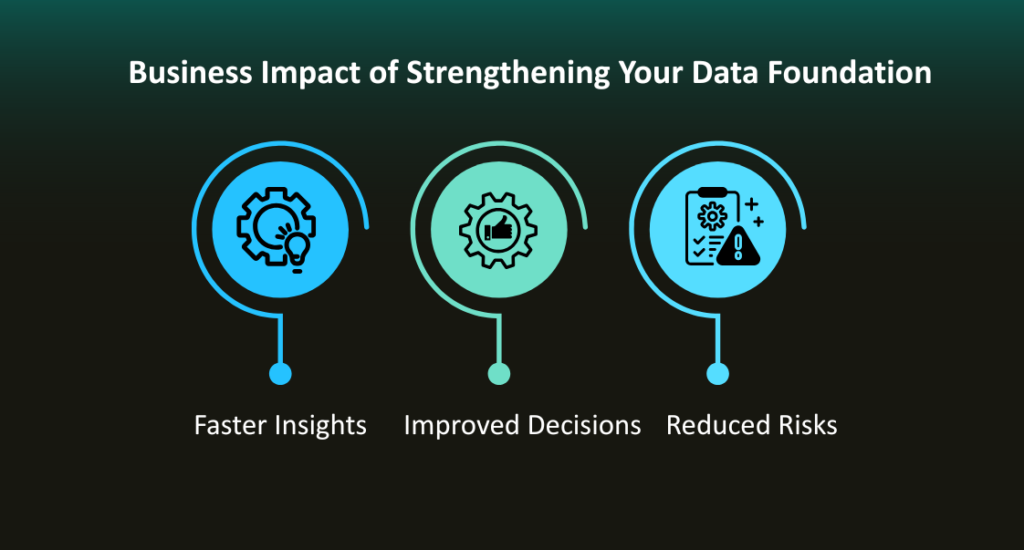
Investing in a robust data foundation directly translates into measurable business outcomes. Organizations achieve faster insights, improved decision-making, and reduced operational risks. With AI-ready data, companies can launch advanced analytics initiatives such as personalized marketing, dynamic pricing, or predictive maintenance with higher confidence.
A strong AI data foundation also drives agility. Businesses can rapidly experiment with new models, pivot strategies based on real-time insights, and maintain resilience against evolving market conditions. In essence, the foundation you build today ensures the AI capabilities you deploy tomorrow are both accurate and scalable.
Why Future-Proofing Analytics is Important
As AI models become more complex, their dependence on high-quality, well-structured data intensifies. Organizations that ignore the AI data foundation risk slow adoption, increased operational costs, and inaccurate insights. Conversely, a forward-looking approach, one that continuously strengthens the data foundation enables enterprises to:
- Deploy AI models faster with minimal rework
- Enhance the accuracy and reliability of predictive analytics
- Streamline regulatory compliance through transparent data governance
- Foster innovation by enabling cross-functional data collaboration
Investing a strong data foundation is not a one-time effort; it is a strategic, ongoing commitment. By continuously refining data pipelines, improving governance, and scaling infrastructure, organizations can ensure their AI models remain robust, adaptable, and capable of delivering measurable business outcomes.
Implementing a Strategic AI Data Foundation
The journey to an effective AI data foundation begins with a comprehensive assessment of current data assets, identifying gaps in quality, structure, and accessibility. Organizations should prioritize:
- Centralizing disparate data sources into unified repositories
- Standardizing data formats to improve interoperability
- Leveraging automation to reduce latency in data preparation
- Establishing monitoring mechanisms to detect anomalies and maintain integrity
By systematically addressing these areas, enterprises can build an AI data foundation that not only supports present analytical needs but also scales with future innovations, from predictive analytics to autonomous decision-making systems.
Summary:
In an era where AI drives competitive differentiation, strengthening your data foundation is essential for success. By focusing on quality, accessibility, governance, and automation, organizations can ensure that their AI data foundation supports reliable insights and scalable innovation. Investing in a future-proof data strategy today reduces risks, accelerates analytics, and positions businesses to capitalize on emerging AI opportunities.
Future-proof your analytics and transform your business intelligence with the expertise of Priorise. Unlock the full potential of AI by building a data foundation that powers innovation, drives strategic decisions, and sustains long-term growth.