



How much of the data your organization collects actually delivers business value? Dark data—information that is stored and protected but never operationalized- now accounts for most modern data estates, spanning unstructured content, legacy systems, and cloud platforms.
In 2026, dark data has become a strategic issue. AI initiatives depend on broader, well-governed datasets; regulatory pressure continues to increase, and uncontrolled data growth drives cost and complexity. For CIOs and data leaders, the challenge is no longer visibility alone, but how effectively dark data is managed and activated for business value.
Here is a strategic framework to transform this dormant resource into a driver of value.
1. Identify Dark Data Through Intelligent Discovery
The first step is systematic discovery. Traditional manual inventory is impossible at scale. In 2026, identification requires AI-powered discovery tools that continuously scan and map the entire data estate from on-premises databases to cloud object storage and SaaS applications.
- How it Works: These platforms use machine learning to detect patterns, file types, and data relationships across disparate silos, creating a comprehensive, living inventory.
- Business Value: This moves you from not knowing what you have a complete data landscape. The immediate payoff is often significant for cost optimization through the safe decommissioning of redundant, obsolete, or trivial (ROT) data, directly reducing storage and management expenses.
2. Classify and Contextualize with Metadata Intelligence
Identification tells you data exists; classification tells you what it means. Automated classification engines use natural language processing and pattern recognition to tag data with business and technical metadata such as data type, sensitivity (PII, financial), subject, provenance, and predicted value.
- How it Works: This process transforms raw data into a contextualized asset. For instance, an old set of support tickets is no longer just text; it’s classified as “customer sentiment data” linked to specific product lines and dates.
- Business Value: Context is king. Rich metadata is the foundation for robust governance, precise AI model training, and efficient searchability. It turns a chaotic data swamp into a navigable library, accelerating time-to-insight for analytics teams.
3. Govern with Risk-Aware Policy Automation
Once classified, dark data must be brought under governance, but not all data requires the same controls. A modern approach employs risk-aware, policy-driven automation. Rules are applied based on classification: automatically encrypting sensitive data, applying legal holds, managing retention schedules, or flagging non-compliant data flows.
- How it Works: This creates a dynamic, “set-and-forget” governance layer that scales. For example, a policy can automatically archive low-value, non-sensitive data after three years or redact personal identifiers before feeding datasets to an AI development environment.
- Business Value: This proactively mitigates compliance and privacy risks (crucial for regulations like the EU AI Act), builds stakeholder trust, and creates the guardrails necessary for safe data utilization.
4. Activate and Monetize via Strategic Integration
The final and most valuable step is activation. Here, newly visible and governed data is integrated into business processes. This could mean feeding historical operational data into predictive maintenance models, enriching customer 360 profiles with previously unused interaction logs, or using legacy research for generative AI-powered innovation.
- How it Works: Activation is enabled by a data fabric or mesh architecture that provides consistent, secure access to curated data products. Think of it as plugging newly discovered power sources into the enterprise grid.
- Business Value: This is where dark data monetization occurs. It fuels more accurate AI, uncovers new revenue opportunities, enhances customer experiences, and drives operational efficiencies. It transforms data from a cost center into a recognized revenue engine.
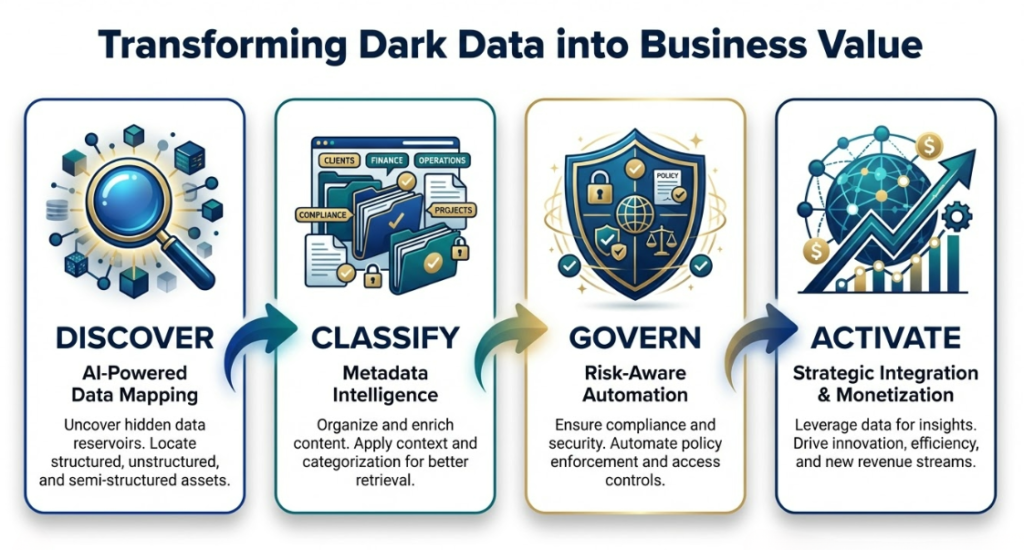
Summary:
Dark data is no longer a hidden inefficiency; it is a measurable source of cost, risk, and unrealized value. In 2026, organizations that fail to address it will face growing operational drag, regulatory exposure, and constraints on AI-driven innovation. By applying intelligent discovery, scalable classification, automated governance, and targeted activation, data leaders can transform dark data from a liability into a strategic asset.
Priorise enables this shift by bringing clarity and control to complex data environments, helping leaders turn dormant data into actionable insight. The next step is not accumulating more data but making better use of the data you already have.
-
Previous Post
How AI-Driven Analytics Is Improving Healthcare Outcomes
Related Posts

6 Metrics That Define Effective Experience Analytics
Most organizations collect experience data. Very few can translate it into measurable outcomes. Clicks, sessions,…

How Predictive Analytics Improves Sales Forecasting and Strategy
How can predictive analytics solutions transform uncertain sales forecasts into a reliable revenue strategy? Many…

Understanding Data Migration: Types, Use Cases, Costs & Risks
Enterprise transformation does not fail because of strategy. It fails because of incorrect execution at the data layer. As organizations…

Uncovering the True Drivers of Revenue Growth with Customer Loyalty Analytics
A national retailer had invested heavily in one of the most visible retail loyalty programs…